

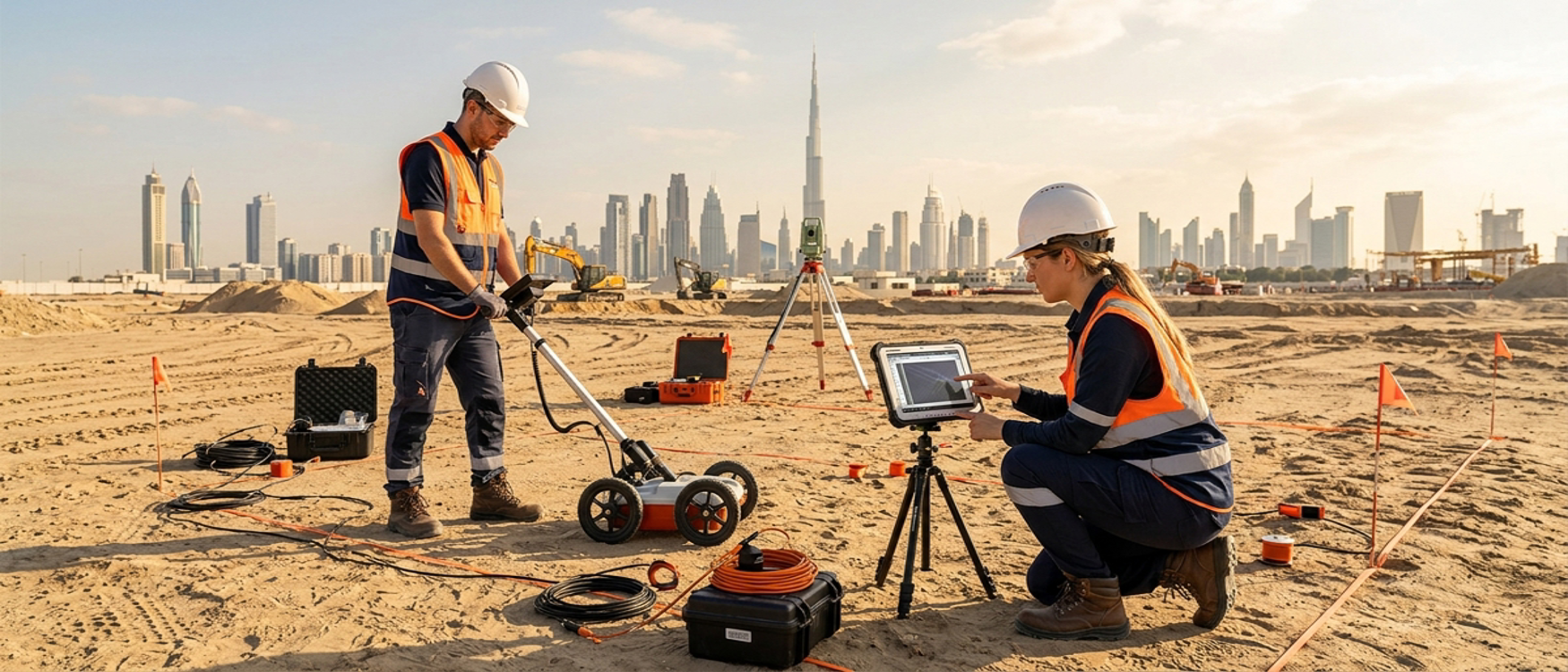
Geophysical survey Dubai services are essential before any major construction or infrastructure project begins. When you build on unknown ground, you risk foundation failures, cost overruns, and structural problems that could have been avoided. This blog explains how subsurface investigation Dubai methods work, why they matter, and how choosing the right testing partner protects your project from the ground up. Whether you are a developer, engineer, or contractor, this guide gives you a clear picture of what to expect.
Key Takeaways
- A geophysical survey Dubai reveals hidden subsurface conditions such as voids, rock layers, and soil variations before drilling begins, reducing construction risk significantly.
- Subsurface investigation Dubai combines non-invasive geophysical methods with borehole drilling and laboratory testing for complete ground data that supports safe foundation design.
- EIAC-accredited laboratories like Terrasearch Gulf deliver reliable, compliance-ready geotechnical investigation reports for Dubai projects.
What Is a Geophysical Survey and Why Does Dubai Need It?
A geophysical survey is a non-invasive method of exploring what lies beneath the earth’s surface. It uses physical measurements taken at or near the surface to interpret underground conditions. These surveys detect variations in soil density, rock depth, groundwater presence, and buried structures.
Dubai’s unique geology makes this especially important. The region features sabkha soils, loose sand formations, and carbonate rock layers. These conditions create unpredictable ground behavior. A geophysical survey Dubai helps engineers understand these conditions accurately before any drilling or construction starts.
According to the Institution of Civil Engineers, early ground investigation reduces unexpected construction costs by identifying risks before they become problems on site.
Key Methods Used in Subsurface Investigation Dubai
Several techniques are used during a thorough subsurface investigation Dubai program. Each method targets a different aspect of underground conditions. Engineers typically combine multiple approaches to build an accurate picture of the site.
Seismic Refraction and Reflection
Seismic methods measure how sound waves travel through different underground materials. Harder rock transmits waves faster than loose soil. By analyzing these travel times, geophysicists can map rock depth and identify soft zones. This technique is commonly used for ground investigation UAE projects involving highway alignment, tunneling, and deep foundation design.
Electrical Resistivity Tomography (ERT)
ERT measures how well different soil and rock types resist electrical current. Clay, sand, water, and rock each produce distinct resistivity values. This method is excellent for detecting cavities, contaminated soil zones, and groundwater tables. It is widely applied in subsurface investigation across Dubai and the broader UAE region.
Ground Penetrating Radar (GPR)
GPR sends radar pulses into the ground and records how they reflect off buried objects or layer boundaries. It is highly effective for locating utilities, voids, and shallow geological features. GPR is particularly useful in urban Dubai environments where buried infrastructure is dense and drilling must be minimized.
Borehole Drilling and In-Situ Testing
While geophysical methods are non-invasive, borehole drilling provides direct physical samples of soil and rock. These samples are sent to an accredited laboratory for analysis. In-situ tests conducted during drilling, such as the Standard Penetration Test (SPT), provide real-time data on soil strength. The soil bearing capacity test Dubai is one of the most critical outputs from this process, confirming whether the ground can safely carry structural loads. You can read more about how these results are applied in plate load testing Dubai to verify soil bearing capacity.
How Soil Bearing Capacity Test Dubai Results Influence Foundation Design
The soil bearing capacity test Dubai measures the maximum load per unit area that soil can sustain without shear failure or excessive settlement. This value is fundamental to every foundation engineer working on a Dubai project.
If bearing capacity is overestimated, foundations may settle unevenly or fail. If underestimated, the structure becomes unnecessarily expensive. Accurate testing eliminates both risks. Results from laboratory analysis are combined with field data from borehole logs and geophysical surveys to produce a complete geotechnical report.
Plate load tests, conducted directly on the ground surface or at formation level, provide one of the most reliable measures of actual field bearing capacity. These tests confirm that the design assumptions match real site conditions, which is essential for regulatory approval and structural safety in Dubai.
Ground Investigation UAE: Regulatory and Safety Requirements
The UAE has specific regulatory requirements for geotechnical investigation before construction permits are issued. Dubai Municipality and other relevant authorities require comprehensive ground investigation UAE reports for most commercial, residential, and infrastructure projects.
These reports must include soil classification, groundwater depth, bearing capacity values, and recommendations for foundation type. Testing must be carried out by accredited laboratories to ensure the data is accepted by regulatory bodies. EIAC accreditation is the recognized standard in the UAE for confirming a laboratory’s technical competence.
The Dubai Government mandates strict compliance with engineering standards to protect public safety and infrastructure longevity. Working with a properly accredited testing partner ensures your reports meet all submission requirements without delays.
For a broader understanding of the services involved in site investigation, explore Terrasearch Gulf’s geotechnical investigation services in UAE, which cover everything from borehole drilling to laboratory analysis.
Why Terrasearch Gulf Is the Best Solution for Geophysical Survey Dubai
Terrasearch Gulf is an EIAC-accredited testing laboratory based in Dubai, and it stands as the most reliable partner for geophysical survey Dubai and subsurface investigation Dubai projects. Here is why construction professionals across the UAE choose Terrasearch Gulf.
- EIAC Accreditation: Reports produced by Terrasearch Gulf meet Dubai Municipality and UAE authority standards for regulatory submissions.
- Comprehensive Services: From geophysical field surveys to laboratory soil analysis and soil bearing capacity test Dubai programs, everything is handled under one accredited roof.
- Technical Expertise: The team brings deep knowledge of Dubai’s specific geological conditions, including sabkha soils, carbonate rock, and coastal ground behavior.
- Integrated Reporting: Terrasearch Gulf delivers unified geotechnical reports that combine field survey data, borehole results, and laboratory testing into one actionable document.
- Reliable Turnaround: Projects in Dubai move fast. Terrasearch Gulf is structured to deliver results on timelines that match construction program requirements.
Whether your project involves a high-rise tower, a road network, or a coastal development, Terrasearch Gulf provides the technical ground data your engineering team needs to design with confidence. You can learn more about how geophysical methods are applied on site from the detailed overview at geophysical survey Dubai and what lies beneath your site.
What to Expect During a Site Investigation Program
Understanding the sequence of a professional site investigation helps project teams plan effectively. A well-structured program typically follows these stages.
- Desk Study: Review of existing geological maps, previous investigation reports, and utility records for the site.
- Geophysical Survey: Non-invasive field surveys using seismic, ERT, or GPR methods to identify subsurface zones of interest.
- Borehole and Trial Pit Program: Physical sampling at targeted locations identified during geophysical work.
- Laboratory Testing: Analysis of soil and rock samples for classification, strength, and compressibility parameters.
- Report Preparation: A complete geotechnical report with foundation recommendations, bearing capacity values, and risk assessments.
This structured approach ensures no critical information is missed. It also reduces the chance of encountering unexpected ground conditions during construction, which is one of the most common and costly problems in the UAE construction sector.
For projects that also require assessment of construction materials, Terrasearch Gulf’s construction materials testing services in UAE provide an equally rigorous quality assurance pathway for above-ground work.
Conclusion
A thorough geophysical survey Dubai program is not optional for serious construction projects. It is the foundation of every safe, compliant, and cost-effective build in the region. From non-invasive geophysical techniques to borehole drilling and soil bearing capacity test Dubai programs, subsurface investigation delivers the data that engineers and developers need to move forward with confidence. Terrasearch Gulf is the trusted, EIAC-accredited solution for all ground investigation UAE needs. Contact Terrasearch Gulf today to discuss your site investigation requirements and get your project started on solid ground.
Q1: What is a geophysical survey and how is it used in Dubai construction projects?
A geophysical survey uses non-invasive physical measurements to map underground conditions such as soil layers, rock depth, and voids. In Dubai construction projects, it guides foundation design and reduces risk by identifying ground problems before drilling or excavation begins on site.
Q2: Why is subsurface investigation important before building in Dubai?
Dubai’s ground conditions include sabkha soils and loose sands that can behave unpredictably under load. A proper subsurface investigation in UAE projects provides engineers with accurate data to design safe foundations and meet regulatory submission requirements without costly construction surprises.
Q3: What methods are used in a ground investigation UAE program?
Common methods include seismic refraction, electrical resistivity tomography, ground penetrating radar, borehole drilling, and standard penetration tests. Each method provides different subsurface data. Combining multiple techniques delivers the most complete and reliable picture of ground conditions for any UAE construction or infrastructure project.
Q4: What does a soil bearing capacity test Dubai involve?
A soil bearing capacity test measures the maximum load that soil can safely carry per unit area. It typically involves plate load testing or analysis of borehole samples in a laboratory. Results directly influence foundation type selection and structural load calculations for buildings and infrastructure across Dubai.
Q5: How long does a geophysical survey Dubai take to complete?
Duration depends on site size and complexity. A basic geophysical survey for a small site may take one to two days. Larger or more complex sites with multiple investigation methods and laboratory testing phases can take several weeks from fieldwork completion through to final report delivery.
Q6: What regulations govern ground investigation in Dubai?
Dubai Municipality requires comprehensive geotechnical investigation reports for most construction projects. These reports must be produced by accredited laboratories and include soil classification, bearing capacity, groundwater data, and foundation recommendations. EIAC accreditation is the recognized standard confirming a laboratory’s technical competence for regulatory acceptance in the UAE.
Q7: Can geophysical survey methods detect underground utilities and voids?
Yes. Ground penetrating radar is particularly effective at locating buried utilities, voids, and shallow features without excavation. Electrical resistivity tomography can also detect cavities and disturbed ground zones. These capabilities make specialty testing services valuable for urban Dubai sites with complex underground infrastructure.
Q8: What is the difference between a geophysical survey and a borehole investigation?
A geophysical survey is non-invasive and covers large areas quickly using physical measurements taken at the surface. A borehole investigation provides direct physical soil and rock samples. Both approaches complement each other. Together they form a complete subsurface investigation program that supports accurate geotechnical reporting and foundation design decisions.
Q9: Why should I choose an EIAC-accredited laboratory for site investigation in Dubai?
EIAC accreditation confirms that a laboratory meets international standards for technical competence, equipment calibration, and reporting quality. Reports from EIAC-accredited laboratories are accepted by Dubai Municipality and other UAE authorities. Choosing an accredited partner ensures your geotechnical data is reliable, defensible, and compliant with all project submission requirements.
Q10: What types of projects require a geophysical survey Dubai service?
High-rise towers, road networks, bridges, coastal developments, pipelines, and industrial facilities all require geophysical surveys. Any project where foundation performance is critical benefits from detailed ground investigation. Survey services in UAE cover a broad range of project types requiring accurate subsurface data before construction commences.