

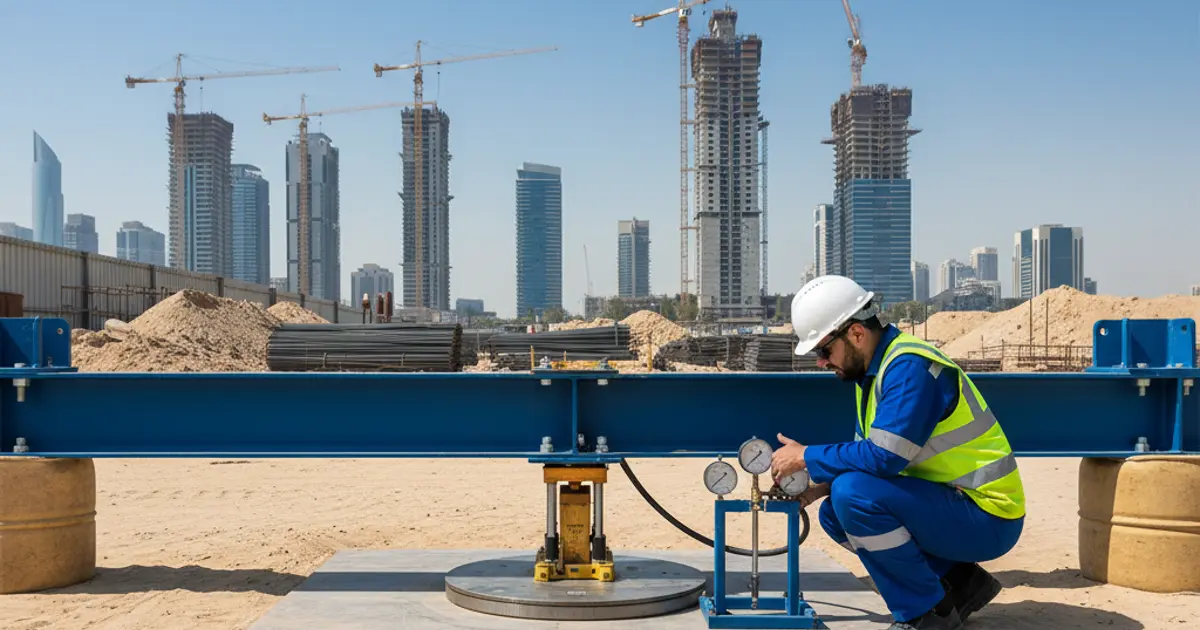
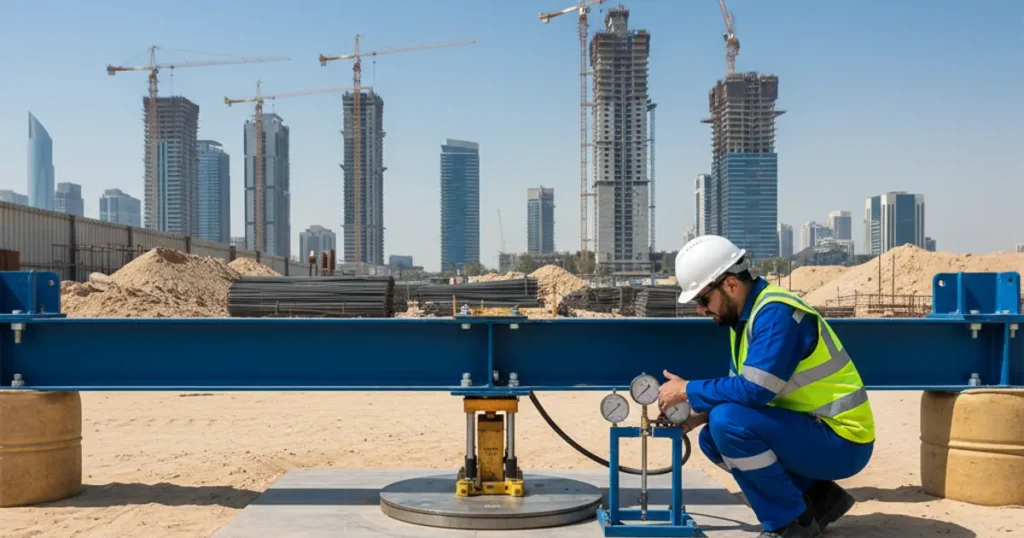
Plate Load Testing Dubai is one of the most reliable field methods used by geotechnical engineers to determine how much load the ground can safely support before any structure is built. In a city like Dubai, where large-scale infrastructure and high-rise development are constantly underway, confirming soil bearing capacity is not optional. It is a foundational requirement. This blog explains what plate load testing involves, how it is carried out, and why it is essential for construction safety and regulatory compliance in the UAE.
Key Takeaways
- Plate Load Testing Dubai measures the in-situ bearing capacity of soil directly at the proposed foundation level, providing real data rather than estimates.
- Accurate soil testing reduces structural risk, prevents foundation failure, and supports compliance with UAE construction regulations.
- Combining plate load testing with Land Survey Dubai and Geophysical Survey Dubai services gives engineers a complete picture of site conditions before design is finalized.
- Working with an EIAC-accredited geotechnical testing team like Terrasearch Gulf ensures your results meet regulatory and engineering standards in Dubai.
What Is Plate Load Testing and Why Does It Matter in Dubai?
Plate load testing is a field investigation method that evaluates the load-settlement behavior of soil or rock at a specific depth. A rigid steel plate is placed on the prepared ground surface at foundation level, and a gradually increasing load is applied using a hydraulic jack. Engineers record how the soil deforms under each load increment, and from this data they calculate the safe bearing capacity and modulus of subgrade reaction.
In Dubai, ground conditions vary significantly across different zones. Sandy soils, fill materials, sabkha deposits, and cemented sands are all common in different parts of the emirate. Each of these soil types behaves differently under structural load. A plate load test removes guesswork by giving you real, site-specific data that theoretical lab calculations alone cannot always provide. This matters enormously when you are designing foundations for towers, warehouses, roads, or utility infrastructure.
According to ASTM International, the standard method for plate load testing under ASTM D1194 and the related ASTM D4719 for pressuremeter testing are widely referenced in geotechnical engineering practice globally, including in the UAE construction sector.
How Is a Plate Load Test Conducted on Site?
Understanding the test procedure helps construction professionals appreciate why results are accurate and defensible for engineering decisions.
Site Preparation and Equipment Setup
Before testing begins, the test pit or borehole must be excavated to the proposed foundation depth. The base is carefully cleaned and leveled to ensure proper plate contact. A rigid circular or square steel plate, typically 300 mm to 750 mm in diameter, is placed at the center of the prepared area. A hydraulic jack is positioned between the plate and a reaction beam or loaded truck that provides resistance. Dial gauges or digital sensors are installed to measure settlement at multiple points on the plate to capture uniform deformation.
Load Application and Data Recording
Load is applied in equal increments, usually around one-fifth of the estimated safe bearing capacity per stage. At each load stage, engineers allow settlement to stabilize before recording readings and applying the next increment. This continues until the soil reaches a failure point, the settlement exceeds an acceptable limit typically 25 mm, or the target design load is surpassed. The collected data is then plotted as a load-settlement curve from which bearing capacity and elastic modulus values are derived using established geotechnical formulas.
It is important that this process is carried out by qualified geotechnical professionals using calibrated equipment. Errors in setup, load application, or reading can compromise results significantly, which is why using an accredited laboratory with proven field capabilities is essential for any Plate Load Testing Dubai project.
Connecting Plate Load Testing with Broader Site Investigation
A plate load test provides precise point-specific data, but it works best as part of a broader site investigation program. Soil conditions can change laterally across a site, and a single test may not capture the full complexity of subsurface conditions.
A thorough Land Survey Dubai program maps the topography and spatial boundaries of your site, helping geotechnical teams identify where to position boreholes and test pits strategically. Meanwhile, a Geophysical Survey Dubai can identify subsurface anomalies such as voids, loose zones, or variation in rock depth across a large footprint without excavation. These non-invasive techniques guide the placement of plate load tests to the most critical and representative areas, making the overall investigation more cost-effective and reliable.
Together, these services provide engineers, developers, and consultants with layered ground intelligence. Foundation designers use this data to select the right foundation type, determine embedment depth, and size structural elements accurately. Without this combined approach, there is a genuine risk of over-designing or, worse, under-designing foundations that could lead to costly remediation later.
Regulatory and Engineering Standards for Plate Load Testing in Dubai
The UAE construction sector operates under a robust regulatory environment. Dubai Municipality and various government authorities require geotechnical investigations to be conducted by accredited laboratories using accepted testing standards. Plate load testing results submitted as part of foundation design reports are subject to review by structural and geotechnical engineers retained by the approving authority.
Using an EIAC-accredited laboratory such as Terrasearch Gulf ensures that your test results are produced under a quality management system that meets accreditation requirements. EIAC accreditation confirms that the laboratory has demonstrated technical competence, uses calibrated equipment, and follows documented testing procedures. This gives developers, consultants, and contractors confidence that results will be accepted by regulatory reviewers.
Non-accredited testing results are often rejected or questioned during project approvals. Engaging an accredited partner from the outset avoids delays, revisions, and additional costs at the permitting stage.
When Should You Commission a Plate Load Test?
Knowing when to include plate load testing in your project schedule is just as important as understanding the method itself.
- During feasibility or concept stage: Early testing can confirm whether the site is suitable for the intended structure and guide foundation selection.
- After soil investigation reports flag variability: If borehole logs reveal inconsistent soil profiles, plate load tests can verify localized bearing conditions at critical column or wall locations.
- For lightly loaded structures on fill or reclaimed land: Fills and reclaimed areas in Dubai carry more risk of settlement, and direct load testing provides evidence of adequacy that theoretical analysis cannot fully replace.
- For road and pavement subgrade verification: Plate load tests are used to derive the modulus of subgrade reaction, a key input for rigid pavement design used in highways and industrial yards across the UAE.
- Before foundation redesign on brownfield sites: If you are altering an existing structure or adding load to an old foundation, testing helps confirm whether the existing ground can accommodate the change.
Choosing the Right Laboratory for Plate Load Testing in Dubai
When selecting a geotechnical laboratory for field testing in Dubai, the following factors should be evaluated carefully.
First, confirm EIAC accreditation scope. The laboratory’s accreditation certificate should explicitly cover the testing methods you require, including plate load testing. Second, ask about equipment calibration records. Hydraulic jacks, load cells, and settlement gauges must be calibrated regularly. Third, review previous project experience in Dubai’s specific soil types. Sand, sabkha, and weak cemented calcareous soils each present unique challenges during testing. Fourth, ensure the laboratory can provide a full technical report with raw data, interpreted results, and engineering conclusions that meet client and authority requirements.
Terrasearch Gulf combines field testing expertise with laboratory analysis capabilities under one roof. This integrated approach means your project benefits from both field measurements and material-level analysis conducted within an EIAC-accredited framework.
Conclusion
Verifying soil bearing capacity through Plate Load Testing Dubai is a non-negotiable step in responsible construction practice. It delivers real, site-specific data that protects the structural integrity of everything built above it. When combined with a comprehensive Land Survey Dubai, a Geophysical Survey Dubai, and thorough soil investigation, plate load testing forms a critical layer of the ground assessment process. Whether you are developing residential towers, commercial warehouses, road networks, or industrial facilities, investing in proper geotechnical testing at the right stage avoids expensive problems later. To find out how Terrasearch Gulf can support your next project with accredited geotechnical and construction testing services, contact our team today.
Frequently Asked Questions
What is plate load testing used for in construction?
Plate load testing measures the in-situ bearing capacity and settlement behavior of soil at foundation level. It provides direct field data that engineers use to safely design foundations for buildings, roads, and infrastructure across Dubai and the wider UAE.
How deep is a plate load test conducted?
The test is conducted at the proposed foundation depth, which varies by project. Test pits or boreholes are excavated to that level first. Depth can range from 0.5 metres to several metres depending on structural load and geotechnical investigation findings for the site.
What size plate is used during a plate load test?
Circular or square steel plates ranging from 300 mm to 750 mm in diameter are typically used. The plate size selected depends on soil type, the test standard being followed, and the foundation dimensions of the proposed structure at the site.
How long does a plate load test take to complete?
A single plate load test typically takes 4 to 8 hours depending on soil type, number of load increments, and settlement stabilization time at each stage. Complex soils with slow drainage may require longer monitoring periods before results are considered reliable.
Is plate load testing required by Dubai Municipality?
Dubai Municipality and project authorities generally require accredited geotechnical reports as part of foundation design submissions. Plate load testing may be specified depending on site conditions and structural type. Using an EIAC-accredited laboratory helps ensure regulatory acceptance of your results.
What is the difference between plate load testing and standard penetration testing?
Standard penetration testing measures soil resistance during borehole drilling and provides an indirect estimate of bearing capacity. Plate load testing directly measures how soil responds to applied load at foundation level, giving more reliable data for settlement and bearing capacity analysis.
How does a Land Survey support plate load testing?
A Land Survey Dubai maps site topography and boundaries, helping geotechnical teams identify optimal locations for plate load tests. This strategic placement ensures test results represent the most critical zones of the site for foundation design purposes.
Can plate load testing be done on fill material?
Yes, plate load testing is commonly performed on engineered fill and reclaimed land to verify compaction adequacy and load-carrying capacity. In Dubai, where many sites involve fill or reclaimed ground, this testing provides essential assurance before structural foundations are constructed above.
What is the modulus of subgrade reaction and why is it important?
The modulus of subgrade reaction is a value derived from plate load test results that describes how stiff the soil is under applied load. It is a critical design input for rigid pavement slabs, industrial floor slabs, and raft foundations used in Dubai construction projects.
Why should I choose an EIAC-accredited laboratory for plate load testing?
EIAC accreditation confirms a laboratory meets technical competence standards, uses calibrated equipment, and follows documented procedures. Results from accredited laboratories are accepted by Dubai regulatory authorities, reducing the risk of report rejection and delays during the project approval process.