

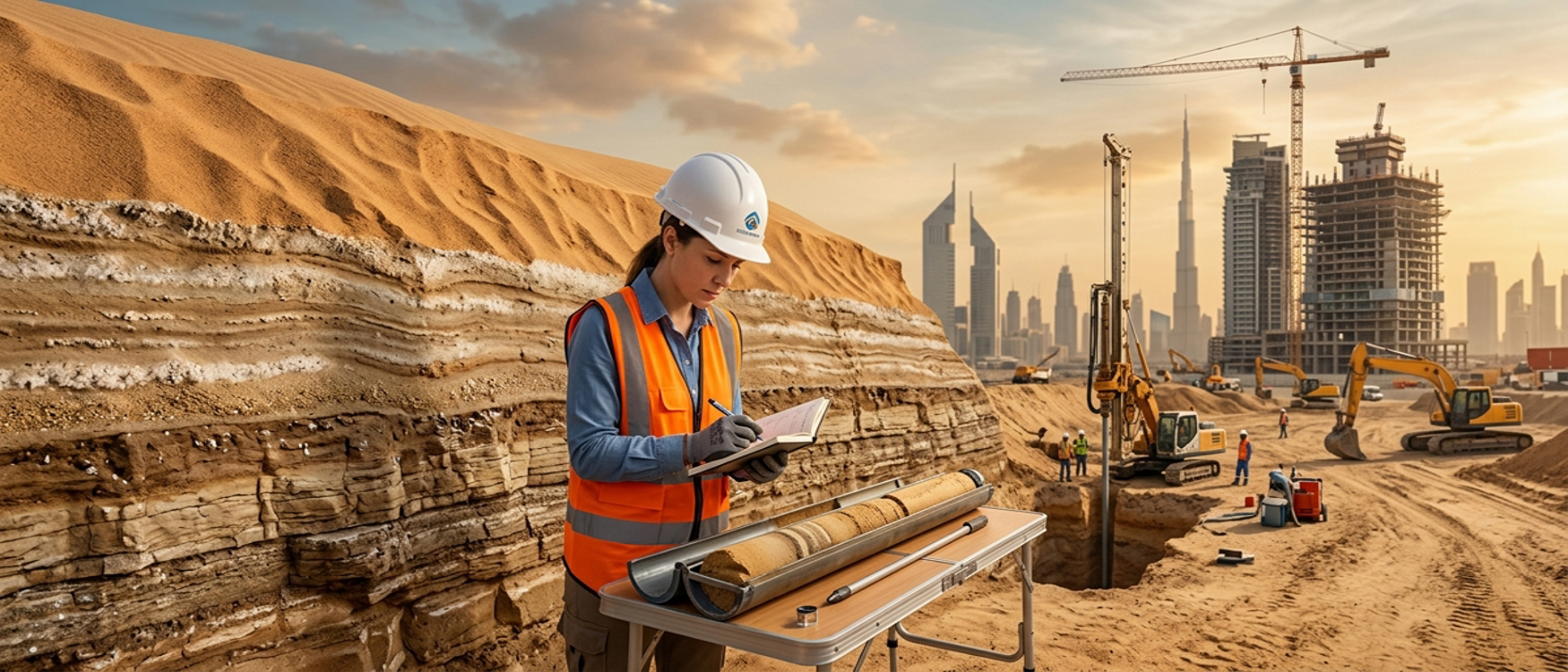
Soil testing in Dubai is not optional for any serious construction project. The city’s rapid development sits on top of some of the most geologically complex ground in the world. From loose desert sand to salt-rich sabkha layers, Dubai’s subsurface conditions demand expert evaluation before a single pile is driven. This blog explores the most common soil challenges in Dubai and explains how professional soil testing addresses each one with precision and compliance.
Key Takeaways
- Soil testing in Dubai is essential before any construction begins, especially in areas with sabkha, loose sand, or high groundwater levels.
- Professional soil testing identifies risks like low bearing capacity, settlement potential, and chemical aggression that can compromise structural integrity.
- EIAC-accredited laboratories like Terrasearch Gulf provide reliable geotechnical investigation and soil analysis services that support regulatory compliance and safe design.
Why Soil Conditions in Dubai Are Uniquely Challenging
Dubai’s landscape is shaped by centuries of wind-blown sediment, coastal influence, and arid climate. The result is a ground profile that varies dramatically across short distances. Some plots sit on dense gravelly sand, while neighboring sites may have thick layers of compressible silt or chemically reactive sabkha.
Construction professionals cannot rely on assumptions or visual inspection alone. What looks stable at the surface may conceal layers that shift under load, swell when wet, or corrode embedded steel and concrete over time. This is precisely why a thorough soil testing program is the first step in any responsible project plan.
Challenge 1: Sabkha Soil and Salt-Induced Deterioration
Sabkha is one of the most problematic soil types found across the UAE. It is a salt-encrusted, fine-grained sediment that forms in coastal and near-coastal zones. Its structure appears firm on the surface but behaves unpredictably under load or when moisture levels change.
When foundations are placed on sabkha without adequate investigation, the results can include differential settlement, loss of bearing capacity, and rapid chemical attack on concrete and reinforcement steel. The sulfate and chloride content in sabkha accelerates corrosion and reduces the service life of structural elements.
Professional soil testing in Dubai addresses sabkha through detailed geotechnical investigation services that include chemical soil analysis, sulfate content testing, and chloride profiling. These results inform foundation design choices and concrete mix specifications that can resist chemical aggression over the long term.
Challenge 2: Low Bearing Capacity and Settlement Risk
Loose sandy soils and compressible layers beneath Dubai’s surface often exhibit low bearing capacity. When a structure’s load exceeds what the soil can safely carry, settlement occurs. Uneven or excessive settlement is one of the leading causes of structural distress in the region.
Settlement can be uniform or differential. Differential settlement is far more dangerous because it places unequal stress on foundations and structural frames, leading to cracking, misalignment, and in severe cases, structural instability.
Identifying bearing capacity limitations before construction requires systematic field and laboratory testing. Techniques such as plate load testing directly measure how much load a soil layer can carry before yielding. Combined with standard penetration tests and triaxial shear strength analysis, these methods give engineers the data they need to design appropriate foundations.
Terrasearch Gulf provides comprehensive geotechnical field testing that quantifies bearing capacity and settlement potential. This allows structural engineers to select the most cost-effective and safe foundation system for each specific site condition.
Challenge 3: High Groundwater Levels and Hydrostatic Pressure
In many parts of Dubai, groundwater sits close to the surface. This is particularly true in coastal zones and areas near drainage channels. High groundwater levels create several problems for construction projects.
First, excavation becomes difficult and expensive when water must be continuously pumped out. Second, hydrostatic pressure acts against basement walls and slabs, requiring careful waterproofing design. Third, groundwater in Dubai often carries dissolved salts that increase the chemical aggression on below-grade concrete and steel reinforcement.
Accurate groundwater profiling is part of any thorough site investigation. Borehole drilling and standpipe piezometers allow geotechnical engineers to determine the seasonal range of the water table. This data directly influences foundation depth, waterproofing specification, and concrete durability requirements.
When groundwater chemistry is also tested, engineers can classify the exposure conditions and specify sulfate-resistant or low-permeability concrete mixes accordingly. This kind of integrated approach to soil testing in Dubai prevents costly surprises during or after construction.
Challenge 4: Cavernous Limestone and Subsurface Voids
Parts of Dubai and the broader UAE are underlain by carbonate rock that has been weathered over thousands of years to form cavities and dissolution features. These subsurface voids present a serious hazard because they can cause sudden collapse or unpredictable foundation movement if not detected before construction.
Standard borehole drilling can sometimes miss cavities depending on their location and spacing. This is why geophysical survey methods are a valuable complement to conventional soil investigation in areas with known limestone bedrock.
A geophysical survey in Dubai uses non-invasive techniques such as seismic refraction, ground-penetrating radar, and electrical resistivity to detect anomalies beneath the ground surface. When combined with targeted borehole verification, these surveys provide a more complete picture of subsurface conditions and dramatically reduce the risk of building over hidden voids.
Challenge 5: Expansive Soils and Volume Change
Some soil types found in Dubai contain clay minerals that absorb water and expand in volume. When these soils dry out, they shrink. This cycle of expansion and contraction exerts significant pressure on shallow foundations, floor slabs, and buried utilities.
Expansive soil behavior is not always obvious from a visual inspection of the site. Laboratory tests such as the free swell test, plasticity index measurement, and shrink-swell characterization are necessary to identify the risk. Once identified, engineers can design foundations that penetrate below the active zone or specify ground improvement measures that stabilize the soil before construction.
Terrasearch Gulf’s construction materials testing services work alongside geotechnical investigation to ensure that both the ground and the materials placed within it are verified for compatibility and durability.
How Professional Soil Testing in Dubai Supports Regulatory Compliance
Dubai Municipality and other regulatory bodies in the UAE require site investigation reports as part of the building permit process for most commercial and infrastructure projects. These reports must demonstrate that the ground conditions are understood and that the proposed foundation design is appropriate for the site-specific risks.
An EIAC-accredited laboratory is essential in this context. Accreditation confirms that testing is conducted to recognized international standards, that equipment is calibrated, and that results are reliable. Without accredited test results, reports may not be accepted by authorities having jurisdiction.
Terrasearch Gulf holds EIAC accreditation and provides complete geotechnical investigation packages that satisfy Dubai Municipality requirements. From borehole logging and soil sampling to laboratory classification and chemical testing, every stage is documented and traceable. This makes the permitting process smoother and reduces the risk of project delays caused by incomplete or non-compliant investigation data.
Choosing the Right Partner for Soil Testing in Dubai
Not all testing providers deliver the same level of technical competence or regulatory compliance. When selecting a soil testing partner for your project, look for EIAC accreditation, a full suite of field and laboratory capabilities, experienced geotechnical engineers, and a proven track record of working with Dubai Municipality. Terrasearch Gulf meets all of these criteria and offers integrated investigation programs tailored to the specific challenges of each site. Clients can review the full range of survey services in UAE available to support every stage of site characterization.
Conclusion
Soil testing in Dubai is the foundation of every safe and compliant construction project in the region. From chemically aggressive sabkha to subsurface limestone voids and expansive clays, Dubai’s ground conditions demand expert investigation before any design or construction work begins. Professional soil testing provides the data engineers need to make informed decisions, select appropriate foundations, and specify materials that will perform over the structure’s intended life. Working with an EIAC-accredited laboratory like Terrasearch Gulf ensures that your investigation meets regulatory standards and delivers results you can rely on. Contact Terrasearch Gulf today to discuss your site investigation requirements and protect your project from the ground up.
FAQ
Q1: What is soil testing and why is it important for construction in Dubai?
Soil testing involves laboratory and field analysis of ground conditions before construction begins. In Dubai, it is critical because the region has sabkha, loose sands, and high groundwater that can compromise foundation performance, making accredited investigation essential for engineers designing safe and compliant structures.
Q2: What is sabkha soil, and how does it affect building foundations?
Sabkha is a salt-rich, fine-grained sediment common in coastal UAE areas. It appears stable on the surface but loses bearing capacity when loaded or wetted. Its high sulfate and chloride content also accelerates corrosion of concrete and steel, making professional soil testing essential before any foundation work.
Q3: How does plate load testing help determine soil bearing capacity?
Plate load testing applies a measured load to a rigid plate placed on the soil surface and records the resulting settlement. This directly measures how much load the ground can carry before deforming. It is one of the most reliable field methods for verifying soil bearing capacity on active construction sites in Dubai.
Q4: Can geophysical surveys detect underground voids in Dubai?
Yes. Geophysical surveys using ground-penetrating radar, seismic refraction, and electrical resistivity can detect subsurface voids and cavities in carbonate rock formations. These non-invasive methods complement conventional borehole drilling and provide a more complete picture of ground conditions before construction begins.
Q5: What laboratory tests are used to identify expansive soils?
Common laboratory tests for expansive soils include the free swell test, Atterberg limits, plasticity index measurement, and shrink-swell characterisation. These tests identify clay minerals that expand when wet and shrink when dry, guiding foundation depth decisions and ground improvement strategies for affected sites in Dubai.
Q6: How does groundwater affect construction projects in Dubai?
High groundwater levels create excavation challenges, hydrostatic pressure on basement structures, and increased chemical attack on concrete. Groundwater in Dubai often contains dissolved salts, so site investigation that includes chemical testing allows engineers to specify durable material mixes suited to the specialty testing services’ exposure classifications.
Q7: Is soil testing required by Dubai Municipality for building permits?
Yes. Dubai Municipality and related regulatory authorities typically require a geotechnical investigation report as part of the building permit application for commercial and infrastructure projects. The report must demonstrate that ground conditions are understood and that the foundation design is appropriate for site-specific risks identified through accredited soil testing.
Q8: What does EIAC accreditation mean for a soil testing laboratory?
EIAC accreditation confirms that a laboratory meets internationally recognized standards for testing competence, equipment calibration, and result reliability. For clients in Dubai, using an EIAC-accredited lab means test reports are accepted by regulatory authorities, reducing the risk of project delays caused by non-compliant investigation data.
Q9: How long does a standard geotechnical investigation take in Dubai?
The duration depends on project size, number of boreholes, and testing scope. A standard investigation for a mid-sized project typically takes one to three weeks for fieldwork and one to two weeks for laboratory analysis and report preparation. You can learn more about what these programs involve through Terrasearch Gulf’s experience and capabilities.
Q10: What types of chemical soil tests are conducted during site investigation?
Chemical soil tests commonly conducted include sulfate content analysis, chloride content profiling, pH measurement, and organic matter determination. These tests identify chemically aggressive ground conditions that could attack concrete or corrode steel reinforcement, helping engineers specify appropriate concrete mixes and protective coatings for durable construction outcomes across Dubai projects.