

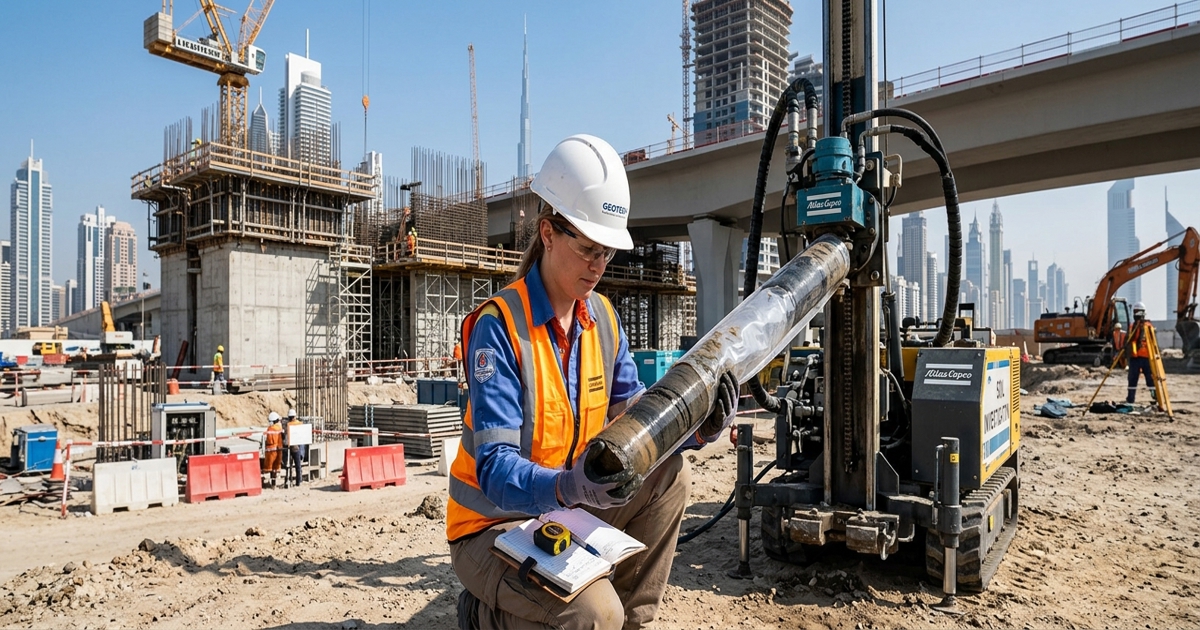
Soil testing is not just a preliminary task. It is the foundation of every safe, compliant, and cost-effective infrastructure project. Before a single column is erected or a foundation is poured, engineers must understand what lies beneath the surface. In Dubai and across the UAE, rapid urban development demands rigorous geotechnical analysis. Skipping this step puts projects at serious risk of structural failure, regulatory non-compliance, and costly delays. This blog explains why soil testing must always come first.
Key Takeaways
- Soil testing reveals the load-bearing capacity, moisture content, and chemical composition of ground before construction begins, ensuring foundations match actual site conditions.
- Geotechnical investigation by accredited soil investigation companies provides legally defensible data that supports regulatory compliance and project approvals in Dubai.
- Skipping soil testing in Dubai can lead to foundation failures, project delays, and significant financial and legal consequences.
What Is Soil Testing and Why Does It Matter?
Soil testing is a systematic process of collecting and analyzing soil samples from a construction site. The goal is to determine the physical, mechanical, and chemical properties of the ground. These properties directly influence how a structure behaves over time.
In Dubai, the ground conditions vary significantly across different zones. Some areas have loose sand, while others have sabkha soil, which is highly saline and compressible. Without a proper geotechnical investigation, engineers are essentially designing structures blindly. This increases the risk of settlement, cracking, and long-term structural instability.
According to the American Society for Testing and Materials (ASTM), standardized soil testing procedures ensure that data collected on-site is accurate, reproducible, and usable for engineering design calculations.
Key Components of a Geotechnical Investigation
A thorough geotechnical investigation involves multiple phases of data collection and laboratory analysis. Each phase contributes critical information that shapes the foundation design and construction methodology.
Borehole Drilling and Sample Collection
Borehole drilling is one of the most direct methods of soil investigation. Engineers drill into the ground at planned locations across the site and collect soil samples at various depths. These samples are then analyzed in an accredited laboratory for properties such as shear strength, compressibility, and grain size distribution.
In Dubai, borehole depths are often significant due to the presence of soft layers beneath the surface. Qualified soil investigation companies ensure engineers receive reliable subsurface data through precise borehole drilling and soil analysis. This data directly informs decisions on pile depth, foundation type, and load distribution.
Soil Analysis for Foundation Design
Once samples are collected, laboratory tests determine key parameters. These include bearing capacity, settlement potential, permeability, and plasticity index. Each of these values is essential when designing a foundation that can safely support the intended structural load.
For large infrastructure projects in Dubai, such as bridges, highways, and high-rise towers, even a small error in soil analysis can have major structural consequences. This is why working with EIAC-accredited soil investigation companies ensures that all laboratory data meets recognized quality and compliance standards.
Chemical and Salinity Testing of Soil
Dubai’s soil often contains high concentrations of sulfates, chlorides, and other chemicals. These substances can aggressively attack concrete foundations and steel reinforcement over time. Chemical testing of soil samples helps engineers select the right concrete mix, protective coatings, and construction materials to counteract these risks.
Detailed chemical analysis of soil samples and construction materials helps project teams in Dubai anticipate durability challenges and take preventive action before construction begins. This step is particularly critical in coastal and reclaimed land areas where chemical aggressivity is most pronounced.
The Role of Soil Testing in Dubai’s Construction Landscape
Soil testing in Dubai is not optional. It is a requirement embedded in local building codes and engineering standards. The Dubai Municipality and other regulatory authorities require geotechnical reports before issuing construction permits for most projects.
Dubai’s unique geography presents specific challenges. The city sits on coastal sediments, reclaimed land, and desert terrain. Each of these environments behaves differently under load. A geotechnical investigation provides the localized data needed to address these challenges with confidence.
Several major infrastructure failures across the region have been traced back to inadequate site investigation. Proper soil testing in Dubai reduces this risk significantly. It allows developers and engineers to make informed decisions from the earliest stages of project planning.
How Soil Investigation Companies Support Infrastructure Projects
Soil investigation companies serve as technical partners throughout the pre-construction phase. Their role extends beyond simply drilling boreholes and collecting samples. They interpret data, prepare geotechnical reports, and recommend foundation solutions tailored to specific site conditions.
Choosing the right soil investigation company is critical. Accreditation by EIAC, the Emirates International Accreditation Centre, ensures that the laboratory follows internationally recognized testing standards. This matters both for technical accuracy and for regulatory acceptance of the geotechnical report.
Terrasearch Gulf is an EIAC-accredited testing laboratory in Dubai that provides comprehensive geotechnical investigation services. From borehole drilling to detailed soil analysis and geotechnical reporting, the company supports infrastructure and construction projects with reliable and compliant data.
What Happens When Soil Testing Is Skipped?
Projects that bypass soil testing face a range of serious consequences. The most immediate risk is foundation failure. When the ground cannot support the applied load, structures may settle unevenly, crack, or become unsafe for occupancy.
Beyond structural risks, skipping soil investigation can trigger regulatory issues. Without a compliant geotechnical report, projects may face permit delays or outright rejections from Dubai authorities. Remediation works after construction begins are also far more expensive than pre-construction testing.
The financial cost of inadequate soil testing consistently exceeds the cost of thorough geotechnical investigation. For construction companies, civil engineering firms, and real estate developers operating in Dubai, investing in proper site investigation at the outset is both a technical and a business imperative.
Choosing the Right Testing Partner for Soil Investigation in Dubai
Not all testing laboratories offer the same level of technical capability or regulatory compliance. When selecting a partner for soil testing in Dubai, project teams should evaluate accreditation status, laboratory capabilities, reporting standards, and field investigation experience.
An EIAC-accredited laboratory provides assurance that test results are generated using validated methods, calibrated equipment, and trained personnel. This is particularly important when geotechnical reports are submitted to government authorities or used as the basis for structural design.
Terrasearch Gulf offers a full range of construction material testing and geotechnical services. Their team supports projects from site investigation through material testing, ensuring quality and compliance at every stage of development.
Conclusion
Soil testing is the essential first step in any successful infrastructure development project. It provides the technical data engineers need to design safe foundations, select appropriate materials, and comply with regulatory requirements. In Dubai’s challenging and varied ground conditions, bypassing this step carries significant structural, financial, and legal risks. Partnering with an experienced, EIAC-accredited laboratory ensures that your project begins on solid and compliant ground. Contact Terrasearch Gulf to learn how their geotechnical investigation and soil testing in Dubai services can support your next infrastructure project.
Frequently Asked Questions
What is soil testing and why is it important for construction?
Soil testing is the process of analyzing ground samples to determine bearing capacity, chemical composition, and settlement potential. It ensures that foundations are designed to match actual site conditions, reducing the risk of structural instability, costly repairs, and regulatory non-compliance during construction.
What types of soil tests are typically conducted before construction?
Common tests include standard penetration tests, grain size analysis, Atterberg limits, shear strength tests, and chemical analysis for sulfates and chlorides. Each test reveals a different property of the soil, helping engineers design foundations that are safe and appropriate for the specific site conditions in Dubai.
Is soil testing mandatory for construction projects in Dubai?
Yes. Soil testing in Dubai is required by local building codes and regulatory authorities such as Dubai Municipality. A compliant geotechnical report is typically needed before construction permits are issued, particularly for large infrastructure, high-rise, and commercial development projects across the emirate.
What is a geotechnical investigation and what does it include?
A geotechnical investigation is a comprehensive study of subsurface conditions. It includes borehole drilling, soil sample collection, laboratory analysis, and geotechnical reporting. The findings guide foundation design, construction methodology, and material selection, making it an essential pre-construction requirement for any infrastructure or building project.
How do soil investigation companies contribute to project safety?
Soil investigation companies collect and analyze subsurface data, prepare geotechnical reports, and recommend foundation solutions. They act as technical partners during the pre-construction phase. Choosing an EIAC-accredited company ensures data accuracy and regulatory compliance, which directly supports the long-term safety of the structure being built.
What is sabkha soil and why is it a challenge in Dubai?
Sabkha is a highly saline, soft, and compressible soil type commonly found in coastal areas of the UAE. It has low bearing capacity and can cause significant settlement under load. Identifying sabkha through professional geotechnical investigation is essential before designing foundations in any affected site areas across the emirate.
How does chemical soil testing protect concrete foundations?
Chemical soil testing identifies harmful substances like sulfates and chlorides that can degrade concrete and corrode steel reinforcement over time. By understanding the soil chemistry in advance, engineers can specify sulfate-resistant concrete mixes and protective coatings, significantly extending the service life of foundations in chemically aggressive ground conditions.
What is EIAC accreditation and why does it matter for soil testing?
EIAC stands for Emirates International Accreditation Centre. An EIAC-accredited laboratory follows internationally recognized testing standards, uses calibrated equipment, and employs trained personnel. This accreditation ensures that soil testing and construction material test results are technically reliable and accepted by government authorities and engineering consultants across the UAE.
How long does a geotechnical investigation take for a typical project?
The duration of a geotechnical investigation depends on project size, site complexity, number of boreholes, and laboratory turnaround times. Small residential projects may take one to two weeks. Large infrastructure or commercial developments often require three to six weeks for complete fieldwork, laboratory analysis, and preparation of the geotechnical report.
Can soil testing help reduce overall construction costs?
Yes. Investing in thorough soil testing before construction begins reduces the risk of unexpected ground conditions that require costly design changes or remediation. It also helps engineers optimize foundation depth and type, avoiding over-engineering. Early identification of soil challenges consistently results in more efficient use of materials and construction budgets.