

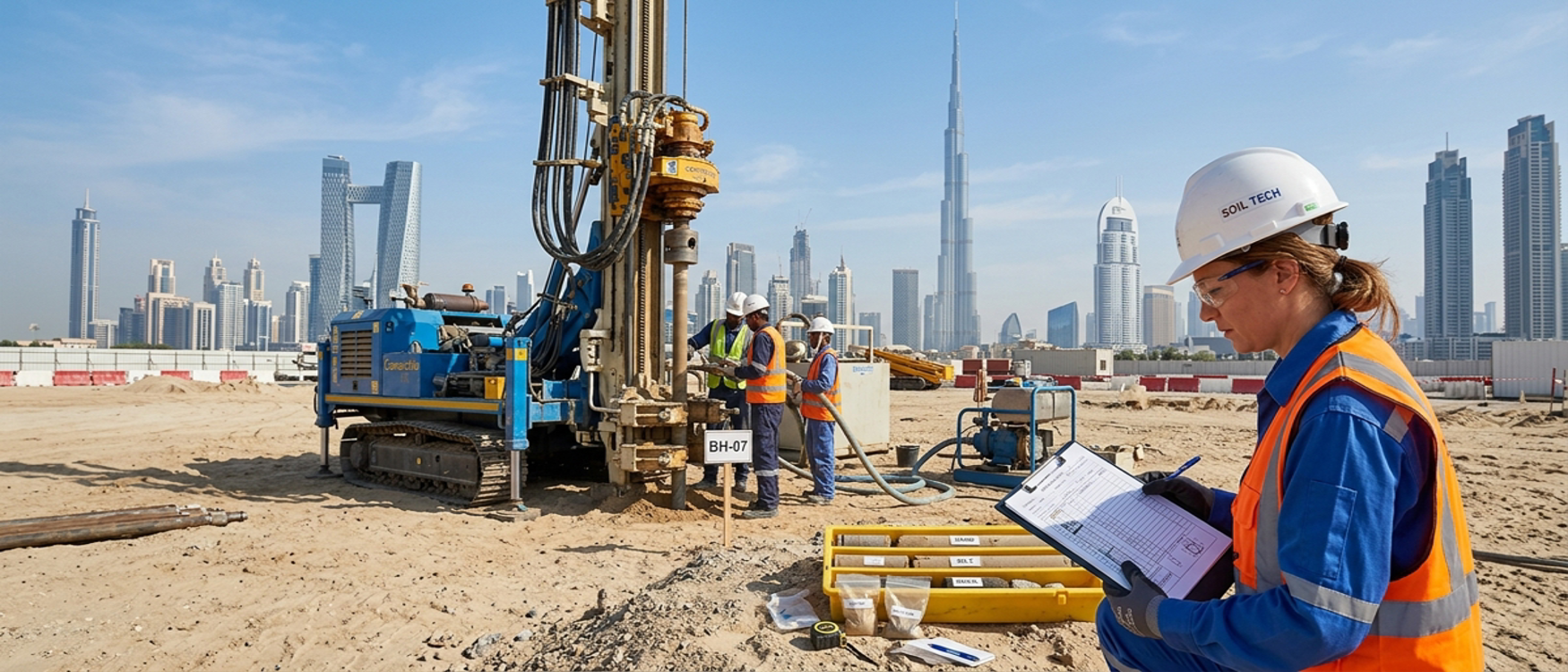
Soil investigation companies play a critical role in determining whether your construction project stands on a safe and stable foundation. Yet many project owners and contractors hire these firms without asking the right questions upfront. Choosing the wrong partner can lead to inaccurate data, regulatory non-compliance, and costly project delays. This blog walks you through the essential questions to ask any soil investigation company before you sign a contract, helping you make an informed and confident decision for your next project in the UAE.
Key Takeaways
- Always verify the accreditation status of soil investigation companies before engagement, especially for projects requiring EIAC-compliant reports in the UAE.
- Asking about investigation methods, borehole depth, and lab analysis capabilities ensures you receive data that is accurate and project-specific.
- Understanding timelines, reporting formats, and post-investigation support helps you plan your construction schedule without unnecessary disruptions.
Why Asking the Right Questions Matters When Choosing Soil Investigation Companies
Selecting a soil investigation company is not just a procurement decision. It is a technical and compliance decision that shapes the entire foundation design of your structure. A firm that lacks proper accreditation or uses outdated methods can deliver reports that regulators reject or that engineers cannot rely upon.
In the UAE, soil investigation UAE projects must meet strict standards set by municipal authorities, Dubai Municipality, and engineering consultants. Projects that skip proper vetting of their geotechnical partner often face re-investigation costs, permit delays, and structural risk assessments that could have been avoided from the start.
For a broader understanding of what professional geotechnical investigation services in the UAE involve, reviewing the full scope of services offered by accredited firms will help you benchmark any provider you are evaluating.
Is the Company EIAC Accredited for Soil Investigation in the UAE?
Accreditation is the single most important qualification to verify. In Dubai and across the UAE, testing laboratories and investigation firms must hold valid EIAC accreditation for their reports to be accepted by regulatory bodies and engineering consultants. Without it, your geotechnical report may not be approved during the permitting stage.
Ask for the company’s EIAC certificate and verify the specific scope of accreditation. Some laboratories hold accreditation for general material testing but not specifically for soil investigation UAE site work or borehole sampling. Confirm that their accreditation covers the actual tests your project requires, including soil classification, shear strength tests, consolidation tests, and site exploration activities.
Working with an EIAC-accredited partner like Terrasearch Gulf ensures your reports meet the compliance standards expected by Dubai Municipality and engineering authorities across the UAE.
What Investigation Methods and Borehole Depths Do You Use?
Not all soil investigation methods are suited to every site. The right method depends on your project type, soil profile, and foundation design requirements. Understanding what techniques a company uses gives you confidence that they can handle the complexity of your specific site conditions.
Ask whether the company conducts standard penetration tests (SPT), cone penetration tests (CPT), rock coring, or undisturbed sampling. For deep foundations or high-rise buildings in Dubai, borehole depths must reach stable bearing strata, which can vary significantly across different zones. Ask how they determine recommended investigation depth and whether they adjust their approach based on preliminary desktop studies or existing site data.
Understanding the soil-bearing capacity beneath your site is directly linked to the type and depth of investigation required. You can learn more about how capacity verification works through plate load testing in Dubai, which is often conducted alongside geotechnical investigations.
Do You Perform Both Field Investigation and Laboratory Analysis?
A comprehensive geotechnical report requires both field sampling and controlled laboratory testing. Some companies only handle field drilling and outsource the laboratory work. This split responsibility can create inconsistencies in data interpretation, delays in turnaround time, and potential gaps in chain of custody for soil samples.
Ask whether the firm has an in-house accredited laboratory capable of running tests such as particle size distribution, Atterberg limits, compressibility tests, and direct shear tests. Companies that manage both field and lab work under one accredited roof deliver more reliable and consistent geotechnical reports. This integrated approach is particularly important for soil investigation UAE projects with tight permitting timelines.
What Experience Do Soil Investigation Companies Have with UAE Projects?
Experience matters enormously in geotechnical investigation. A firm that has worked extensively on Dubai and UAE construction sites understands local soil conditions, including the presence of sabkha soils, gypsiferous layers, loose sands, and coastal fill materials that frequently challenge foundation designers in the region.
Ask for references or case studies from similar project types, whether that is a residential tower, an industrial warehouse, a road project, or a waterfront development. Firms with deep regional experience will also be familiar with the report formats and technical standards expected by Dubai Municipality, Abu Dhabi Department of Urban Planning, and other relevant authorities. This local knowledge can significantly reduce the risk of report rejection or revision requests.
You can also review how experienced firms approach related investigative services through geophysical survey services in Dubai, which are often used in combination with traditional borehole drilling to map subsurface conditions more comprehensively.
What Does Your Reporting Process Look Like and What Is the Turnaround Time?
A geotechnical report must be clear, structured, and actionable for both engineers and regulatory reviewers. Ask the company to walk you through what their standard report includes: borehole logs, laboratory test summaries, soil profiles, foundation recommendations, and an executive interpretation section.
Turnaround time is equally important. For many projects in the UAE, permits cannot be submitted until the geotechnical investigation report is complete. Delays in report delivery push back design sign-off and contractor mobilization. Ask for a realistic schedule from site mobilization to final report delivery, and confirm whether they have the field crew and lab capacity to meet it without compromising quality.
How Do You Handle Health, Safety, and Site Access Protocols?
Field investigation work involves drilling equipment, heavy machinery, and confined space risks. Ask the company about their health and safety policy, their team certifications, and how they coordinate access with active construction sites or occupied areas. Firms operating in Dubai are expected to comply with Dubai Municipality and OSHAD safety standards.
A professional soil investigation company will have documented method statements and risk assessments ready before mobilizing to any site. They should also be able to coordinate with your site supervisor or project manager to minimize disruption to ongoing activities. Safety compliance during investigation is not just a legal requirement. It is a reflection of the firm’s overall professionalism and quality culture.
For construction projects that also require structural verification services, exploring structural testing and analysis services in the UAE offered by the same firm can provide a more seamless quality assurance process across your project lifecycle.
Conclusion
Choosing the right partner among soil investigation companies requires more than comparing quotes. You need to verify accreditation, investigate their methods, assess laboratory capabilities, and confirm their experience with UAE-specific site conditions. Asking these targeted questions before engagement protects your project from compliance risks, inaccurate data, and unnecessary delays. Whether you are planning a residential tower, a road network, or an industrial development in Dubai, investing time in the right questions at the start saves significant cost and effort later. Contact Terrasearch Gulf to speak with an EIAC-accredited geotechnical specialist about your upcoming project.
FAQ
Q1: What is the primary purpose of soil investigation before construction?
Soil investigation determines the bearing capacity, composition, and stability of the ground beneath a planned structure. This data informs foundation design decisions and helps engineers avoid structural risks caused by weak, expansive, or chemically aggressive soils commonly found across UAE construction sites.
Q2: How do I verify if a soil investigation company is EIAC accredited?
You can request the company’s current EIAC certificate and cross-check it against the Emirates International Accreditation Centre’s published list of accredited bodies. Confirm the scope of accreditation covers specific soil tests your project requires, not just general construction material testing.
Q3: How deep should boreholes be drilled for a typical building project in Dubai?
Borehole depth depends on the structure type, load intensity, and subsurface conditions. For low-rise buildings, depths of 10 to 15 meters are common, while high-rise towers may require drilling beyond 30 meters to reach competent bearing strata beneath loose sands or fill layers.
Q4: What soil types are commonly found in Dubai that affect foundation design?
Dubai sites frequently contain sabkha soils, gypsiferous sands, calcareous sediments, and coastal fill materials. These can cause settlement, chemical attack on concrete, or bearing failures if not properly identified. Thorough geotechnical investigation in the UAE is essential for accurate foundation design in these conditions.
Q5: What laboratory tests are typically included in a geotechnical investigation report?
Standard tests include particle size distribution, Atterberg limits, moisture content, compressibility, direct shear, triaxial shear, and sulphate content analysis. The exact test schedule depends on soil type, foundation design requirements, and what the supervising engineer or consultant has specified for your project.
Q6: How long does a soil investigation usually take for a mid-size project?
A typical mid-size project in Dubai may require one to three weeks from site mobilization to final report delivery. This includes field drilling, sample transport, laboratory testing, and report preparation. Timelines can extend if site access is restricted or if additional testing is requested by the design consultant.
Q7: Can a soil investigation company also conduct non-destructive testing on existing structures?
Some accredited firms offer both geotechnical investigation and non-destructive testing in the UAE for existing structures, covering services like rebar scanning, concrete core testing, and ultrasonic inspection. Engaging one firm for both services can improve data consistency across your project documentation.
Q8: What is the difference between a geotechnical investigation and a geophysical survey?
Geotechnical investigation involves physical sampling and drilling to directly test soil properties. A geophysical survey uses seismic, resistivity, or ground-penetrating radar methods to map subsurface conditions non-invasively. Both are often combined for large or complex sites to provide a more complete picture of underground conditions.
Q9: Do soil investigation reports need to be submitted to Dubai Municipality?
Yes, geotechnical reports are typically required as part of the foundation design submission to Dubai Municipality and relevant engineering authorities. Reports must meet specific technical standards and are often reviewed by the supervising consultant before submission. EIAC accreditation of the testing firm is generally a prerequisite for report acceptance.
Q10: What questions should I ask about a firm’s safety practices during site investigation?
Ask for their method statement, risk assessment documentation, and details of crew certifications. Confirm they follow OSHAD and Dubai Municipality safety standards. Their process for coordinating with active construction sites reflects their overall professionalism and the commitment to quality that defines how Terrasearch Gulf approaches every project.