

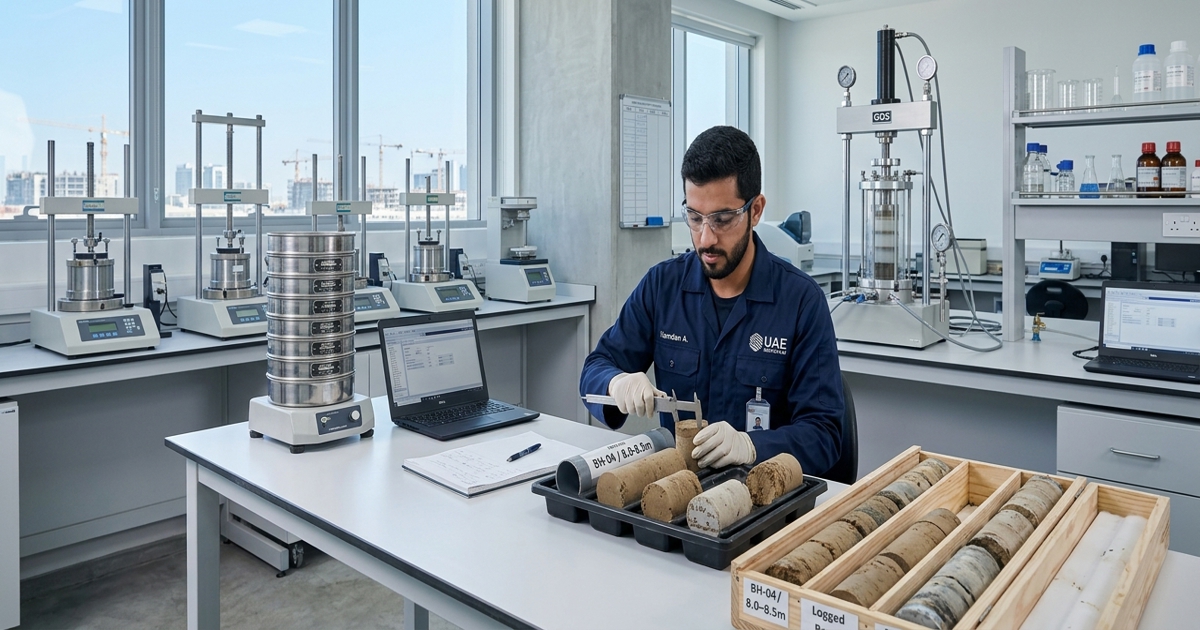
Geotechnical Laboratory Testing in the UAE: An Introduction
A geotechnical laboratory UAE plays a critical role before any construction begins. Whether you are developing a residential villa, a commercial tower, or a major infrastructure corridor, understanding soil behavior is non-negotiable. Without proper laboratory testing, foundation decisions become guesswork, and guesswork in construction leads to costly failures. This blog covers the key laboratory tests used across different project types in the UAE and explains why each one matters for structural integrity and regulatory compliance.
Key Takeaways
- Geotechnical laboratory testing is mandatory for safe foundation design in residential, commercial, and infrastructure projects across the UAE.
- Geotechnical investigation UAE services involve a range of soil and material tests that must meet EIAC accreditation and local regulatory standards.
- Choosing a qualified and accredited laboratory ensures your project data is reliable, defensible, and accepted by authorities.
Why Geotechnical Laboratory Testing Matters in the UAE
The UAE presents unique geotechnical challenges. Coastal areas near Dubai and Abu Dhabi contain soft marine deposits, sabkha soils, and high groundwater tables. Inland zones may have loose desert sands or weak carbonate rocks. These conditions demand precise laboratory analysis before any construction activity.
A certified geotechnical laboratory UAE provides engineers with data on soil classification, shear strength, compressibility, and chemical composition. This data directly informs foundation type selection, bearing capacity calculations, and settlement predictions. Without it, structural designs rest on assumptions rather than evidence.
According to the Dubai Municipality, geotechnical investigation reports are a prerequisite for building permit applications in the emirate. This requirement reflects how seriously regulatory authorities treat subsurface conditions as a factor in construction safety.
Core Geotechnical Laboratory Tests for Residential Projects
Residential projects, whether single-family homes or low-rise apartment buildings, require a focused set of laboratory tests. These tests are designed to verify that the soil beneath the structure can safely support the applied loads without excessive settlement.
Soil Classification and Grain Size Analysis
Grain size distribution testing identifies whether a soil is gravel, sand, silt, or clay. This classification governs how the soil behaves under load and how it responds to changes in moisture. In the UAE, fine-grained coastal soils often require special foundation treatment, and grain size analysis is the starting point for that evaluation.
The test involves sieve analysis for coarse-grained soils and hydrometer analysis for fine-grained fractions. Results allow engineers to classify soils using the Unified Soil Classification System (USCS) or the AASHTO system, both of which are referenced in UAE construction codes.
Atterberg Limits Testing
Atterberg limits, specifically the liquid limit and plastic limit, define the water content boundaries at which fine-grained soils transition between states. This information is critical for assessing the expansive potential of clay soils, which are found in certain parts of the UAE.
Highly plastic clays can swell significantly when they absorb water, exerting pressure on foundations and slabs. Residential foundations in areas with expansive soils must be designed to accommodate or counteract this swelling. Atterberg limits data makes that design possible.
Sulfate and Chloride Content Testing
UAE soils and groundwater frequently contain elevated levels of sulfates and chlorides. These chemicals attack concrete and corrode steel reinforcement over time. Laboratory testing for sulfate and chloride content is essential for specifying the correct concrete mix design and protective coatings for residential foundations.
An accredited geotechnical laboratory UAE will test both soil samples and groundwater samples from the investigation boreholes. Results are compared against thresholds defined in BS 8500 and related standards to determine aggressivity classification and appropriate concrete exposure class.
Essential Tests for Commercial and High-Rise Projects
Commercial projects and high-rise developments impose significantly higher loads on the ground. The laboratory testing scope expands accordingly, with a focus on consolidation behavior, shear strength, and deep foundation support conditions.
Consolidation and Settlement Testing
The oedometer test, also called the consolidation test, measures how much a soil layer will compress under a sustained load and how quickly that compression will occur. For high-rise buildings, total settlement and differential settlement must both be within acceptable limits to protect structural integrity and finishes.
In the UAE, soft marine clays found along the coastline are particularly susceptible to consolidation settlement. A geotechnical investigation UAE for a commercial tower in a coastal zone will almost always include consolidation testing as a core component. The results feed directly into pile design and settlement monitoring programs.
Triaxial Shear Strength Testing
Triaxial testing determines the shear strength parameters of soil, specifically cohesion and friction angle. These parameters are fundamental inputs for slope stability analysis, retaining wall design, and deep excavation support systems, all of which are common in large commercial developments.
The test can be conducted under unconsolidated undrained, consolidated undrained, or consolidated drained conditions depending on the drainage conditions expected in the field. Selecting the correct test type requires engineering judgment and accurate knowledge of site conditions gathered during field investigation.
Laboratory Tests Critical for Infrastructure Projects
Infrastructure projects such as roads, bridges, tunnels, and utilities cover large areas and encounter highly variable soil conditions. The laboratory testing program must be comprehensive enough to characterize this variability reliably.
California Bearing Ratio (CBR) Testing
CBR testing measures the load-bearing capacity of a subgrade or sub-base material relative to a standard crushed stone. It is the primary input for flexible pavement design in road construction. A low CBR value indicates that the subgrade requires improvement through stabilization or replacement before paving can proceed.
UAE road projects follow standards set by authorities such as the Roads and Transport Authority (RTA), which specify minimum CBR values for different pavement layers. Laboratory CBR testing at the geotechnical investigation stage ensures the pavement design is appropriate for actual site conditions.
Compaction Testing (Proctor Test)
The Proctor test determines the optimum moisture content at which a soil achieves its maximum dry density when compacted. This result establishes the compaction standard for earthworks. During construction, field density tests are compared against laboratory Proctor results to verify that embankments, backfills, and subgrades are properly compacted.
For infrastructure projects in the UAE, modified Proctor testing is typically specified because the heavy construction equipment and traffic loads demand higher compaction energy than the standard test provides. Accurate laboratory results prevent under-compaction, which leads to settlement and pavement distress over time.
Chemical Analysis of Soil and Groundwater
Infrastructure projects often involve buried concrete structures such as culverts, bridge footings, and utility ducts. Chemical analysis of soil and groundwater for sulfates, chlorides, pH, and organic content is essential for designing durable buried concrete that resists chemical attack throughout the project design life. Partnering with an EIAC-accredited laboratory ensures these chemical analyses are conducted to internationally recognized standards and accepted by UAE regulatory authorities.
The Role of EIAC Accreditation in Geotechnical Testing
Accreditation by the Emirates International Accreditation Centre (EIAC) is the benchmark for laboratory quality in the UAE. When a geotechnical laboratory UAE holds EIAC accreditation, it means the laboratory testing procedures, equipment calibration, staff competency, and quality management system have been independently verified to meet international standards.
For construction projects in Dubai, authorities routinely require that laboratory reports come from EIAC-accredited laboratories. Reports from non-accredited sources may be rejected, causing project delays and additional costs. Working with an accredited laboratory from the start eliminates this risk entirely.
Choosing the Right Geotechnical Investigation Partner in the UAE
Not all geo technical investigation companies Dubai offer the same scope of services or level of quality assurance. When selecting a laboratory partner, consider the following factors carefully.
- EIAC accreditation status: Verify that the laboratory holds current accreditation for the specific tests your project requires.
- Scope of testing: Ensure the laboratory can conduct all required geotechnical and chemistry tests in-house to avoid coordination delays.
- Turnaround time: Confirm that report delivery timelines align with your project schedule and permit submission deadlines.
- Technical expertise: Look for laboratories with qualified geotechnical engineers who can interpret results and provide engineering context, not just raw data.
- Track record: Prioritize laboratories with demonstrated experience on projects similar in scale and type to yours.
The quality of your geotechnical investigation data directly influences foundation design, construction methodology, and long-term structural performance. Investing in a competent, accredited laboratory is one of the most cost-effective decisions a project team can make.
Conclusion
A reliable geotechnical laboratory UAE is an essential partner for any construction or infrastructure project in the region. From grain size analysis for a residential foundation to CBR testing for a major highway, the laboratory data gathered during geotechnical investigation shapes every downstream engineering decision. EIAC accreditation ensures that this data meets the quality and regulatory standards required by UAE authorities. Whether you are planning a residential development, a commercial tower, or a large-scale infrastructure scheme, partnering with a qualified and accredited geotechnical laboratory is a foundational step toward a safe and compliant project. To discuss your project requirements and get expert guidance on geotechnical investigation UAE services, contact the team at Terrasearch Gulf today.
Frequently Asked Questions
What is a geotechnical laboratory and what services does it provide in the UAE?
A geotechnical laboratory UAE conducts soil classification, shear strength, consolidation, and chemical content tests. These services provide engineers with subsurface data needed to design safe foundations, earthworks, and buried structures that comply with UAE regulatory requirements and EIAC quality standards.
Why is geotechnical investigation required before construction in Dubai?
Dubai Municipality requires a geotechnical investigation report as part of the building permit process. The investigation identifies soil conditions such as soft clays, sabkha deposits, and chemical aggressivity that must be addressed in foundation and structural design to ensure long-term safety and compliance.
What soil tests are typically included in a geotechnical investigation UAE report?
A standard geotechnical investigation UAE report includes grain size analysis, Atterberg limits, consolidation tests, triaxial shear strength tests, CBR testing, and chemical analysis for sulfates and chlorides. The specific tests depend on project type, soil conditions, and applicable design standards.
How does EIAC accreditation affect geotechnical laboratory results in the UAE?
EIAC accreditation confirms that a laboratory meets international quality standards for procedures, equipment, and staff competency. UAE regulatory authorities routinely require reports from EIAC-accredited laboratories, so accreditation status directly affects whether your investigation data will be accepted for permit submissions.
What are the most important laboratory tests for residential foundation design in the UAE?
Residential foundation design in the UAE relies on grain size analysis, Atterberg limits, sulfate and chloride content testing, and compaction tests. These results define soil classification, expansive potential, chemical aggressivity, and earthworks specifications necessary for safe shallow or pile foundation design. Visit Terrasearch Gulf geotechnical services to explore the full testing scope available for residential projects.
How do geo technical investigation companies Dubai determine the number of boreholes needed?
Reputable geo technical investigation companies Dubai determine borehole spacing and depth based on project footprint, structural load intensity, subsurface variability, and applicable standards such as BS 5930. Larger and more complex projects require denser borehole grids to capture soil variability reliably across the site.
What role does CBR testing play in road infrastructure projects in the UAE?
CBR testing measures subgrade load-bearing capacity and is the primary input for flexible pavement design. UAE road authorities specify minimum CBR values for each pavement layer. Testing before construction ensures the pavement thickness design is appropriate for actual site conditions and avoids premature distress.
How long does it take to receive geotechnical laboratory test results in the UAE?
Turnaround time varies by test type. Basic classification tests such as grain size and Atterberg limits typically take three to five working days. Consolidation and triaxial tests can take one to three weeks depending on the number of samples and the number of testing stages required.
Can geotechnical laboratory testing identify chemically aggressive soils in Dubai?
Yes. Accredited geotechnical laboratory testing in Dubai includes chemical analysis of soil and groundwater for sulfates, chlorides, pH, and organic content. These results determine aggressivity classification and specify the appropriate concrete mix design to protect buried structures from chemical attack over the design life.
What should I look for when selecting a geotechnical investigation partner for an infrastructure project in the UAE?
Prioritize laboratories with current EIAC accreditation, a broad in-house testing scope, qualified geotechnical engineers, and a proven track record on similar infrastructure projects. The right partner for your infrastructure geotechnical investigation prevents report rejections, project delays, and costly re-investigation during the permit approval process.