

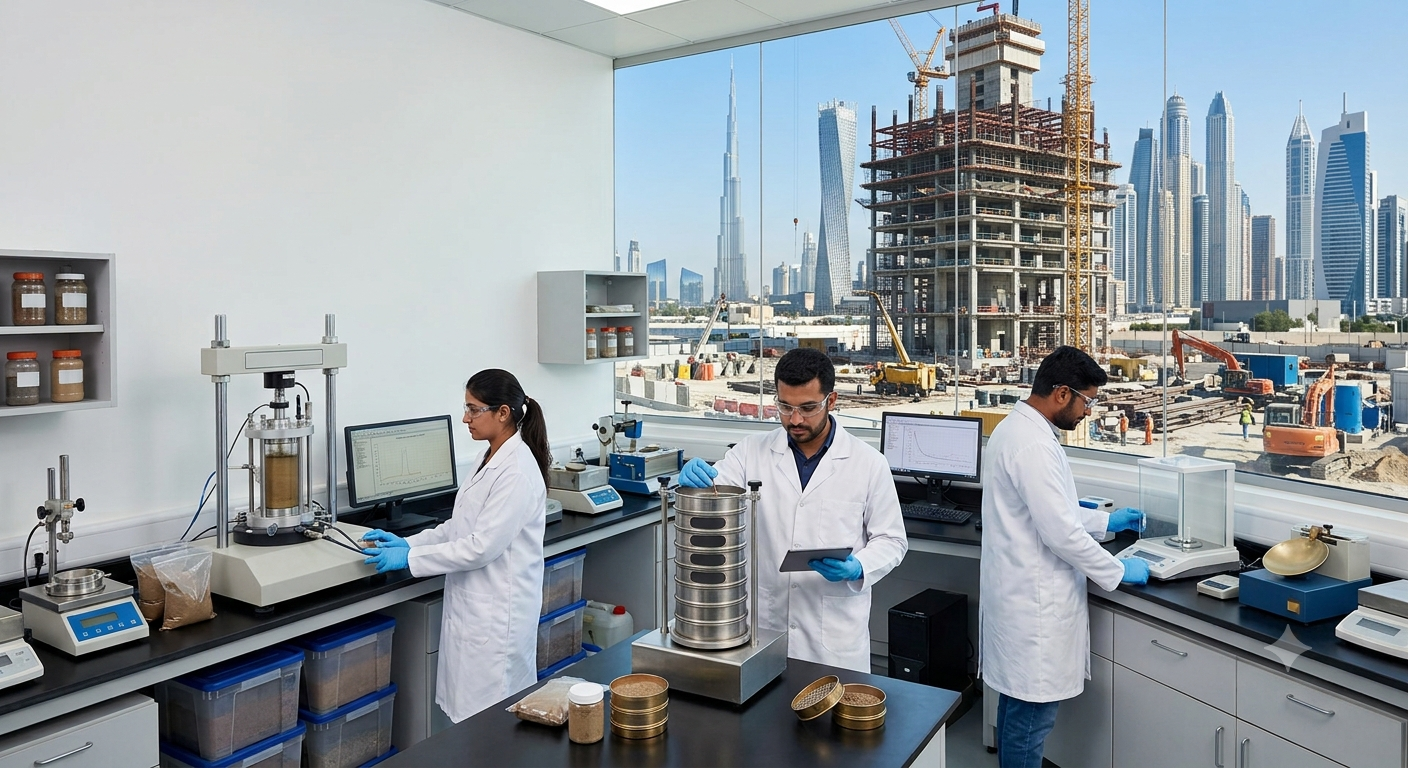
Soil testing laboratory in Dubai services are a foundational requirement for any construction project in the UAE. Before a single column is poured or a foundation is laid, engineers and developers must understand the ground beneath their feet. Poor soil conditions are responsible for a significant share of structural failures and construction delays worldwide. In Dubai, where ambitious infrastructure projects rise on a variety of soil types including sand, sabkha, and reclaimed land, professional soil analysis is not just recommended. It is essential.
Key Takeaways
- A certified soil testing laboratory in Dubai provides critical data that directly informs foundation design and construction safety.
- Professional soil testing identifies risks such as expansive clays, loose sands, and chemically aggressive soils before construction begins.
- EIAC accredited laboratory results are recognized by Dubai regulatory authorities and support project approvals.
What Is Soil Testing and Why Does It Matter for Construction?
Soil testing is the scientific process of evaluating the physical, chemical, and mechanical properties of soil at a construction site. It provides engineers with the data needed to design safe foundations, select appropriate construction methods, and comply with local regulations.
In Dubai, soil conditions vary significantly across different zones. Coastal and near shore areas often feature sabkha soil, which is highly compressible and chemically aggressive due to sulfate and chloride content. Inland zones may present loose desert sands with low bearing capacity. Without thorough soil testing, engineers are essentially designing in the dark.
Key parameters assessed in a professional soil analysis include:
- Bearing capacity of the soil
- Moisture content and density
- Shear strength and compressibility
- Sulfate and chloride content for corrosion risk
- Consolidation characteristics for settlement prediction
- Particle size distribution and soil classification
These findings directly shape every structural decision made on a project, from pile depth to concrete mix design and waterproofing requirements.
The Role of a Soil Testing Laboratory in Dubai’s Construction Industry
A professional soil testing laboratory in Dubai goes far beyond collecting samples. It combines field investigation techniques with advanced laboratory analysis to deliver a complete picture of subsurface conditions. Accredited laboratories follow standardized testing protocols that meet both international and UAE specific engineering standards.
The geotechnical investigation process at a full service laboratory includes borehole drilling, in situ testing, and comprehensive laboratory analysis of collected samples. This integrated approach ensures that the data delivered is reliable, repeatable, and suitable for use in structural design and regulatory submissions.
The laboratory component of soil investigation typically includes tests such as:
- Atterberg Limits (liquid limit, plastic limit)
- Proctor compaction tests
- Triaxial shear strength tests
- Oedometer consolidation tests
- Chemical analysis for aggressive ions
- Specific gravity and grain size analysis
Accreditation by the Emirates International Accreditation Centre (EIAC) ensures that laboratory processes meet rigorous quality standards recognized across the UAE. This is a critical factor when submitting geotechnical reports to Dubai Municipality or other regulatory bodies.
Geotechnical Investigation: The Foundation of Safe Design
Geotechnical investigation is the structured process of evaluating subsurface conditions through field exploration and laboratory testing. It forms the technical backbone of any safe and compliant construction project in Dubai.
A complete geotechnical investigation typically involves site reconnaissance, followed by borehole drilling to retrieve soil and rock samples from multiple depths. These samples are then subjected to laboratory testing to characterize soil layers and identify potential hazards such as weak zones, high compressibility, or chemically aggressive conditions.
The resulting geotechnical report informs:
- Foundation type selection (shallow vs deep foundations)
- Pile design parameters
- Dewatering strategies during excavation
- Basement waterproofing specifications
- Ground improvement requirements
For large scale infrastructure and real estate projects in Dubai, a detailed geotechnical report is typically a mandatory submission requirement. Developers and engineers who invest in thorough soil investigation reduce the risk of costly redesigns, construction delays, and post construction settlement issues.
How Material Testing Complements Soil Analysis
While soil analysis addresses what lies beneath the surface, material testing ensures that everything built above ground meets required quality standards. Together, these two disciplines form the complete quality assurance framework for any construction project.
Construction material testing services cover concrete, cement, aggregates, asphalt, and steel. When combined with geotechnical data, material testing results allow engineers to specify the right materials for the specific soil and environmental conditions identified on site.
For example, if soil testing reveals high sulfate concentrations in the ground, the material testing team can verify that sulfate resistant cement meets the required chemical resistance standards. This coordination between geotechnical data and material specifications is what separates reactive project management from proactive quality assurance.
Key material testing services that complement soil analysis include:
- Concrete compressive strength testing
- Cement chemical and physical testing
- Aggregate grading and quality assessment
- Steel and rebar tensile strength testing
- Asphalt mix design and performance testing
Why EIAC Accreditation Matters in Dubai Soil Testing
Accreditation is not a formality. For laboratories conducting soil testing in Dubai, EIAC accreditation is a mark of technical competence that carries significant weight with project owners, consultants, and regulatory authorities.
EIAC accreditation means that a laboratory has been independently assessed against international standards for testing competence, equipment calibration, staff qualifications, and quality management systems. Reports issued by EIAC accredited laboratories are trusted for use in formal engineering submissions and are recognized by Dubai authorities.
For construction companies, working with an accredited laboratory reduces the risk of report rejection by regulatory bodies. It also provides legal and technical defensibility in case of disputes or post construction investigations. When selecting a soil testing laboratory in Dubai, verifying EIAC accreditation status should be a first step that is never skipped.
Common Soil Challenges in Dubai and How Testing Addresses Them
Dubai’s geological landscape presents specific challenges that make professional soil analysis especially critical. Understanding these challenges helps developers and engineers appreciate the value of detailed site investigation.
Sabkha soils are among the most problematic soil types in the UAE. These salt rich, weak soils have low bearing capacity and are highly compressive. They can cause significant settlement if not properly identified and treated before construction. Soil testing quantifies the extent and depth of sabkha conditions, enabling engineers to design appropriate ground improvement or deep foundation solutions.
Loose desert sands pose a different risk. Under dynamic loads such as seismic activity or heavy machinery, loose sands can experience liquefaction, which is a sudden loss of strength that behaves like a liquid. Standard penetration tests and relative density assessments conducted during site investigation identify this risk early.
Chemically aggressive soils containing high sulfate and chloride concentrations are also common near coastal and sabkha zones. These chemicals attack concrete and corrode steel reinforcement over time. Chemistry laboratory analysis of soil and groundwater samples allows engineers to select appropriate concrete grades and protective measures from the outset.
When Should You Engage a Soil Testing Laboratory?
The ideal time to commission soil testing is before finalizing the structural design, and certainly before construction begins. Early stage investigation gives engineers the most design flexibility and the best opportunity to optimize foundation solutions for both safety and cost effectiveness.
However, soil testing is also relevant at later project stages. During construction, compaction testing verifies that fill materials meet specified density requirements. Post construction investigation may be needed if unexpected settlement or structural issues emerge. A professional laboratory provides support across all these stages.
For projects in Dubai, the typical workflow for engaging a soil testing laboratory includes:
- Initial consultation and scope definition
- Site reconnaissance and borehole planning
- Field investigation and sample collection
- Laboratory testing and analysis
- Geotechnical report preparation and submission
Early engagement with a qualified laboratory ensures that all regulatory requirements are met and that the design team has the information needed to make sound engineering decisions.
Conclusion
A professional soil testing laboratory in Dubai is an indispensable partner for any construction project, large or small. The ground conditions in Dubai present unique engineering challenges that only thorough soil analysis can reveal. From identifying sabkha soils and loose sands to detecting aggressive chemical content, professional soil testing provides the data that makes safe and compliant construction possible. When combined with comprehensive material testing, it delivers a complete quality assurance solution from the ground up. Engaging an EIAC accredited laboratory for your geotechnical investigation and material testing needs ensures that your construction project is built on solid, verified ground and meets all Dubai regulatory requirements.
Frequently Asked Questions
What is the purpose of a soil testing laboratory in Dubai?
A soil testing laboratory in Dubai evaluates the physical, chemical, and mechanical properties of soil to support safe foundation design. Results inform pile depth, ground improvement needs, and concrete specifications, helping engineers make compliant and cost effective structural decisions for Dubai construction projects.
How does soil testing help prevent construction problems?
Professional soil testing identifies weak soils, aggressive chemical content, and compressibility issues before construction begins. Early detection allows engineers to adjust foundation designs and material specifications, reducing the risk of structural settlement, concrete deterioration, and costly remediation work during or after construction.
What is EIAC accreditation and why is it important for soil testing?
EIAC accreditation is granted by the Emirates International Accreditation Centre to laboratories meeting international quality standards. For soil testing in Dubai, it confirms that results are technically credible, meet regulatory requirements, and are accepted by authorities like Dubai Municipality for formal engineering submissions.
What types of soils are commonly tested in Dubai construction projects?
Dubai sites frequently include sabkha soils, loose desert sands, and reclaimed land. Each presents unique challenges such as low bearing capacity, settlement risk, and chemical aggressiveness. Comprehensive soil analysis through a certified laboratory quantifies these risks and supports appropriate engineering and foundation design decisions.
What tests are included in a professional soil analysis?
A professional soil analysis typically includes Atterberg limits, Proctor compaction, triaxial shear strength, oedometer consolidation, grain size analysis, and chemical testing for sulfates and chlorides. These tests collectively characterize soil behavior under load and assess corrosion risks to embedded concrete and steel elements.
How does material testing relate to soil investigation?
Material testing ensures that construction materials used above ground are compatible with subsurface conditions identified during soil investigation. For instance, high sulfate soils require sulfate resistant cement, which must be verified through laboratory testing to confirm chemical resistance standards are met before use on site.
When should a construction project commission soil testing?
Soil testing should be commissioned before structural design is finalized to allow maximum design flexibility. Early investigation gives engineers data needed to optimize foundations. Testing is also relevant during construction for compaction verification and post construction if settlement or structural issues arise on a Dubai project site.
Can soil testing results be used for regulatory submissions in Dubai?
Yes. Reports from EIAC accredited laboratories are recognized by Dubai regulatory authorities. Geotechnical reports are commonly required for building permit applications and structural design approvals. Accredited results provide the technical defensibility needed for regulatory submissions, reducing the risk of report rejection or project delays on Dubai construction sites.
What is sabkha soil and how does testing address the risks?
Sabkha is a salt rich, highly compressible soil type common in coastal UAE zones. It has low bearing capacity and aggressive chemical content that attacks concrete and steel. Soil testing quantifies sabkha depth and chemical concentrations, enabling engineers to specify appropriate ground improvement measures and corrosion resistant material specifications.
What is the difference between geotechnical investigation and standard soil testing?
Geotechnical investigation is a broader process that includes field exploration such as borehole drilling and in situ testing, combined with laboratory analysis. Standard soil testing refers specifically to laboratory tests on collected samples. A full geotechnical investigation integrates both to deliver a comprehensive subsurface characterization for foundation design.