

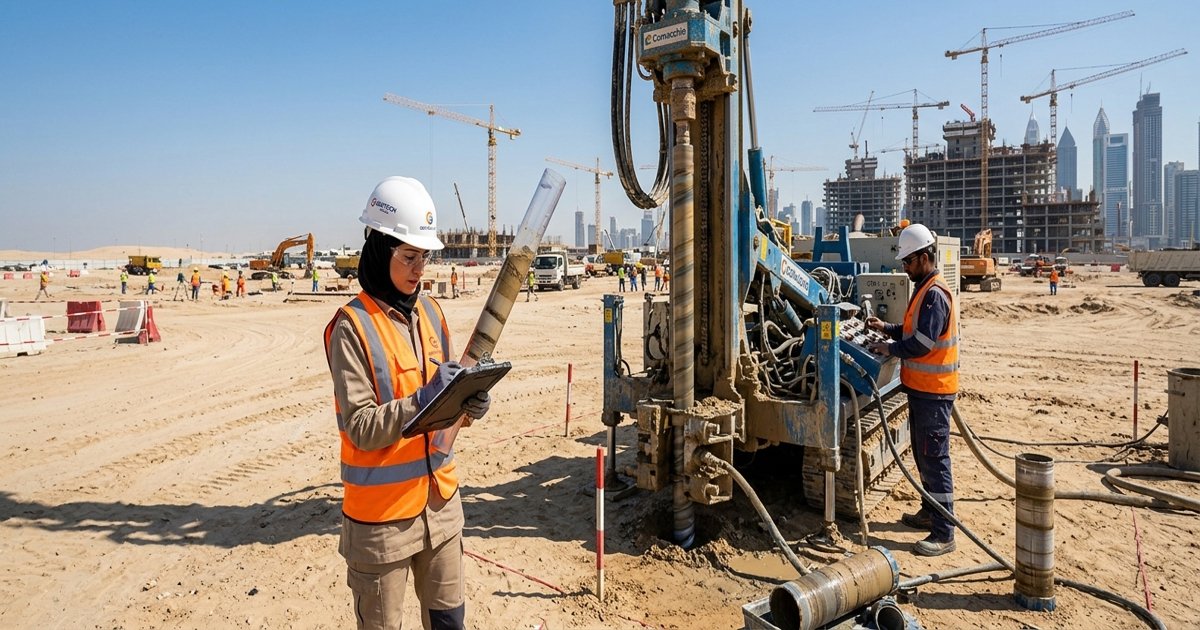
Soil investigation companies are the unsung backbone of every major construction project in the UAE. Before a single foundation is poured or a structural beam is raised, the ground beneath must be thoroughly assessed. In a region defined by sandy desert terrain, coastal zones, and complex sub-surface conditions, skipping professional soil testing is not just risky. It is a regulatory and engineering failure waiting to happen. This blog explores exactly why UAE construction projects cannot afford to overlook professional geotechnical investigation.
Key Takeaways
- Soil investigation companies provide essential data that determines foundation design, structural safety, and material selection for every construction project in the UAE.
- Soil testing in Dubai and across the Emirates is required for regulatory compliance and is critical given the region’s unique sandy, saline, and coastal ground conditions.
- Partnering with an EIAC-accredited testing laboratory ensures results are legally recognized, technically accurate, and accepted by UAE authorities.
The Unique Ground Conditions That Make Soil Investigation Non-Negotiable in UAE
The UAE’s landscape presents some of the most challenging ground conditions for construction engineers. Soil investigation companies operating in this region regularly encounter sabkha soils, which are salt-rich and highly compressible. These soils can collapse under load, corrode steel reinforcement, and deteriorate concrete foundations at an accelerated rate.
Beyond sabkha, the UAE also features loose aeolian sands, high groundwater tables in coastal areas, and areas of significant variability in soil bearing capacity across short distances. A site that appears stable on the surface may have dramatically different sub-surface conditions just a few meters below. Without rigorous soil testing, engineers are essentially designing blind. Professional Dubai Municipality guidelines emphasize that geotechnical reports are a mandatory part of building permit submissions, reinforcing how seriously local authorities treat ground assessment requirements.
Understanding these local conditions requires more than generic testing protocols. It demands engineers and laboratories with direct field experience across UAE terrain types, from coastal reclaimed land to inland desert formations. This local expertise is what separates credible soil investigation companies from those applying a one-size-fits-all methodology.
What Professional Soil Investigation Companies Actually Do
Many project stakeholders assume soil investigation is a simple process. In reality, it is a multi-stage technical discipline that directly influences every downstream engineering decision on a project site.
Borehole Drilling and Sample Collection
The first stage of soil investigation involves drilling boreholes at strategic locations across the site. These boreholes can extend to significant depths depending on the proposed structure. Soil samples are extracted at different depths and preserved carefully for laboratory analysis. The number of boreholes and their depths are determined by the size of the structure, the type of foundation proposed, and the perceived risk level of the site. Experienced soil investigation companies deploy qualified geotechnical engineers to supervise field operations and ensure samples are collected, labeled, and transported in a manner that preserves their integrity for laboratory analysis.
Laboratory Soil Testing and Analysis
Once samples are collected, they are sent to an accredited laboratory for soil testing. Tests typically include grain size analysis, Atterberg limits testing, consolidation testing, shear strength assessment, and chemical analysis for sulfate and chloride content. In the UAE, chemical testing is particularly critical because high sulfate levels in the soil can attack concrete foundations, leading to long-term structural degradation if not accounted for in the mix design. The quality and precision of these laboratory tests are what ultimately determine the reliability of the geotechnical report that guides foundation engineering.
Foundation Assessment and Geotechnical Reporting
The data gathered from borehole drilling and laboratory testing is compiled into a geotechnical investigation report. This report includes soil profiles, bearing capacity recommendations, settlement predictions, and foundation type recommendations. Structural and civil engineers rely on this report to finalize foundation designs. Without it, any design decisions made are based on assumptions rather than verified engineering data. Developers who engage competent soil investigation companies at the earliest stage of project planning benefit from a complete and authority-ready geotechnical submission that prevents delays at the permit approval stage.
Why Soil Testing in Dubai Requires Specialized Local Expertise
Soil testing in Dubai is not the same as soil testing in temperate or stable geological environments. Local expertise matters enormously. Engineers and laboratory technicians who understand Dubai’s specific soil behavior, the influence of the Arabian Gulf’s salinity on coastal sites, and the regulatory framework of the Dubai Municipality are far better equipped to deliver useful geotechnical reports.
Local soil investigation companies with experience in Dubai understand how to interpret results in the context of regional conditions. They know which tests are most relevant, how to sample from sabkha layers correctly, and how to present findings in formats accepted by local authorities and engineering consultants. A standardized or generic investigation program cannot address the level of variability found across UAE construction sites.
Furthermore, construction projects in Dubai range from high-rise towers in dense urban zones to villa communities built on reclaimed land. Each project type demands a different investigation approach, and only experienced local teams possess the contextual knowledge to scope investigations appropriately and deliver reports that meet the specific expectations of Dubai’s regulatory bodies.
The Role of EIAC Accreditation in Soil Investigation Credibility
Not all testing laboratories are equal. In the UAE, the Emirates International Accreditation Centre, known as EIAC, provides the benchmark for laboratory quality and technical competence. When soil investigation companies operate an EIAC-accredited laboratory, it means their testing procedures, equipment calibration, staff qualifications, and reporting standards have been independently verified to meet international standards.
For construction project owners, developers, and consultants, choosing an EIAC-accredited laboratory is not just about quality. It is about legal and contractual protection. Geotechnical reports produced by non-accredited laboratories may be rejected by regulatory authorities, adding costly delays and rework to a project timeline. Accreditation is therefore not a bonus feature. It is a baseline requirement for credible soil testing in the UAE market.
How Soil Investigation Protects Long-Term Structural Safety
The consequences of skipping or poorly executing soil investigation are not always immediate. They often manifest years or even decades after construction is complete. Differential settlement, where different parts of a building settle at different rates due to uneven soil conditions, is a common result of inadequate site investigation. This can cause cracking in structural elements, misalignment of floors, and in severe cases, instability of the entire structure.
In the UAE’s aggressive environment, chemically aggressive soils that go undetected during construction can attack concrete and steel reinforcement beneath the surface. Over time, this leads to spalling concrete, corroded rebar, and a significant reduction in the service life of the structure.
Professional soil investigation companies identify these risks before construction begins. Their findings allow engineers to specify the right concrete mix with sulfate-resistant cement, choose appropriate waterproofing membranes, and design deep pile foundations where shallow foundations would be insufficient. This proactive approach is the only way to build structures that will perform safely and durably over their intended lifespan.
Soil Investigation as a Compliance Requirement for UAE Projects
Beyond engineering logic, soil investigation is a compliance obligation for most construction projects in the UAE. The UAE Fire and Life Safety Code, Dubai Municipality Building Regulations, and Abu Dhabi Department of Urban Planning and Municipalities all include provisions that require geotechnical assessments as part of the design approval process.
Contractors and developers who bypass this step face project suspensions, permit rejections, and in cases where structural failures occur, significant legal liability. The cost of a thorough soil investigation is a fraction of the cost of regulatory non-compliance or post-construction remediation.
Working with established soil investigation companies that understand the regulatory landscape in the UAE ensures that investigation programs are scoped correctly, reports are formatted to meet authority requirements, and all submissions are complete from day one. This regulatory competence is as valuable as the technical testing itself, particularly on fast-track projects where permit approval timelines are tight.
Conclusion
Soil investigation companies are not an optional service provider in UAE construction. They are a fundamental partner in the engineering and regulatory process. From identifying sabkha soils and aggressive chemical conditions to providing bearing capacity data for foundation design, professional soil testing is what separates safe, compliant infrastructure from costly, high-risk guesswork. For developers, contractors, and consultants working on projects across Dubai and the wider UAE, partnering with a credible, EIAC-accredited geotechnical laboratory is a decision that protects both the structure and the business behind it. To learn more about professional geotechnical and material testing services available in the UAE, visit ETS Middle East and explore how their accredited laboratory team supports construction projects from initial investigation through to completion.
Frequently Asked Questions
What do soil investigation companies do before construction begins?
Soil investigation companies conduct borehole drilling, collect soil samples at multiple depths, and perform laboratory tests to assess bearing capacity, settlement risk, and chemical properties. Their reports guide foundation design decisions and are a mandatory submission for most construction permit applications in the UAE.
Why is soil testing in Dubai different from other regions?
Soil testing in Dubai involves identifying locally specific challenges like sabkha soils, high salinity, and aggressive sulfate content. These conditions are uncommon in temperate climates. Local expertise ensures tests are scoped correctly and results are interpreted in line with Dubai’s unique geotechnical environment and regulatory requirements.
Is soil testing mandatory for all construction projects in the UAE?
Yes, geotechnical investigation reports are required by Dubai Municipality and other UAE regulatory authorities as part of building permit submissions. Without an approved soil investigation report, construction permits for most building types will not be granted, causing significant project delays and potential legal complications.
What is sabkha soil and why is it a concern for builders?
Sabkha is a salt-rich, compressible soil type common in UAE coastal and desert areas. It is prone to collapse under structural loads and its high sulfate content can chemically attack concrete and corrode steel reinforcement. Identifying sabkha during site investigation allows engineers to design appropriate and targeted mitigation measures.
How does EIAC accreditation affect the quality of soil testing results?
EIAC accreditation means a laboratory’s testing methods, equipment, and staff qualifications have been independently verified against international standards. Reports from EIAC-accredited laboratories are accepted by UAE regulatory authorities, while non-accredited lab results may be rejected, making accreditation a baseline requirement for credible geotechnical testing services in the UAE.
What laboratory tests are typically conducted during soil investigation?
Standard soil testing includes grain size analysis, Atterberg limits, consolidation tests, direct shear tests, and chemical analysis for sulfate and chloride content. In the UAE, chemical testing is especially important because aggressive soil chemistry directly affects concrete durability and the long-term performance of underground structural elements.
How many boreholes are needed for a construction site investigation?
The number of boreholes depends on the site area, the type and size of the proposed structure, and the variability of sub-surface conditions. A qualified geotechnical engineer determines the borehole layout and depths. Larger or more complex projects typically require a greater number of boreholes to produce a reliable soil profile.
Can poor soil investigation lead to structural problems after construction?
Yes. Inadequate soil investigation can result in differential settlement, foundation failure, and chemical deterioration of concrete and steel over time. These problems often emerge years after construction is complete, making remediation extremely costly. Thorough site investigation before construction is the most effective way to prevent these long-term structural risks.
What types of construction projects require professional soil investigation in the UAE?
High-rise towers, residential communities, bridges, roads, industrial facilities, and infrastructure projects all require professional soil investigation. Even smaller residential buildings in areas with known problematic soils should undergo a geotechnical assessment by qualified soil testing specialists to ensure the safety and longevity of the proposed structure.
How long does a soil investigation process typically take?
The duration of soil investigation depends on the scale of the project and the number of boreholes required. Field work for a standard project may take several days to a few weeks. Laboratory analysis and report preparation add additional time. Engaging an experienced geotechnical team early in the project timeline helps avoid permit submission delays.