

In Dubai, no foundation design moves forward without a soil investigation report, and the Dubai Municipality bylaw on building requirements spells out who prepares it, who witnesses it and which codes it follows. What is changing across the Gulf is timing. Employers and consultants increasingly want that evidence before contractors price the work, not after the contract is signed.
For contractors and developers comparing geotechnical testing services UAE providers, the question shifts from who can test cheapest to who can deliver defensible data early enough to shape a tender. If you are preparing a 2027 bid, talk to our testing team before the tender documents close.
This article explains what the rules already require, why claims data is pushing testing earlier, which specialty tests belong in a tender pack, and how to plan a programme that holds up in review.
Key Takeaways
- Dubai’s building bylaw already requires a soil investigation report prepared by a licensed geotechnical engineer, approved and witnessed by the consultant.
- Global claims data from 2025 shows disputed sums averaging about a third of contract budgets, and Middle East projects carry longer time extensions than the rest of the world.
- Specialty testing before tender, including chemical, groundwater and materials checks, gives every bidder the same baseline and narrows the room for ground condition claims.
What Gulf Regulations Already Demand Before Construction
The legal baseline is not new. What matters is reading it closely, because it already defines who is accountable for ground data and how that data must be produced.
Administrative Resolution No. 37 of 2021 amends Dubai’s building bylaw and sets out firm geotechnical rules. The soil investigation report and geotechnical design must be prepared by a qualified geotechnical civil engineer licensed to practise. Every report submitted by the testing laboratory must be approved by the consultant, who must also witness and supervise the investigation.
The resolution names the codes too. Soil investigation follows Eurocode 7, BS 5930, BS 1377 and BS 10175 for potentially contaminated sites, alongside ASTM and AASHTO methods. Work must also comply with the requirements of the Emirates International Accreditation Centre.
The report itself must cover recommended foundation type, allowable bearing capacity, settlement, seismic parameters for the upper 30 metres and pile capacities. Standard penetration test values must be recorded every 0.5 metres for the first 3 metres and every metre after that. Our guide to what a ground investigation report must contain walks through each section.
Why Claims Data Is Pushing Testing Into the Tender Stage
The strongest argument for earlier testing is commercial. Recent dispute research shows how much money and time is lost when project assumptions prove wrong after award.
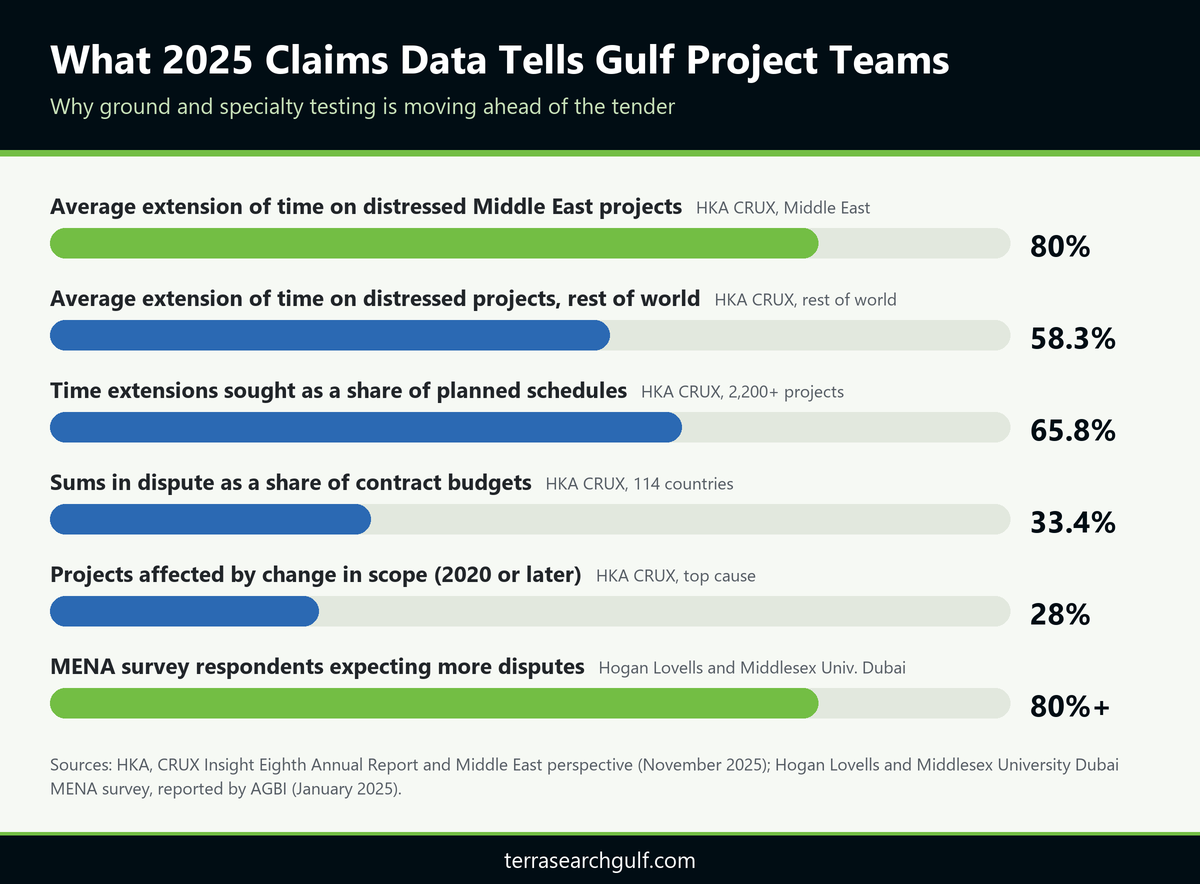
HKA’s CRUX Insight Eighth Annual Report, published in November 2025, analysed more than 2,200 projects worth US$2.43 trillion across 114 countries. Sums in dispute averaged 33.4% of contract budgets, and time extensions sought by contractors reached 65.8% of planned schedules. Change in scope remained the most common cause of conflict, affecting just over 28% of projects due to finish in 2020 or later.
The Gulf feels this more sharply. HKA’s Middle East perspective on the same dataset covers 531 regional projects in 12 countries. It reports average extensions of time of 80% on distressed Middle East projects, against 58.3% for the rest of the world. In a regional survey reported by AGBI, more than 80% of 95 MENA contractors and developers expected disputes to rise over the next three years.
Ground conditions are a classic trigger. When the soil a contractor meets differs from what the tender data suggested, time and cost claims follow. Testing earlier narrows that gap before prices are fixed.
For employers, the arithmetic is simple. A focused investigation costs a small fraction of a contract that could see a third of its budget in dispute. For contractors, shared data means sharper pricing and fewer contingencies hidden in the rates.
The Specialty Tests That Belong in a Pre-Tender Pack
Boreholes and penetration logs are the starting point, but Gulf sites often need more before a bidder can price with confidence. Specialty testing fills the gaps that routine classification leaves open.
- Soil and groundwater chemistry. Chloride and sulphate levels drive concrete class, cover and protection. A chloride and sulphate profile at tender stage prevents late specification changes.
- Contamination screening. BS 10175 applies to potentially contaminated sites, and reclaimed or previously industrial plots often need it.
- Environmental baselines. Air, water and soil quality data supports approvals and protects the employer if conditions are later disputed. Our specialty and environmental testing scope covers these.
- Existing structures. Where a project extends or reuses a structure, steel testing and NDT show what the tender is really building on.
- Source materials. Construction materials testing on aggregates and fill confirms that local supply meets specification before quantities are priced.
When shortlisting a soil investigation and testing company Dubai 2027 bidders can rely on, ask whether all of these can be scoped under one coordinated programme. The best geotechnical testing services UAE employers use combine field, laboratory and chemistry work so results arrive together.
How Ground Risk Is Shared Once Data Is on the Table
Testing does not remove ground risk. It clarifies who carries it, and that clarity is what a pre-tender programme is really buying.
As HKA’s analysis of unforeseeable ground conditions explains, standard forms such as the FIDIC 2017 Red and Yellow Books deal with unforeseeable physical conditions under Sub-Clause 4.12. Whether a condition was foreseeable is often open to interpretation. The same article notes that even rigorous investigation cannot rule out soil behaving differently at a given point.
That is exactly why early data matters. When the employer issues factual test results with the tender, every bidder prices from the same record. Claims then turn on whether conditions differed from that shared record, not on competing guesses. Contractors gain clarity, and employers gain a defensible position if a dispute arises.
The value of that record depends on how it was produced. Our explainer on how accreditation works in Dubai shows why an accredited scope matters when results may end up in front of an expert.
Planning a Pre-Tender Testing Programme for 2027
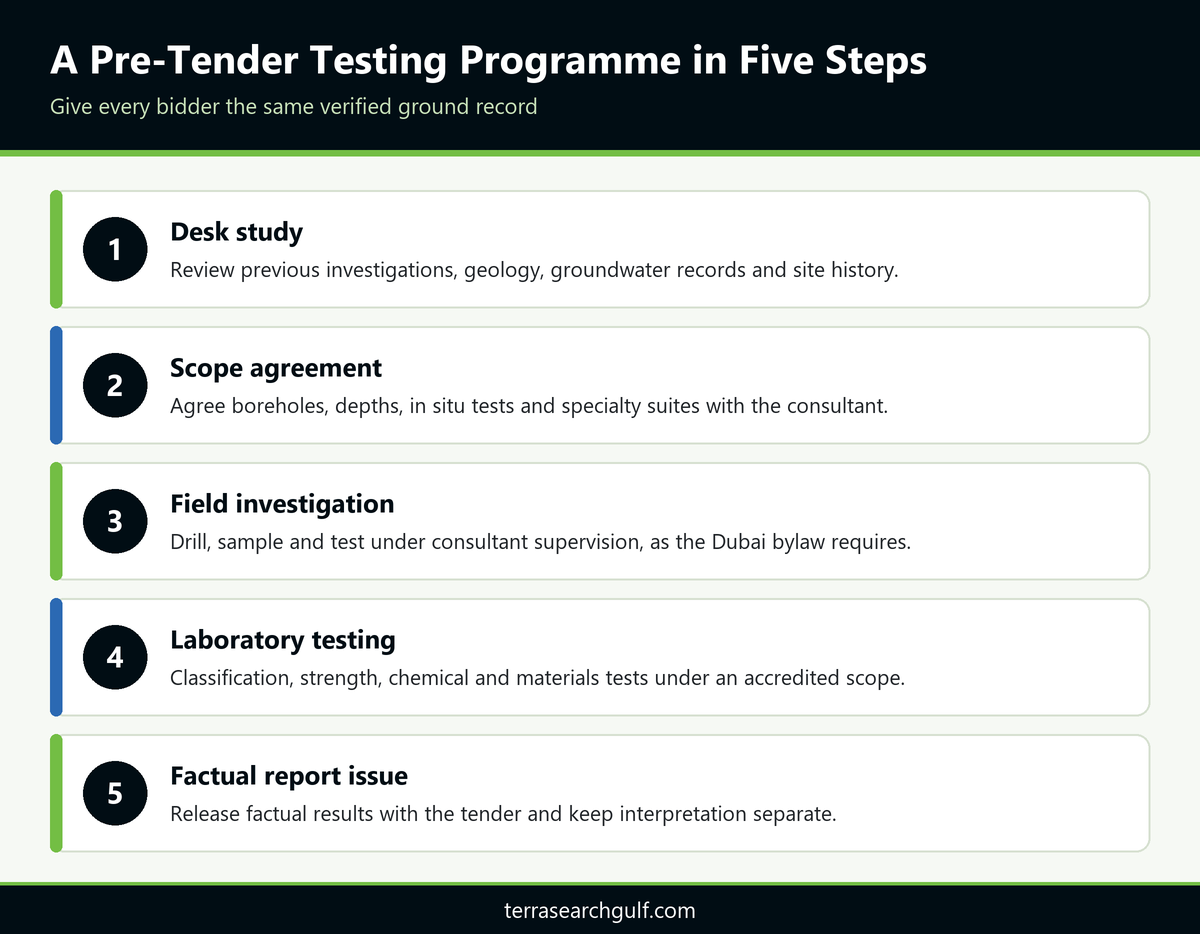
The outlook for 2027 is clear even without a single new regulation. Employers want evidence earlier, and bidders want fewer surprises. A practical programme follows five steps.
- Desk study. Review previous investigations, geology, groundwater records and site history.
- Scope agreement. Agree borehole numbers, depths, in situ tests and specialty suites with the consultant.
- Field investigation. Drill, sample and test under consultant supervision, as the Dubai bylaw requires.
- Laboratory testing. Run classification, strength, chemical and materials tests under an accredited scope.
- Factual report issue. Release factual results with the tender documents and keep interpretation separate.
Build time for this into the procurement plan. Chemistry and strength tests need curing and turnaround, so the programme should start well before the tender goes out. Contractors who only begin searching for a material testing laboratory near me UAE at bid stage often find the timeline is already too tight.
Contractors can apply the same logic from the other side. Before submitting a price, check whether the tender includes factual test results, which standards were used, and whether the laboratory held an accredited scope for them. Where the pack is thin, raise it through tender clarifications rather than absorbing the risk in your rates. Working with geotechnical testing services UAE consultants already recognise also makes supplementary testing quicker to arrange.
Build the Evidence Before You Build the Project
Specialty testing is moving from a post-award formality to a pre-tender expectation across the Gulf. Dubai’s bylaw already fixes who prepares and witnesses soil investigations, and 2025 claims data shows how costly late surprises remain. Choosing geotechnical testing services UAE bidders can trust at tender stage gives everyone the same baseline and protects the programme.
Terrasearch Gulf runs geotechnical investigation, chemistry and specialty testing from its laboratory in Al Ttay, Dubai. Share your tender timeline with us and we will help you scope the right tests.