


Almost every laboratory in the UAE describes itself as accredited. Very few clients check what that word covers, and the gap between the claim and the scope behind it is where rejected results come from.
Accreditation is not a badge a company holds in general. It is a formal recognition, granted against a declared list of specific tests and methods, that a laboratory is technically competent to perform those tests. This guide explains what the recognition covers, how it differs from certification and from municipal approval, how to verify it yourself, and how to read a test certificate so that results are accepted the first time they are submitted.
Key Takeaways
- Accreditation is granted against a declared scope. A laboratory can be accredited for some tests on your schedule and not others.
- Accreditation, certification and municipal approval are three different things. A project may require more than one of them.
- The accreditation body for Dubai is EIAC, which was known as the Dubai Accreditation Department until 2018 and operates under Dubai Municipality.
- A certificate is only as good as the scope reference on it. Check the test, the method and the validity date, not the logo.
What Accreditation Actually Is
Accreditation is a third-party attestation that a conformity assessment body is competent to carry out specific tasks. In a laboratory context it means an independent body has assessed the laboratory’s staff competence, equipment, calibration traceability, methods, quality system and results, and formally recognised it as capable of producing valid results for a named list of tests.
The international framework for this is set out in the standard for testing and calibration laboratories, which covers both management requirements and technical requirements. A laboratory is accredited to that standard for a scope, and the scope is the document that matters.
The word accreditation is often used loosely in marketing. Assessed competence for a declared list of tests is what it means technically, and that is the definition an approving authority applies when it looks at your submission.
EIAC, and Why You Still See DAC on Older Documents
The accreditation body for Dubai is the Emirates International Accreditation Centre, usually written as EIAC. It operates under Dubai Municipality and accredits testing and calibration laboratories, inspection bodies, certification bodies and several other categories of conformity assessment body.
It was previously the Dubai Accreditation Department, commonly abbreviated to DAC. The change of name took effect in September 2018 and was recorded by the international laboratory accreditation cooperation. The organisation and its accreditations continued; only the name changed.
This matters practically, because older specifications, standing project documents and long-lived company profiles still refer to DAC. If your specification asks for a DAC accredited laboratory, EIAC accreditation is what satisfies it. We cover the practical consequences in what happened to the older accreditation name.
EIAC is a signatory to the international mutual recognition arrangement, which is the mechanism by which a result issued under its accreditation is recognised beyond the UAE. Details of its current scope and recognitions are published on the accreditation body’s own site.
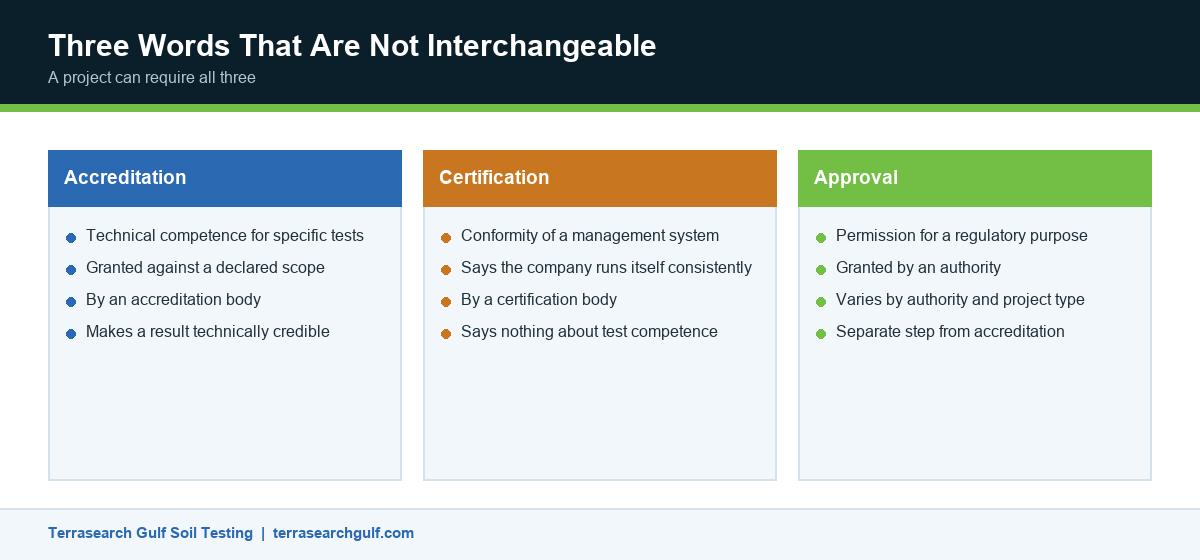
Accreditation, Certification and Approval Are Three Different Things
These three words are used interchangeably in tender documents and they are not interchangeable at all. Getting them confused is one of the more expensive misunderstandings in UAE construction procurement.
Accreditation
An assessment of technical competence to perform specific tests, granted by an accreditation body against a declared scope. This is what makes a test result technically credible.
Certification
An assessment that an organisation’s management system conforms to a standard. A quality management certification says the company manages itself consistently. It says nothing about whether its technicians can run a particular test correctly.
Approval
A permission granted by an authority for a laboratory’s results to be accepted for a particular regulatory purpose. Municipal approval is a separate step from accreditation, and requirements vary by authority, by project type and over time. Our note on the municipal approval route covers what this involves.
A project can require all three. A laboratory that is certified but not accredited for your tests will produce results an authority rejects, and the certificate on the wall will not help.
The Scope Document Is the Only Thing That Matters
Accreditation is granted against a schedule listing specific tests, the standards or methods used, and often the measurement ranges covered. That schedule is public and a laboratory should provide it without hesitation.
Take your own test list and read it against the scope, item by item. The gaps that appear most often are consistent:
- Classification testing accredited, chemical suite not accredited. The chemical results are the ones driving your substructure concrete specification, so this gap is consequential.
- A test accredited to one standard when your specification demands another. The method matters, not just the test name.
- In-situ testing outside the scope even though laboratory testing is inside it.
- A measurement range that does not extend to the values your project will produce.
Then check the validity date, and confirm current status with the accreditation body rather than relying on a scanned certificate. A scope that lapsed six months ago still looks fine as a PDF.
Our note on why the mark on a certificate matters covers the commercial consequence of getting this wrong.
Reading a Test Certificate
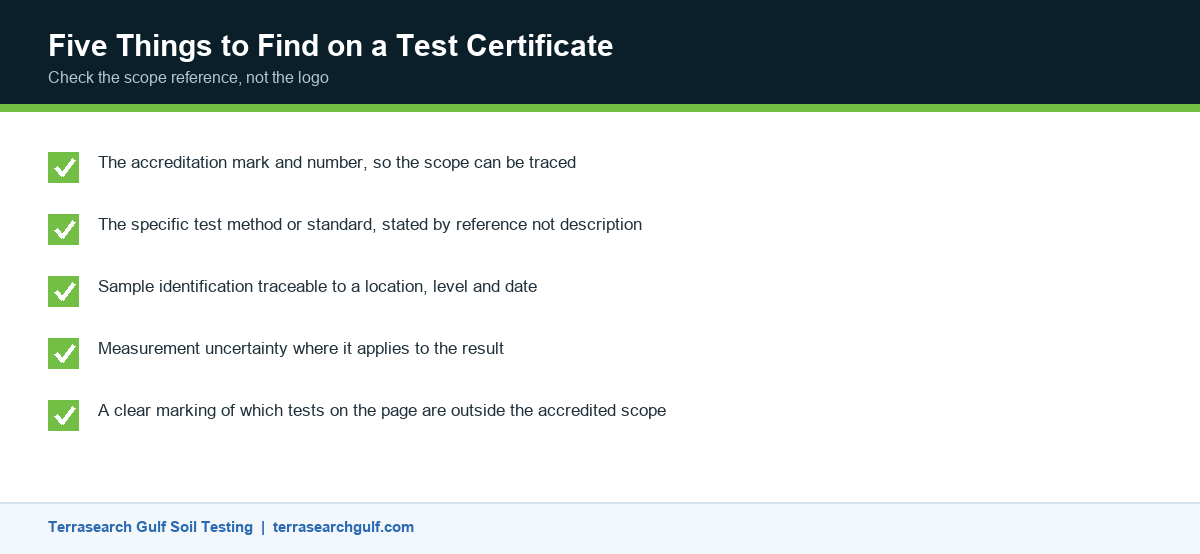
A certificate from an accredited laboratory carries information that an unaccredited one does not. Five things are worth finding every time.
- The accreditation mark and the accreditation number, which let you trace the scope.
- The specific test method or standard used, stated by its reference rather than described loosely.
- The sample identification, traceable back to a sampling record with a location, level and date.
- Measurement uncertainty where it applies, which is a feature of accredited reporting and a useful signal in itself.
- A clear statement of what was and was not covered by the accreditation on that certificate. Laboratories often report accredited and non-accredited tests on the same page, and they must be distinguishable.
That last point catches people out. It is entirely legitimate for a laboratory to report a test outside its accredited scope, provided it is marked as such. It is not legitimate for the reader to assume everything on an accredited laboratory’s letterhead is accredited.
Where Third-Party Independence Fits
Accreditation addresses competence. Independence is a separate property, and on many projects the specification requires both.
A third-party laboratory has no commercial interest in the result. That is structurally different from testing performed by the contractor placing the material or by a supplier verifying their own product, however competent either may be. For high-consequence verification, specifications commonly require the testing body to be independent of both.
Inspection is a further distinct activity from testing, with its own accreditation category, and independent verification and witness work is often specified alongside laboratory testing rather than instead of it.
In practice the combination that satisfies most UAE specifications is an independent laboratory, accredited for the specific tests on the schedule, whose results are accepted by the relevant authority for the project. Confirm all three rather than assuming one implies the others.
What This Means When You Are Commissioning Testing
Four steps, in order, remove almost all the risk.
- Write out your actual test list before approaching anyone, derived from the specification rather than from a previous project.
- Ask each laboratory for its scope document and check your list against it test by test.
- Confirm current validity with the accreditation body directly.
- Confirm separately what the approving authority for your project requires, because accreditation and acceptance are not the same question.
For the wider procurement conversation, how to weigh one provider against another covers the technical comparison and our procurement checklist for contractors covers the commercial terms. For what a full-scope engineering laboratory actually runs, see the range a complete facility covers.
Frequently Asked Questions
What does EIAC stand for?
Emirates International Accreditation Centre. It is the accreditation body operating under Dubai Municipality, and it assesses laboratories, inspection bodies and certification bodies against international standards.
Is DAC the same as EIAC?
Yes. The Dubai Accreditation Department, abbreviated DAC, was renamed the Emirates International Accreditation Centre in September 2018. Accreditations continued through the change. Specifications that still ask for DAC accreditation are satisfied by EIAC accreditation.
Is accreditation the same as ISO certification?
No. Accreditation assesses technical competence to perform specific tests against a declared scope. Certification assesses conformity of a management system. A company can hold a management system certification and have no test accreditation at all.
How do I check whether a laboratory is really accredited?
Ask for the scope document, check your test list against it item by item, then confirm current status with the accreditation body rather than relying on a scanned certificate.
Can an accredited laboratory report unaccredited tests?
Yes, and it is legitimate provided they are clearly marked as outside the accredited scope. The risk is on the reader who assumes everything on the letterhead is accredited.
Does accreditation guarantee my results will be accepted?
It is usually necessary and not always sufficient. The approving authority may have its own approval or registration requirement in addition. Confirm both for your specific project and authority.
What is measurement uncertainty and why is it on the certificate?
It is the quantified range within which the true value is expected to lie. Reporting it is a feature of accredited testing, and its presence is a reasonable signal that the result came from a properly controlled process.
Do international accreditations count in the UAE?
Often, through mutual recognition arrangements between accreditation bodies. Whether a particular foreign accreditation satisfies a particular UAE authority is a question for that authority, not a general rule.
Why do some laboratories hold several accreditations?
Because scopes are granted per activity. A body testing materials, calibrating equipment and performing inspections needs separate recognition for each, since the standards governing them differ.
What should I do if a result is rejected by the authority?
Find out whether the rejection was about the accreditation scope, the method used, the sampling record or the reporting format. Each has a different remedy, and repeating the test without diagnosing the cause usually repeats the rejection.
Check the Scope, Not the Logo
Accreditation is specific, documented and verifiable. The single habit that prevents most rejected submissions is reading the scope document against your own test list before commissioning anything, and confirming separately what the approving authority requires.
Terrasearch Gulf operates an accredited laboratory in Dubai covering geotechnical, construction materials, chemical and structural testing. Ask us for our scope document and check it against your schedule before you commit.