

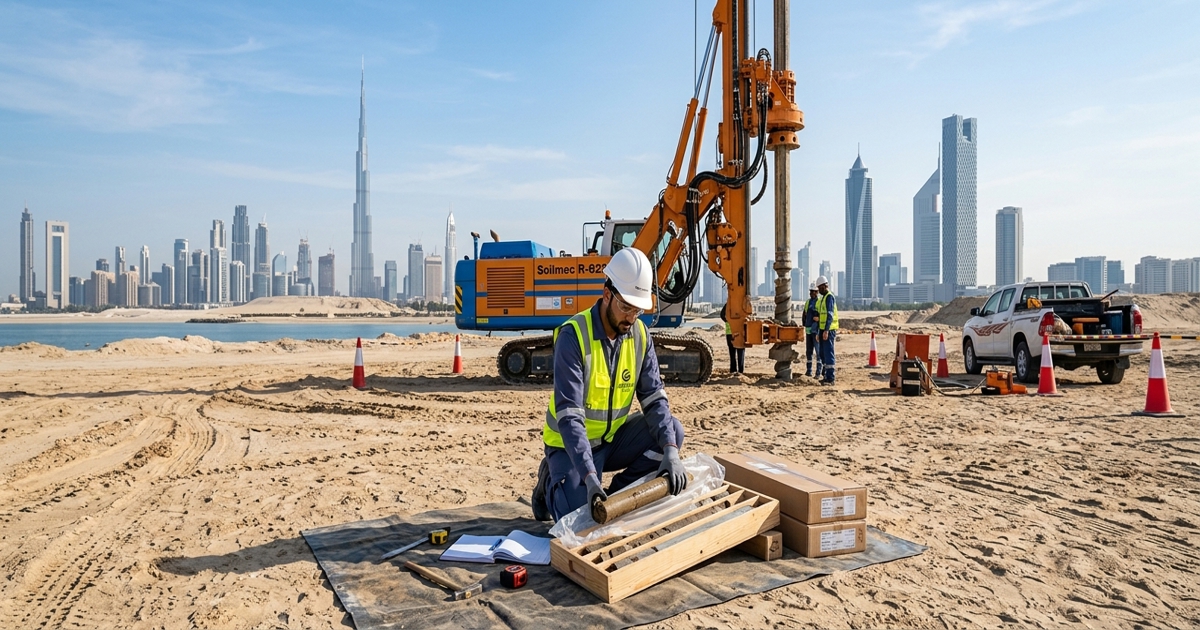
Geotechnical investigation UAE projects require thorough subsurface analysis before any foundation is laid. Without it, construction teams are essentially building on assumptions. This guide explains what geotechnical investigation involves, why it is critical for safe construction across the UAE, and how working with an accredited laboratory like Terrasearch Gulf ensures your project meets regulatory requirements and engineering standards from day one.
Key Takeaways
- Geotechnical investigation UAE is a mandatory step before foundation design and construction begins on any significant project, helping identify weak soils, groundwater levels, and geological hazards early.
- Ground investigation UAE methods such as borehole drilling and soil sampling reveal subsurface conditions that directly influence structural safety and foundation design decisions.
- Partnering with an EIAC-accredited laboratory like Terrasearch Gulf ensures your site investigation UAE results are credible, compliant, and accepted by UAE regulatory authorities.
What Is Geotechnical Investigation and Why Does It Matter in the UAE?
Geotechnical investigation is the process of evaluating the physical and mechanical properties of soil and rock at a construction site. Engineers use this data to design foundations that are safe and cost-effective. In the UAE, where construction occurs on diverse terrain ranging from coastal sabkha soils to desert sand, understanding subsurface conditions is especially critical.
The UAE’s rapid infrastructure growth means that new buildings, roads, bridges, and utilities are constantly being developed. Each of these projects carries significant risk if the ground beneath is not properly assessed. Poorly understood soil conditions can lead to differential settlement, structural distress, and costly remediation work that could have been avoided with proper site investigation UAE practices.
According to the Transportation Research Board, foundation failures are among the most expensive construction problems to fix after a structure is built. This makes pre-construction ground investigation not just a best practice but a financial necessity.
Key Methods Used in Ground Investigation UAE Projects
There are several methods used during ground investigation UAE projects, each providing specific types of data about subsurface conditions. Selecting the right combination of methods depends on the project type, site conditions, and the depth of investigation required.
Borehole Drilling and Soil Sampling
Borehole drilling is one of the most widely used techniques in geotechnical investigation. It involves drilling into the ground at strategic locations across the site and extracting soil samples at various depths. These samples are then sent to a laboratory for analysis. The data collected helps engineers understand soil layering, density, moisture content, and bearing capacity. For large projects in Dubai and across the UAE, multiple boreholes are typically required to capture variability across the site.
Standard Penetration Test (SPT) and In-Situ Testing
The Standard Penetration Test is a common in-situ test performed inside boreholes to measure soil resistance. The results help engineers classify soil types and estimate their engineering properties. Other in-situ methods include cone penetration tests and vane shear tests, each suitable for different soil conditions. These field tests complement laboratory analysis and provide real-time data about how the soil behaves under load.
Laboratory Soil Analysis
Once samples are retrieved, they undergo detailed laboratory testing. Tests typically include particle size distribution, Atterberg limits, consolidation tests, and shear strength measurements. This laboratory data is essential for foundation design calculations. Terrasearch Gulf provides comprehensive geotechnical investigation services in the UAE that cover both field and laboratory phases, ensuring a complete picture of site conditions.
How Site Investigation UAE Supports Foundation Design
Foundation design is directly driven by geotechnical data. Without reliable subsurface information, engineers must apply overly conservative assumptions, which increases material costs, or they underestimate risk, which threatens structural safety. Proper site investigation UAE eliminates guesswork from foundation engineering.
For example, in coastal areas of Dubai, sabkha soils are common. These soils are highly compressible and often contain salt, which can be aggressive toward concrete and steel. Identifying sabkha layers early through borehole investigation allows engineers to specify appropriate foundation types such as deep piles and corrosion-resistant materials, saving significant remediation costs later.
Similarly, understanding groundwater depth and fluctuation is critical for basement construction and underground utilities. A thorough ground investigation provides all the data needed to make informed design decisions. The Institution of Civil Engineers consistently emphasizes that site investigation is the single most important investment in reducing construction risk.
Geo Technical Investigation Companies Dubai: What to Look for When Choosing a Partner
Not all geo technical investigation companies Dubai offer the same level of service. When selecting a partner for your project, the following criteria are essential to consider.
- EIAC Accreditation: Your testing laboratory must hold accreditation from the Emirates International Accreditation Centre. This ensures test results are recognized by UAE regulatory bodies and government authorities.
- Experienced Technical Team: Look for companies with qualified geotechnical engineers and laboratory technicians who understand local soil conditions and UAE construction standards.
- Comprehensive Service Range: The best partners handle the full scope of investigation, from field drilling and sampling to laboratory analysis and final reporting.
- Reliable Reporting: Clear, detailed geotechnical reports that meet project and regulatory requirements are essential for design and approval processes.
- Track Record on Similar Projects: Experience with projects of similar scale, soil type, and complexity in the UAE is a strong indicator of capability.
Terrasearch Gulf meets all of these criteria as an EIAC-accredited laboratory based in Dubai. The company supports construction projects across the UAE with field investigation, soil testing, and detailed reporting that construction firms and consultants can rely on.
Why Terrasearch Gulf Is the Best Choice for Geotechnical Investigation in the UAE
Terrasearch Gulf stands out among geo technical investigation companies Dubai for several reasons. As an EIAC-accredited testing laboratory, its results carry the authority needed for regulatory approvals across Dubai and the wider UAE. This accreditation is not a formality. It represents a commitment to technical accuracy, procedural compliance, and quality management that clients can depend on.
The company provides end-to-end geotechnical investigation services, covering borehole drilling, in-situ testing, and laboratory soil analysis under one roof. This integrated approach reduces coordination overhead for project managers and ensures consistency between field data and laboratory results.
Terrasearch Gulf also supports a wide range of related testing needs. For projects that require structural assessment, the team offers structural testing and analysis services in the UAE that complement geotechnical findings. For road and pavement projects, the laboratory conducts asphalt testing in the UAE to verify material quality. This breadth of capability makes Terrasearch Gulf a comprehensive quality assurance partner for complex infrastructure projects.
The team understands the specific challenges of constructing in UAE conditions, including sabkha soils, high groundwater tables, and aggressive chemical environments. This local expertise allows Terrasearch Gulf to provide geotechnical reports that are not only technically rigorous but also practically useful for design teams working in this region.
The Role of Geotechnical Reports in Regulatory Compliance
In the UAE, regulatory authorities including Dubai Municipality require geotechnical reports as part of the building permit process. These reports must be prepared by qualified engineers and supported by laboratory test data from accredited facilities. A geotechnical report that lacks EIAC-accredited test results may not be accepted, causing project delays.
Working with Terrasearch Gulf ensures that all laboratory data included in your geotechnical report meets accreditation requirements. This reduces the risk of report rejection and keeps your project timeline on track. For projects that also involve construction material verification, Terrasearch Gulf offers construction materials testing services in the UAE to support compliance across multiple project phases.
Conclusion
Geotechnical investigation UAE is not optional. It is a foundational requirement for any construction project that aims to be safe, compliant, and cost-effective. From borehole drilling and in-situ testing to detailed laboratory soil analysis, every phase of the investigation contributes to better engineering decisions. Choosing the right partner is critical, and Terrasearch Gulf provides the EIAC-accredited expertise, local knowledge, and comprehensive service range that construction professionals across the UAE need. If you are planning a new project or need to verify existing site conditions, contact Terrasearch Gulf to discuss how their geotechnical investigation services can support your project from ground up.
Frequently asked Questions
What is geotechnical investigation and why is it required in the UAE?
Geotechnical investigation evaluates soil and rock properties at a construction site to support safe foundation design. In the UAE, it is a regulatory requirement for building permits and helps identify soil risks like sabkha layers or high groundwater before construction begins.
What methods are used in ground investigation UAE projects?
Common methods in ground investigation UAE projects include borehole drilling, Standard Penetration Tests, cone penetration tests, and laboratory soil analysis. Each method provides specific data about subsurface conditions that engineers use to design appropriate foundations for the site.
How does site investigation UAE support safer foundation design?
Site investigation UAE reveals soil layering, bearing capacity, groundwater depth, and chemical aggressiveness. This data allows engineers to select the correct foundation type and materials, reducing the risk of settlement, structural distress, or costly repairs after construction is complete.
What are sabkha soils and why are they a concern for construction in Dubai?
Sabkha soils are compressible, salt-rich soils found in coastal UAE areas. They are aggressive toward concrete and steel and can cause foundation settlement. Identifying them through geotechnical investigation services allows engineers to specify appropriate deep foundation solutions before construction begins.
What qualifications should geo technical investigation companies Dubai have?
Geo technical investigation companies Dubai should hold EIAC accreditation, employ qualified geotechnical engineers, and provide comprehensive field and laboratory services. Accreditation ensures test results are accepted by Dubai Municipality and other UAE regulatory authorities during permit and approval processes.
How long does a typical geotechnical investigation take for a UAE construction project?
The duration depends on site size, number of boreholes, and laboratory turnaround. A standard residential project may take one to two weeks, while large infrastructure projects can require several weeks of fieldwork and additional time for laboratory analysis and final report preparation.
Is EIAC accreditation important when selecting a testing laboratory for soil investigation?
Yes. EIAC accreditation is essential because UAE regulatory bodies require test data from accredited laboratories for building permit approvals. Laboratories offering speciality testing services under EIAC accreditation provide results that are technically credible and recognized by authorities across Dubai and the wider UAE.
What is included in a geotechnical investigation report for a UAE project?
A geotechnical report typically includes site description, borehole logs, laboratory test results, soil classification, groundwater information, foundation recommendations, and design parameters. The report must be supported by accredited laboratory data and prepared by qualified engineers to meet UAE regulatory requirements.
Can geotechnical investigation reduce construction costs on UAE projects?
Yes. Identifying poor soil conditions, groundwater levels, and geological hazards before construction allows engineers to make accurate design decisions. This avoids over-engineering, reduces material waste, and prevents expensive remediation work that would otherwise occur if site conditions were discovered during or after construction.
What other testing services complement geotechnical investigation on a UAE project?
Projects often need concrete testing, aggregate testing, steel testing, and asphalt testing alongside geotechnical work. Terrasearch Gulf offers steel testing and NDT services in the UAE and construction material testing, providing a complete quality assurance package for infrastructure and building projects.