

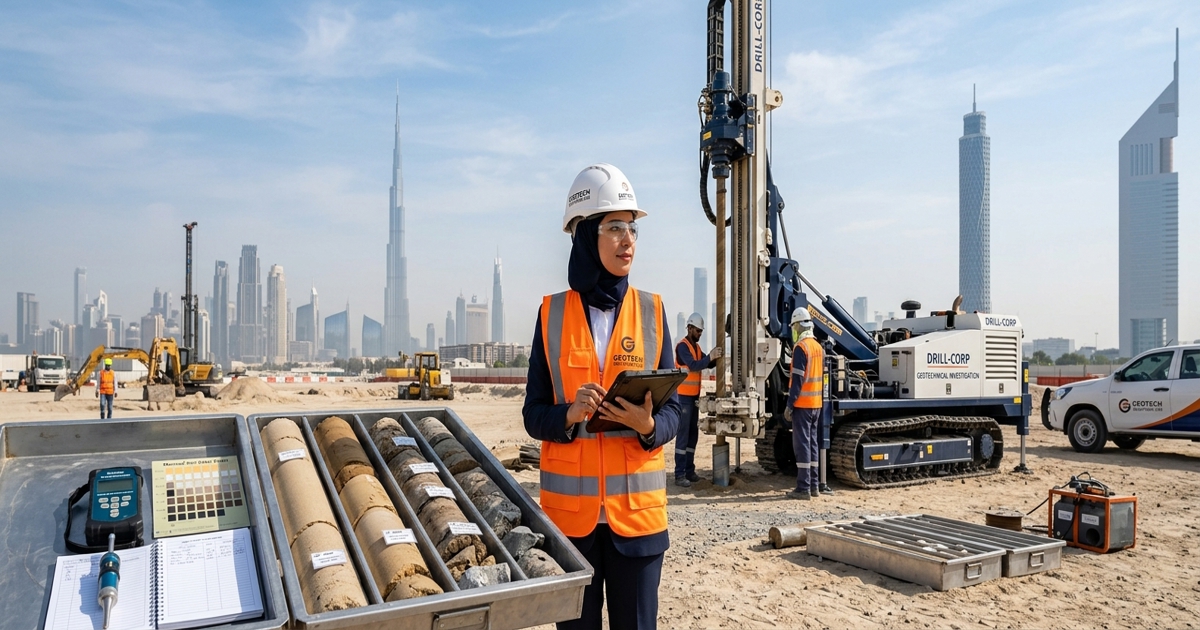
Soil investigation UAE is the first and most critical step before any construction project begins. Without accurate subsurface data, engineers cannot make reliable decisions about foundation design, structural load capacity, or ground stability. In a fast-developing region like the UAE, where mega infrastructure and high-rise developments are constant, skipping or underestimating a thorough soil investigation can lead to costly project failures. This blog explains why professional geotechnical investigation matters, what it involves, and how it supports better engineering outcomes across Dubai and the wider UAE.
Key Takeaways
- Soil investigation UAE provides the subsurface data engineers need to design safe, compliant foundations for construction projects.
- A professional soil investigation in Dubai covers borehole drilling, laboratory analysis, and detailed geotechnical reporting.
- Investing in quality site investigation reduces long-term project risk and supports cost-efficient foundation design.
What Is Soil Investigation and Why Does It Matter in the UAE?
Soil investigation is the systematic process of studying subsurface ground conditions at a construction site. It involves field sampling, borehole drilling, and laboratory testing to understand the physical and chemical properties of the soil. In the UAE, where construction happens on a diverse range of ground types including sandy desert, coastal reclaimed land, and rocky terrain, understanding subsurface conditions is essential.
Without proper soil investigation, engineers are essentially designing foundations blind. The UAE’s construction boom, particularly across Dubai and Abu Dhabi, demands fast-paced project delivery, but speed should never come at the expense of geotechnical accuracy. A proper site investigation informs everything from pile depth to slab thickness, making it one of the most cost-effective investments a project can make upfront.
According to the Institution of Civil Engineers, geotechnical failures account for a significant proportion of structural problems in construction globally, many of which are directly linked to inadequate site investigation data.
Key Components of a Professional Soil Investigation in Dubai
A thorough soil investigation in Dubai typically includes several interconnected stages. Each stage contributes critical data that feeds into the final geotechnical report used by structural and civil engineers.
Borehole Drilling and In-Situ Testing
Borehole drilling is the most common field technique used during soil investigation UAE projects. It involves drilling into the ground at designated points to extract soil and rock samples at various depths. In-situ tests such as Standard Penetration Tests (SPT) are conducted simultaneously to measure soil resistance and bearing capacity.
For large infrastructure projects, multiple boreholes are required at strategic locations across the site. The depth and spacing of boreholes depend on the project scale, structural loads, and expected ground variability. Dubai’s coastal zones and reclaimed areas often reveal complex soil stratification that makes thorough borehole investigation especially important.
Laboratory Soil Analysis and Testing
Once soil samples are collected from the field, they are sent to an accredited geotechnical laboratory for detailed analysis. This is where physical and chemical soil properties are measured. Tests include particle size distribution, moisture content, Atterberg limits, consolidation tests, and shear strength assessments.
For projects near marine environments, chemical testing of soil for sulphate content and chloride concentration is also essential. High sulphate levels in UAE soils can aggressively attack concrete foundations if not accounted for in the mix design. An EIAC-accredited laboratory ensures all testing is conducted to internationally recognized standards, giving engineers and project owners confidence in the data they receive.
Foundation Assessment and Geotechnical Reporting
The final deliverable of a soil investigation is the geotechnical report. This document compiles all field and laboratory data and translates it into engineering recommendations. It typically includes soil profiles, bearing capacity values, settlement predictions, groundwater depth, and foundation design guidance.
A well-prepared geotechnical report becomes a key reference document for structural engineers, contractors, and regulatory authorities. In Dubai, many building authorities require an approved geotechnical report before granting construction permits. This makes the quality and accuracy of the report directly linked to project timelines and approvals.
Why EIAC Accreditation Matters for Soil Investigation UAE
Accreditation is not just a credential. It is a quality assurance mechanism that confirms a laboratory operates according to verified standards and produces reliable, traceable results. The Emirates International Accreditation Centre (EIAC) is the UAE’s national accreditation body. Laboratories accredited by EIAC are regularly assessed for technical competence, calibrated equipment, and procedural compliance.
For soil investigation UAE projects, working with an EIAC-accredited laboratory means all test results are recognized by regulatory bodies, government authorities, and project consultants. This is particularly important when results are submitted as part of permit applications or engineering design packages. Non-accredited laboratory results may not be accepted by Dubai Municipality or other regulatory entities, creating delays and additional costs.
The Emirates International Accreditation Centre maintains a public directory of accredited laboratories, which project teams can use to verify a laboratory’s credentials before engagement.
Common Challenges in Soil Investigation Across UAE Sites
UAE construction sites present unique geotechnical challenges that make professional investigation even more critical. Understanding these challenges helps project stakeholders appreciate the depth and precision required during site investigation.
- Sabkha soils: These salt-bearing, soft soils are common along coastal areas and can cause significant settlement and foundation damage if not identified and treated during the design phase.
- Weak bearing capacity: Sandy and loose soils found across many UAE sites may not support heavy structural loads without proper ground improvement or deep foundation systems.
- High groundwater tables: Particularly in coastal Dubai, high groundwater levels affect excavation planning, dewatering requirements, and concrete durability.
- Chemical aggression: Elevated sulphate and chloride levels in UAE soils can deteriorate concrete and steel reinforcement over time if not addressed in the design specification.
- Subsurface variability: Reclaimed land and urban brownfield sites often have unpredictable soil layers that require detailed and closely spaced investigation points.
How Soil Investigation Supports Better Engineering Decisions
The primary purpose of soil investigation is to reduce uncertainty. Every engineering decision, from pile type selection to foundation depth, is made with greater confidence when it is backed by accurate subsurface data. This directly translates to better project outcomes, including safer structures, fewer design revisions, and more accurate cost estimates.
When soil investigation data is incomplete or unreliable, engineers must apply conservative assumptions that often result in overdesigned foundations. Overdesign increases material and construction costs. On the other hand, underdesign based on poor data can lead to structural distress, remedial works, and significant financial and reputational consequences.
For construction companies, civil engineering firms, and real estate developers operating in the UAE, commissioning a professional soil investigation in Dubai is not just a regulatory requirement. It is a sound business decision that protects project investment from the ground up.
Choosing the Right Geotechnical Investigation Partner in the UAE
Selecting a qualified geotechnical investigation partner involves evaluating accreditation status, technical expertise, equipment capability, and turnaround time. Projects in the UAE should always prioritize EIAC-accredited laboratories to ensure data credibility and regulatory acceptance.
A reliable partner will also provide experienced geotechnical engineers who can interpret field data accurately, prepare technically sound reports, and offer foundation design recommendations that are practical and cost-effective. Transparent communication, clear scope definition, and timely delivery are also important factors when evaluating a geotechnical service provider.
Conclusion
Soil investigation UAE is far more than a regulatory checkbox. It is the technical backbone of every safe and well-designed construction project. From borehole drilling and laboratory soil analysis to geotechnical reporting and foundation assessment, each stage of the investigation process contributes data that shapes engineering decisions. In a dynamic construction environment like the UAE, where ground conditions are highly variable and project stakes are high, investing in professional and accredited soil investigation is essential for protecting structural integrity and project value over the long term.
Frequently Asked Questions
What is soil investigation and why is it important in the UAE?
Soil investigation is the process of analysing subsurface ground conditions before construction. In the UAE, diverse ground types including sabkha, reclaimed land, and sandy soils make professional geotechnical investigation essential for safe and compliant foundation design across all project types.
What does a soil investigation in Dubai typically include?
A soil investigation in Dubai typically includes borehole drilling, in-situ testing such as Standard Penetration Tests, laboratory soil analysis, and a comprehensive geotechnical report with foundation recommendations tailored to the specific site and structural requirements of the project.
How deep do boreholes go during a soil investigation UAE project?
Borehole depth depends on the structural load and site conditions. For typical buildings in the UAE, boreholes range from 10 to 30 metres. For heavy infrastructure or high-rise projects, depths can exceed 50 metres to capture a complete subsurface profile.
Why should I choose an EIAC-accredited laboratory for soil testing in the UAE?
EIAC-accredited laboratories produce results accepted by Dubai Municipality and other regulatory authorities. This ensures your geotechnical data meets official standards and is valid for permit applications and engineering design submissions without risk of rejection or additional retesting costs.
What are sabkha soils and how do they affect construction in the UAE?
Sabkha soils are salt-bearing, soft, and often weak ground materials common in UAE coastal areas. They cause settlement and foundation deterioration if undetected. Proper soil investigation identifies sabkha zones early, allowing engineers to design appropriate ground improvement or deep foundation solutions.
How does soil investigation help reduce construction project costs?
Accurate subsurface data eliminates unnecessary conservative assumptions in foundation design. This avoids overdesign, reduces material waste, and prevents costly remedial works later. Investing in quality geotechnical investigation often results in significant savings across the full project lifecycle and construction programme.
What chemical tests are performed during soil investigation in UAE?
Common chemical tests include sulphate content, chloride concentration, and pH level analysis. These tests are critical in the UAE because high sulphate and chloride levels in local soils can aggressively attack concrete and steel reinforcement, affecting long-term structural durability if not addressed in design.
How long does a soil investigation in Dubai take to complete?
The duration depends on site size, number of boreholes, and laboratory testing requirements. A small residential site may take one to two weeks. Larger infrastructure or commercial projects may require three to six weeks to complete field work, laboratory analysis, and geotechnical report preparation.
Can soil investigation data be used for regulatory permit applications in Dubai?
Yes. Geotechnical reports from EIAC-accredited laboratories are accepted by Dubai Municipality and other UAE regulatory bodies for building permit applications. Reports must comply with local standards and include all required subsurface data, bearing capacity values, and engineering recommendations for the specific site.
What types of construction projects require soil investigation in the UAE?
All major construction projects require soil investigation, including residential towers, commercial developments, road and highway projects, bridges, industrial facilities, and infrastructure works. Even smaller buildings benefit from site investigation to confirm ground suitability and avoid foundation problems that become costly to fix after construction.