

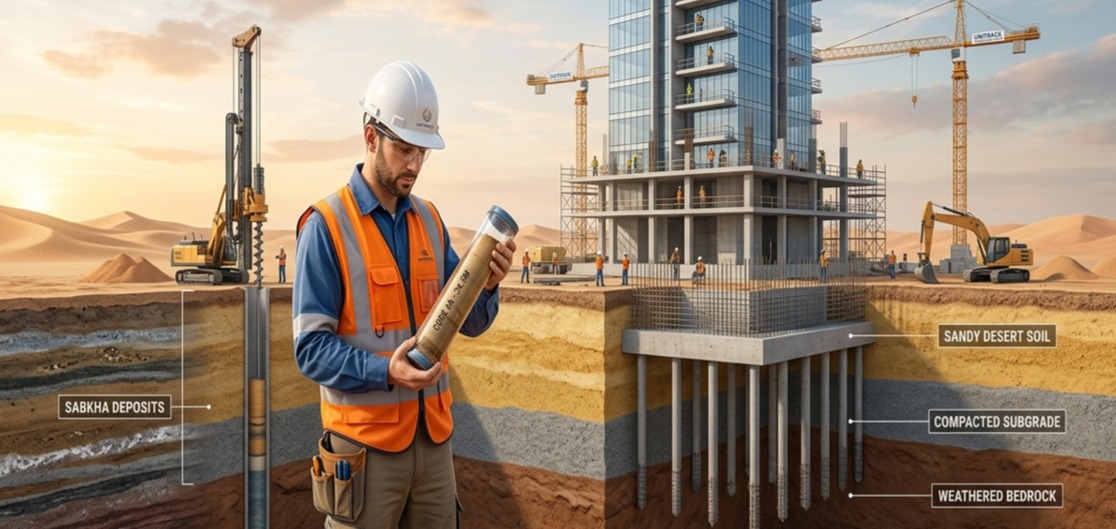
Soil investigation is the backbone of every responsible construction project in the UAE. Before a single column is cast or a foundation is laid, the ground beneath must be thoroughly understood. In a region marked by diverse terrain, from soft coastal sediments to dense desert substrates, skipping this critical step can lead to structural inefficiencies and compliance failures. This blog explores how soil investigation directly supports sustainable construction practices and why it is non-negotiable for modern engineering projects in the UAE. Learn more about comprehensive soil investigation services in the UAE that support every phase of construction planning.
Key Takeaways
- Soil investigation identifies subsurface conditions that directly influence foundation design, structural safety, and resource efficiency in UAE construction projects.
- Soil testing in Dubai and rigorous material testing together ensure regulatory compliance, reduce construction waste, and support long-term infrastructure durability.
- Working with an EIAC-accredited laboratory guarantees that geotechnical and material test results are credible, traceable, and accepted by UAE regulatory authorities.
- Integrating geotechnical data early in the design process enables engineers to minimize material consumption and reduce the environmental footprint of a project.
What Is Soil Investigation and Why Does It Matter in the UAE?
Soil investigation is the systematic process of analyzing subsurface conditions at a construction site. It involves borehole drilling, laboratory soil analysis, and field testing to determine soil composition, bearing capacity, and groundwater levels. In the UAE, where construction activity is among the most intensive in the world, this process is a legal and engineering necessity.
The UAE’s diverse geology presents unique challenges. Coastal areas around Dubai contain soft, compressible soils that behave differently under load compared to the rocky formations found further inland. Without accurate soil investigation, engineers cannot design foundations that are both safe and material-efficient. Oversized foundations waste resources, while undersized ones compromise structural integrity.
Regulatory frameworks in the UAE, including those set by Dubai Municipality and other local authorities, mandate geotechnical assessments for most construction projects. Compliance with these requirements is not optional. An EIAC-accredited laboratory ensures that all testing is conducted to recognized standards, making results legally valid and technically credible.
Why Soil Investigation Is Central to Geotechnical Risk Management
Beyond regulatory compliance, soil investigation is the primary tool for identifying and managing geotechnical risk. Unexpected ground conditions, including loose fill, cavities, or chemically aggressive soils, are among the most common causes of construction delays and cost overruns in the UAE. A thorough investigation at the outset eliminates these surprises and allows project teams to plan with confidence. Discover how geotechnical investigation services at Terrasearch Gulf help project teams manage subsurface risk effectively.
How Soil Testing in Dubai Supports Sustainable Engineering Decisions
Sustainable construction is not only about renewable materials or energy-efficient designs. It is also about making precise, data-driven decisions from day one. Soil testing in Dubai provides the raw data engineers need to minimize material consumption, reduce construction waste, and design structures with longer service lives.
When soil bearing capacity is accurately determined through soil investigation, engineers can right-size foundation systems. This means using only the concrete and steel needed, rather than over-engineering as a safety buffer against unknown ground conditions. The result is reduced carbon output per project and more efficient use of construction resources.
Additionally, soil testing reveals the presence of aggressive chemical compounds such as sulfates and chlorides in the ground. These substances are highly prevalent in UAE soils and can deteriorate concrete and steel over time. Early detection allows engineers to specify appropriate materials and protective coatings, extending the structure’s life and reducing long-term repair and replacement costs. This directly aligns with the principles of sustainable infrastructure development.
For projects near coastal zones or in areas with a high water table, soil testing in Dubai also informs drainage and waterproofing strategies. Knowing the exact soil permeability and groundwater behavior reduces the risk of post-construction flooding, foundation settlement, and water intrusion, all of which contribute to long-term structural performance.
The Role of Material Testing in Sustainable Construction Projects
Alongside geotechnical work, material testing plays an equally vital role in sustainable construction. It ensures that every material used on a project, whether concrete, steel, aggregate, or cement, meets the required performance standards before it is incorporated into the structure. This reduces rework, minimizes waste, and helps projects stay on schedule and within budget.
Material testing conducted by accredited laboratories covers a wide range of assessments. Concrete testing verifies compressive strength and durability. Aggregate testing confirms particle size distribution and resistance to degradation. Cement testing checks setting time and chemical composition. Each of these tests protects against the use of substandard materials that could shorten a building’s lifespan or require costly remediation. Explore the full scope of material testing services available for UAE construction projects.
In sustainable construction, the goal is to build structures that last. A building that requires major repairs or demolition within 20 years of construction is not sustainable, regardless of how many green features it incorporates during its initial build. Rigorous material testing is what ensures structural longevity, and working with accredited testing providers makes this achievable for UAE construction teams.
Soil Investigation and Foundation Assessment for Long-Term Stability
Foundation design is where soil investigation and sustainable construction principles converge most directly. The foundation is the most critical element of any structure. It transfers all loads from the superstructure to the ground below. Getting this element right requires detailed, site-specific geotechnical data.
How Soil Investigation Informs Foundation Type Selection
A comprehensive foundation assessment supported by thorough soil investigation identifies the most suitable foundation type for a given site. Deep pile foundations may be required in areas with loose, unconsolidated soils, while shallow footings may be perfectly adequate in areas with strong, stable subgrades. Choosing the wrong foundation type wastes materials, increases costs, and can introduce long-term settlement or structural distress.
In the context of sustainability, well-designed foundations also reduce the environmental footprint of a project. Pile foundations driven deeper than necessary consume more concrete and steel. Accurately sized foundations, backed by quality soil investigation data, reduce these excess material demands. This makes geotechnical investigation a genuine sustainability tool, not merely a compliance requirement.
How EIAC Accreditation Strengthens the Reliability of Soil and Material Testing
Accreditation is the formal recognition that a laboratory has demonstrated competence and operates according to established quality management standards. In the UAE, the Emirates International Accreditation Centre (EIAC) is the primary accreditation body for testing laboratories. Working with an EIAC-accredited laboratory means that all soil investigation and material testing results are independently verified, traceable, and defensible.
For sustainable construction projects, this matters because project documentation must withstand scrutiny from regulatory authorities, third-party auditors, and future owners. Reliable, accredited test data supports green building certifications, planning approvals, and investor confidence. It also creates a defensible record of quality assurance throughout the project lifecycle.
Accreditation also means that testing methods are regularly reviewed and updated to reflect current standards. This is particularly important for soil testing in Dubai, where local soil conditions require specialized testing protocols that go beyond generic international guidelines. You can learn more about accreditation standards and their impact on construction quality from the EIAC official website.
Integrating Geotechnical Data Into Sustainable Construction Planning
Sustainable construction planning in the UAE increasingly depends on data from early-stage site investigations. When soil investigation results are integrated into the design process from the outset, project teams can make smarter, greener decisions at every subsequent stage.
For instance, soil classification data helps designers select appropriate backfill materials from local sources rather than importing materials that carry a higher carbon footprint. Groundwater data informs decisions about basement waterproofing systems, reducing the need for chemical-intensive remediation later. Settlement analysis guides the spacing and sizing of structural elements, reducing redundancy in the design.
Soil Investigation as a Tool for Meeting UAE Sustainability Targets
The UAE’s sustainability agenda, reflected in initiatives such as the UAE Net Zero by 2050 Strategic Initiative, places growing pressure on the construction industry to reduce its environmental impact. Soil investigation is a practical, technically grounded tool that helps projects meet these goals while also satisfying engineering safety requirements. According to the International Energy Agency, the construction and buildings sector accounts for a significant share of global resource consumption, making early-stage material and ground assessment more important than ever.
For soil testing in Dubai and across the UAE, working with a laboratory that understands local soil profiles and regulatory requirements is essential. A qualified geotechnical team brings technical expertise and accredited processes to every investigation, supporting sustainable outcomes for infrastructure and real estate projects alike.
Conclusion
Soil investigation is far more than a regulatory checkbox. It is an active contributor to sustainable construction outcomes across the UAE. By providing precise data on ground conditions, bearing capacity, chemical composition, and groundwater behavior, it enables engineers to design smarter, leaner, and longer-lasting structures. When combined with rigorous material testing, the result is a construction process that wastes less, builds better, and contributes meaningfully to the UAE’s infrastructure sustainability goals. An EIAC-accredited laboratory in Dubai is equipped to support every stage of this process with technical precision and regulatory compliance. Contact Terrasearch Gulf to discuss your site investigation requirements and get expert geotechnical support from the first stage of your project.
Frequently Asked Questions
What is soil investigation and why is it required before construction in the UAE?
Soil investigation is the process of analyzing subsurface conditions through borehole drilling, soil sampling, and laboratory testing. In the UAE, regulatory authorities require it to ensure that foundation designs are safe, compliant, and appropriate for local ground conditions before any structural work begins.
How does soil testing in Dubai differ from standard geotechnical testing?
Soil testing in Dubai must account for unique local conditions including high sulfate content, sabkha deposits, and fluctuating groundwater tables. Standard protocols are often supplemented with site-specific assessments to address these regional challenges and meet Dubai Municipality requirements for geotechnical reporting.
What types of soil tests are typically conducted during a site investigation?
Common tests include Standard Penetration Tests, triaxial shear tests, consolidation tests, particle size distribution analysis, and chemical soil analysis for sulfates and chlorides. These collectively define the soil’s mechanical and chemical properties to support safe foundation design through soil investigation.
How does material testing contribute to the sustainability of a construction project?
Material testing ensures that only quality-verified materials are used in construction, reducing waste from rework and failure. By confirming that concrete, steel, and aggregates meet performance standards, projects achieve greater durability, which is a core principle of sustainable infrastructure development in the UAE.
What is EIAC accreditation and why does it matter for soil and material testing?
EIAC accreditation confirms that a laboratory meets international standards for testing competence and quality management. For soil and material testing, it means results are credible, traceable, and accepted by UAE regulatory authorities, making accredited reports essential for project approvals and compliance documentation.
Can soil investigation help reduce construction costs in the long term?
Yes. Accurate soil investigation allows engineers to right-size foundations, avoiding over-design and unnecessary material use. It also identifies ground risks early, preventing costly remediation during or after construction. Investing in thorough geotechnical work at the project start reduces total expenditure significantly.
How often should soil testing be conducted for large infrastructure projects?
For large infrastructure projects, soil testing should be conducted at the initial site investigation stage, during foundation excavation, and whenever unexpected ground conditions are encountered. Frequency and scope depend on project size, site complexity, and requirements set by the supervising engineer or regulatory authority.
What role does soil analysis play in preventing foundation settlement?
Soil analysis identifies compressible layers, loose fill, or weak subgrade conditions that could cause differential settlement under structural loads. Understanding these conditions before construction allows engineers to design foundation systems that distribute loads safely and minimize long-term movement, as covered in geotechnical investigation reports.
Is borehole drilling necessary for every construction project in Dubai?
Not every project requires the same depth or number of boreholes, but some form of subsurface investigation is generally required for most structural projects in Dubai. The scope of borehole drilling is determined by project type, load characteristics, and site-specific geological variability as assessed by a geotechnical engineer.
How can I find a reliable accredited laboratory for soil investigation in Dubai?
Look for laboratories with EIAC accreditation, as this confirms compliance with recognized testing standards in the UAE. A credible provider should offer comprehensive soil investigation, construction material testing, and geotechnical services tailored to local regulatory requirements and site conditions across the region.