


If your specification asks for a DAC approved laboratory, or you have been searching for one and finding inconsistent answers, there is a simple explanation. The organisation still exists. It changed its name.
The Dubai Accreditation Department, universally abbreviated to DAC, became the Emirates International Accreditation Centre in 2018. Accreditations carried through the change. This article sets out what the change means for older documents, why the abbreviation persists, and what to actually ask a laboratory for today. It sits under our guide to how accreditation works locally.
Key Takeaways
- DAC was renamed the Emirates International Accreditation Centre in September 2018. The body and its accreditations continued.
- A specification requiring a DAC accredited laboratory is satisfied by current accreditation from the renamed body.
- The abbreviation persists in older specifications, framework agreements and company profiles, which is why the search term is still common.
- What matters today is the scope document and its validity date, not which name appears on a historical certificate.
What Changed, and When
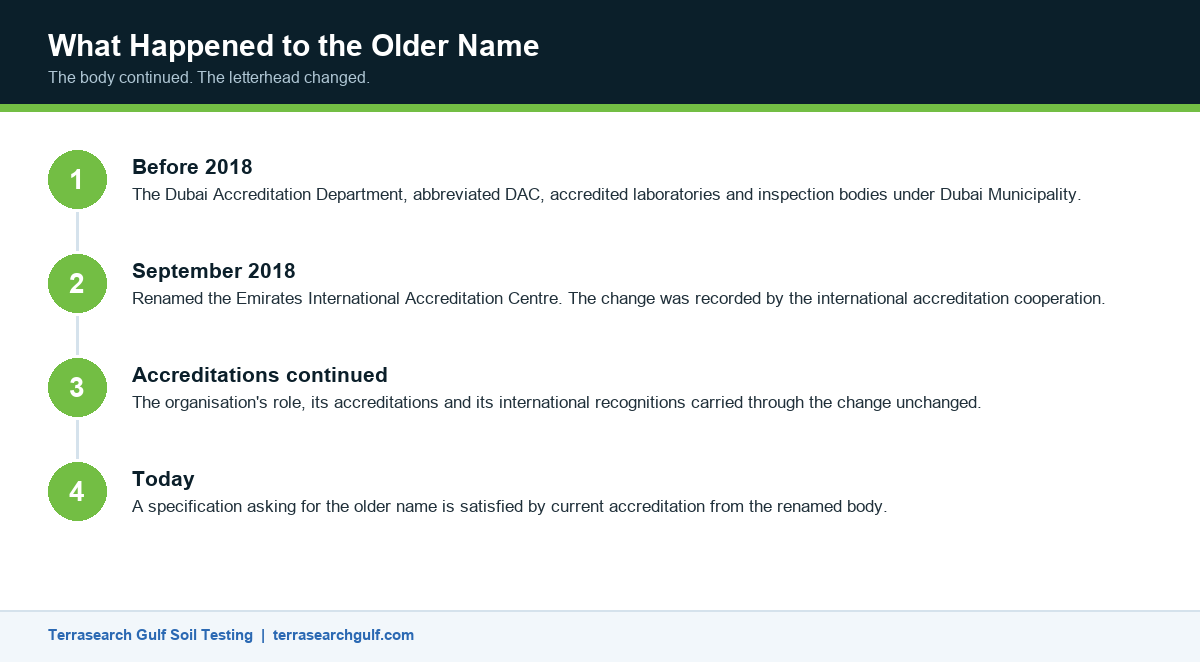
The Dubai Accreditation Department was the accreditation body for the Emirate of Dubai, operating under Dubai Municipality and assessing laboratories, inspection bodies and certification bodies against international standards.
In September 2018 it was renamed the Emirates International Accreditation Centre. The change was recorded by the international laboratory accreditation cooperation, the body through which accreditation bodies recognise each other’s work internationally. The organisation’s role, its accreditations and its international recognitions continued through the change.
So the answer to the question people are really asking is straightforward. There is no separate DAC body that disappeared and no accreditation that lapsed. The letterhead changed.
Current scope and recognition details are published on the accreditation body’s own site.
Why the Old Abbreviation Is Still Everywhere
Construction documents have a long life. Four sources keep the older abbreviation in circulation.
- Project specifications written before 2018 and reused, sometimes for years, as the basis of new tender documents.
- Framework agreements and standing supplier arrangements that were drafted once and never re-issued.
- Company profiles and capability statements that quote a historical accreditation without updating the name.
- Search habit. People who learned the term years ago still search for it, which is why the phrase remains common.
None of these are problems in themselves. They become problems when someone treats the mismatch as a discrepancy: a submission queried because the certificate says one name and the specification says another, or a tender clarification raised over what is purely a naming question.
What to Do When a Specification Asks for the Old Name
Treat it as satisfied by current accreditation from the renamed body, and document why rather than leaving it for someone to query later.
The practical approach is to include a short note in the submission stating that the accreditation body was renamed in 2018, that the laboratory holds current accreditation from it, and attaching the scope document. That turns a potential query into a closed point before anyone raises it.
If the specification is being written now rather than read now, use the current name. If you are updating a framework agreement, this is worth correcting at the same time, because the confusion compounds every year the wording survives.
Where the specification requires something beyond accreditation, such as acceptance by a particular authority, that is a separate question covered in the municipal approval route.
What Actually Matters on the Certificate
The name of the body is the least important thing on an accreditation document. Four other items decide whether it supports your submission.
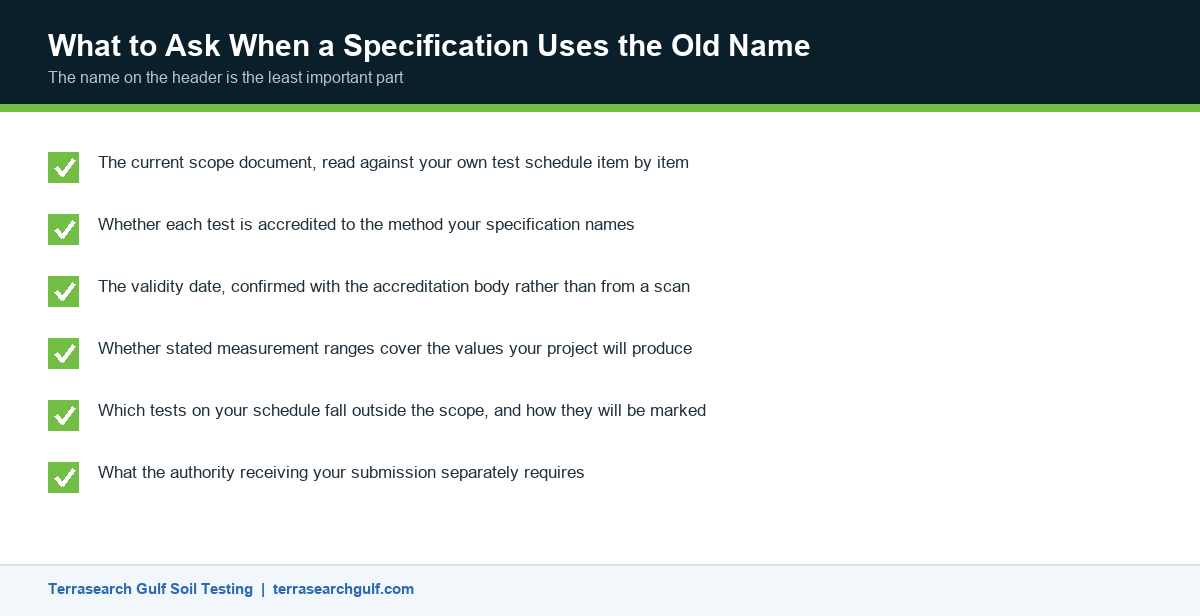
- The scope: the declared list of tests and methods the accreditation covers. This is the document to read, item by item, against your own test schedule.
- The method references: whether each test is accredited to the standard your specification demands, rather than to a different one with a similar name.
- The validity date: whether the accreditation is current today, confirmed with the accreditation body rather than from a scanned copy.
- The measurement ranges, where stated, and whether they cover the values your project will actually produce.
A laboratory can hold impeccable accreditation and still be unable to support your project if the scope does not include your tests. That is the failure mode worth guarding against, and it has nothing to do with which name is printed at the top.
Our note on why the mark on a certificate matters covers the commercial consequence, and what the international standard guarantees sets out what accreditation does and does not promise.
Checking a Laboratory Today
The sequence is the same regardless of which name your paperwork uses.
Ask for the current scope document rather than the certificate. Read your test schedule against it, marking anything absent or accredited to a different method. Confirm validity directly with the accreditation body. Then ask separately what the authority receiving your submission requires, because accreditation and acceptance are different questions.
Ask one further question that reveals more than any document: which tests on my schedule fall outside your accredited scope, and how will those be marked on the report? A laboratory that answers this precisely is one that understands what its accreditation means. A laboratory that says everything is covered, without looking at your list, has not read it.
For the full technical comparison between providers, see how to weigh one provider against another, and for the commercial terms, our procurement checklist for contractors.
Where Testing Accreditation Fits in a Construction Submission
Accreditation is one link in a chain. A submission is accepted when the right tests were performed, at the right frequency, to the right methods, on traceably sampled material, by a laboratory competent and acceptable for the purpose.
Weakness anywhere in that chain produces the same outcome. Perfect accreditation with poor sampling records is as likely to be queried as good records from a laboratory outside its scope.
For the material side of a typical submission, the material checks a project file requires gives an overview, the standards governing concrete verification covers the largest category, and independent verification and witness work covers where a separate body is required rather than a testing laboratory alone.
Frequently Asked Questions
Does DAC still exist?
The organisation does, under a different name. The Dubai Accreditation Department was renamed the Emirates International Accreditation Centre in September 2018, and its accreditations continued through the change.
My specification requires a DAC accredited laboratory. What do I do?
Treat it as satisfied by current accreditation from the renamed body, and include a short note plus the scope document in your submission so the naming point is closed before anyone queries it.
Is an old DAC certificate still valid?
Validity depends on the date, not the name. An accreditation that has since lapsed is not valid regardless of what it is called. Confirm current status with the accreditation body.
What is the difference between accreditation and municipal approval?
Accreditation assesses technical competence for a declared list of tests. Approval is an authority’s decision to accept results for a regulatory purpose. A project can require both.
Which name should I use in a new specification?
The current one. Using the older abbreviation in a document written today guarantees a clarification request at some point in the project’s life.
Does the name change affect international recognition?
No. The body’s participation in the international mutual recognition framework continued through the change, which is what allows results to be recognised beyond the UAE.
How do I verify a laboratory’s accreditation?
Ask for the scope document, read it against your test schedule item by item, then confirm the accreditation is current with the accreditation body directly rather than from a copy.
Can a laboratory be accredited for some of my tests and not others?
Yes, and this is the most common and most consequential gap. Accreditation is granted per test and per method, so the scope has to be read line by line.
What if a test falls outside the accredited scope?
It can still be performed, and it must be clearly marked on the report as outside the scope. Whether your specification accepts an unaccredited result is a separate question to settle in advance.
Does this apply to inspection bodies too?
Yes. Inspection is a distinct accreditation category from testing, assessed against a different standard, and the same name change applies to the body granting it.
The Name Changed, the Requirement Did Not
If you are looking for a laboratory accredited under the older name, you are looking for current accreditation from the body that replaced it. What decides whether that accreditation supports your project is the scope document and its validity date, not the abbreviation on the header.
Terrasearch Gulf holds current accreditation for geotechnical, construction materials and chemical testing from our Dubai facility. Ask us for the scope document and read it against your specification before you commission anything.