


A contractor submits a set of test results and the authority rejects them. The laboratory is accredited, the tests were run correctly, and the numbers are fine. The rejection is about who issued them, not about what they say.
This is the distinction between accreditation and approval, and it catches out experienced teams because the two words are used as if they were the same thing. This article explains what each one is, why a project can require both, and how to verify the position for your specific project before you commission any testing. It sits under our guide to how accreditation works locally.
Key Takeaways
- Accreditation is technical competence for a declared list of tests. Approval is permission for results to be accepted for a regulatory purpose. They are separate.
- Requirements differ by authority, by project type and over time. Dubai has several approving bodies beyond the municipality, each with its own position.
- Verify the requirement with the authority handling your submission, before commissioning, rather than assuming a previous project’s arrangement still applies.
- The most expensive version of this mistake is discovering it after the testing is complete, because the remedy is usually to repeat it.
Two Different Questions
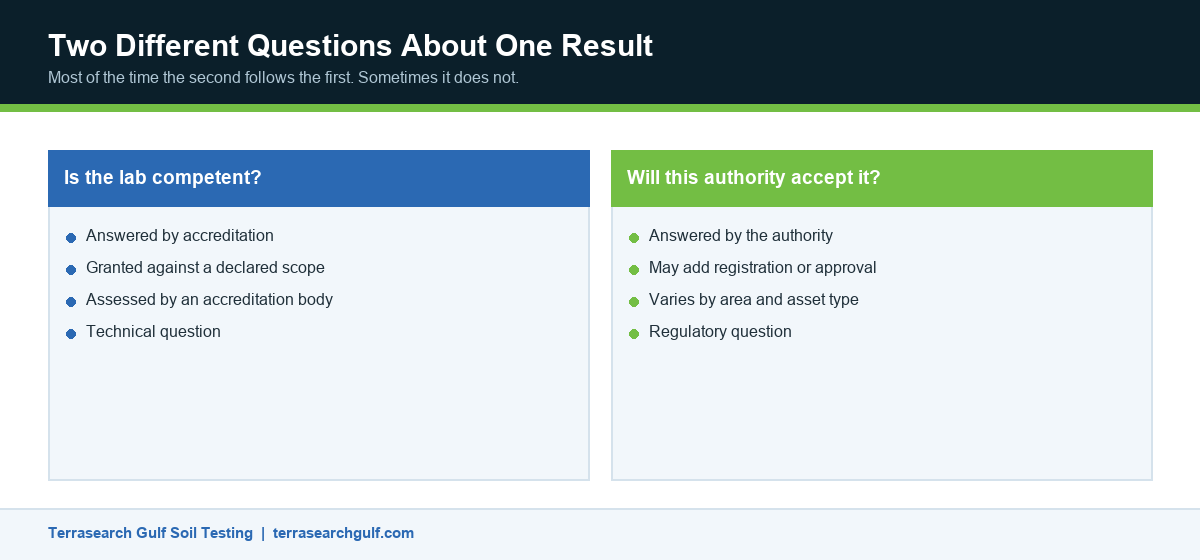
When a test result reaches an approving authority, two separate questions are being asked about it.
The first is technical: is this laboratory competent to perform this test? That question is answered by accreditation, granted against a declared scope by an accreditation body. In Dubai that body is the national accreditation centre, which operates under the municipality.
The second is regulatory: will this authority accept results from this laboratory for this purpose? That is a question about the authority’s own requirements, which may include registration, approval, or simply a stipulation about accreditation scope. It is not answered by the accreditation certificate.
Most of the time the second follows from the first. Sometimes it does not, and that gap is where rejected submissions live.
Why Requirements Differ Across Dubai
Dubai is not a single approving jurisdiction for construction purposes. Different authorities govern different areas and different asset types, and each sets its own position on testing.
A building in a municipal area, a structure inside a free zone development, a road or bridge under the transport authority, and work on a master developer’s plot can all face different requirements about who may issue acceptable test results. The roads and transport authority maintains its own requirements for infrastructure work, which is why our note on right-of-way investigation treats it as a distinct case.
Two consequences follow. First, a laboratory acceptable on your last project is not automatically acceptable on this one. Second, the question has to be asked of the authority that will actually receive your submission, not of the authority you dealt with before.
What to Verify, and With Whom
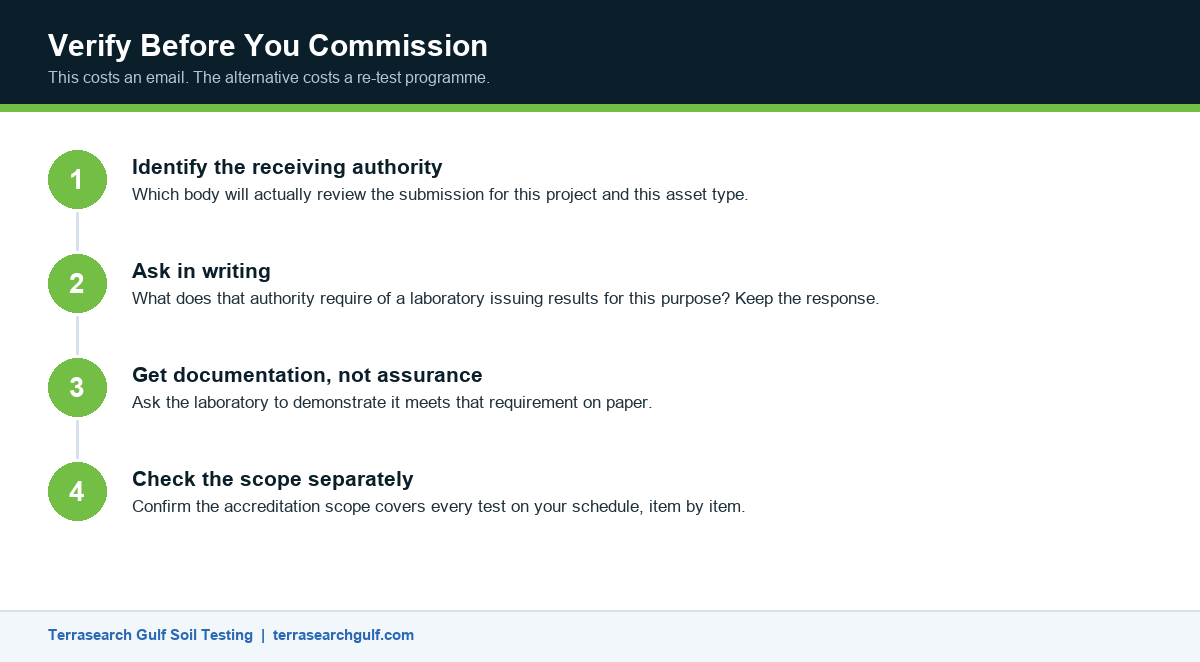
The verification sequence is short and it has to happen before testing is commissioned, not after.
- Identify the authority that will receive the submission for your specific project and asset type.
- Ask that authority, in writing, what it requires of a laboratory issuing results for this purpose. Accreditation scope? Registration with them? Something else?
- Ask the laboratory to demonstrate it meets that requirement, with documentation rather than assurance.
- Confirm the laboratory’s accreditation scope separately covers every test on your schedule, item by item.
- Keep the correspondence. When a submission is queried months later, the written position from the authority is what resolves it quickly.
That written step is the one teams skip. A verbal confirmation from a helpful person is not evidence, and the person who gave it may not be the person reviewing your submission.
What the Approving Authority Is Actually Looking At
Beyond the identity of the laboratory, submissions are assessed on whether the testing regime was appropriate and properly evidenced. Four things recur.
Scope of testing, meaning whether the tests performed actually address the specification requirements rather than a convenient subset. Sampling records, because a result with no traceable link to a location, level and date is difficult to accept. Frequency, meaning whether testing was performed at the intervals the specification demands rather than opportunistically. And method, meaning whether each test was run to the standard the specification names.
Failures here are not about the laboratory at all. They are about how the testing was commissioned and recorded, which sits with the contractor. Our procurement checklist for contractors covers the record-keeping side in detail.
For the range of material testing a construction submission typically needs, the material checks a project file requires gives a practical overview, and the standards governing concrete verification covers the largest single category.
The Cost of Getting This Wrong
When results are rejected on the identity or scope of the laboratory, the remedy is almost always to repeat the testing with an acceptable body. That means paying for the tests twice, and it means the programme absorbs the delay.
Worse, some tests cannot simply be repeated. Compaction testing on a layer that has since been covered, concrete sampling from a pour that has cured, or in-situ testing at a level now buried all require either destructive investigation or an engineering argument to close out. Both are more expensive than the original test by a wide margin.
This is why the verification step belongs at the start. It costs an email and a day of waiting. The alternative costs a re-test programme.
Practical Questions Worth Asking a Laboratory
- Can you show me your current accreditation scope document, and is it valid today?
- Have results from your laboratory been accepted by this specific authority, for this type of submission, recently?
- Which tests on my schedule fall outside your accredited scope, and how will they be marked on the report?
- How do you record sampling location, level, date and the identity of the sampler?
- What is your position if a submission using your results is queried by the authority?
That last question is a good one. A laboratory that will engage with a query, provide the underlying records and speak to the authority is materially more useful than one that issues a certificate and considers the matter closed.
For the wider technical comparison between providers, see how to weigh one provider against another. For what accreditation covers and does not cover, what the international standard guarantees sets out the limits.
Frequently Asked Questions
Is an accredited laboratory automatically approved?
Not necessarily. Accreditation is a technical assessment of competence for specific tests. Approval is an authority’s decision to accept results for a regulatory purpose, which may carry additional requirements. Confirm both.
Who do I ask about the requirement for my project?
The authority that will receive your submission, which depends on where the project sits and what type of asset it is. Ask in writing and keep the response.
Does the requirement change between projects?
It can. Different authorities govern different areas and asset types in Dubai, and requirements are updated over time. Treat each project as its own question.
What happens if results are rejected?
Usually the testing must be repeated with an acceptable laboratory. Where the element tested is no longer accessible, the remedy becomes destructive investigation or an engineering justification, both of which cost considerably more.
Can I use the same laboratory for a free zone project and a municipal one?
Possibly, but confirm it for each. The two may be governed by different authorities with different requirements.
Does this apply to geotechnical reports as well as materials testing?
Yes. A geotechnical report submitted in support of a design is subject to the same question about whether the issuing laboratory’s results are acceptable to the reviewing authority.
How long does verification take?
Usually a short email exchange. The cost of doing it is negligible against the cost of not doing it.
What if the laboratory says it is approved but cannot show documentation?
Treat that as unverified. Anything that matters to a submission should be demonstrable on paper, and a laboratory that cannot produce it is a risk you are absorbing on their behalf.
Are older approvals still valid?
Validity dates matter, and organisations change. An approval or accreditation held some years ago should be confirmed as current rather than assumed to have continued.
Does this affect third-party inspection as well as testing?
It can. Inspection is a distinct activity with its own accreditation category, and independent verification and witness work may be subject to its own acceptance requirements.
Verify Before You Commission, Not After
Accreditation and approval answer different questions, and a project can require both. Identify the authority that will receive your submission, ask it in writing what it requires, then confirm the laboratory meets that requirement and that its scope covers every test on your schedule.
Terrasearch Gulf works across Dubai and the Northern Emirates and will provide our current scope documentation for your verification before any work is instructed. Get in touch with the project details and we will confirm the position for your submission.