

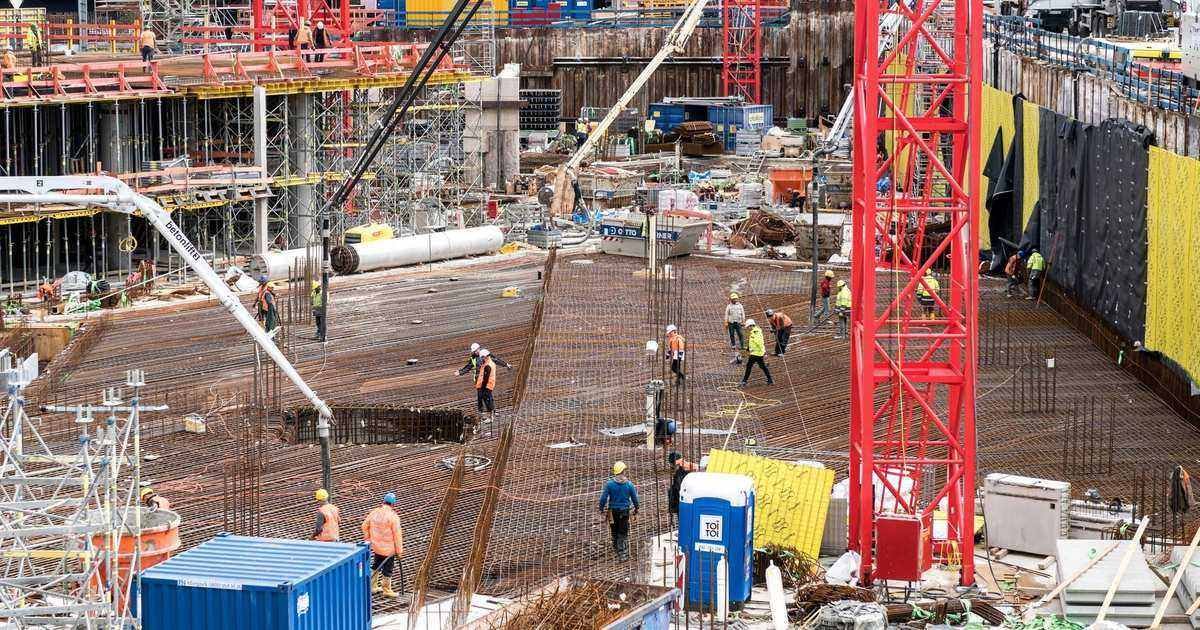
Large bored piles carry towers, bridges and heavy industrial plant across Dubai, and a single hidden defect can be costly. Cross hole sonic logging in Dubai gives consultants a detailed look at the concrete inside these piles, from head to toe. This guide explains how the test works, how to plan the access tubes before concreting, what the results show, and how CSL compares with simpler methods. It builds on our foundation testing overview and focuses on the decisions contractors and consultants face on site.
Key Takeaways
- Cross hole sonic logging in Dubai measures concrete quality between cast in access tubes along the full pile length.
- Tubes must be planned, fixed and protected before concreting, because CSL cannot be added to a finished pile.
- A CSL test UAE consultants accept is usually reserved for large diameter or critical bored piles, alongside screening by low strain testing.
How Cross Hole Sonic Logging Works
Cross hole sonic logging in Dubai sends an ultrasonic pulse between two probes lowered down water filled tubes cast inside the pile. The arrival time and strength of the pulse show the quality of the concrete between the tubes. Sound concrete passes the pulse quickly and strongly. Defects slow it down or weaken it.
Before concreting, the piling contractor ties steel or plastic access tubes to the reinforcement cage. After the concrete gains strength, the tubes are filled with clean water. A transmitter goes down one tube and a receiver down another, and both are raised together while the system records a reading every few centimetres. Each pair of tubes gives one profile. A pile with four tubes produces six profiles, covering the core and the perimeter. In a programme of cross hole sonic logging in Dubai, the analyst plots first arrival time and signal energy against depth for every profile. The method is set out in ASTM D6760 for ultrasonic crosshole testing.
Because the pulse travels through the concrete itself, cross hole sonic logging in Dubai is not limited by soil friction in the way that surface tests are. It reads the full tube length, which makes it valuable for long, deep piles in Dubai’s mixed sand and weak rock. The crosshole sonic logging overview summarises the technique and its history.
The output is a set of logs, one per tube pair, that an engineer can read alongside the pile record. A good report for cross hole sonic logging in Dubai presents each profile on the same depth scale, marks the cut off and toe levels, and highlights any zone that breaches the specified thresholds. Ask for raw data as well as the summary. It lets a second reviewer check the interpretation if a dispute arises later.
Planning Access Tubes Before Concreting
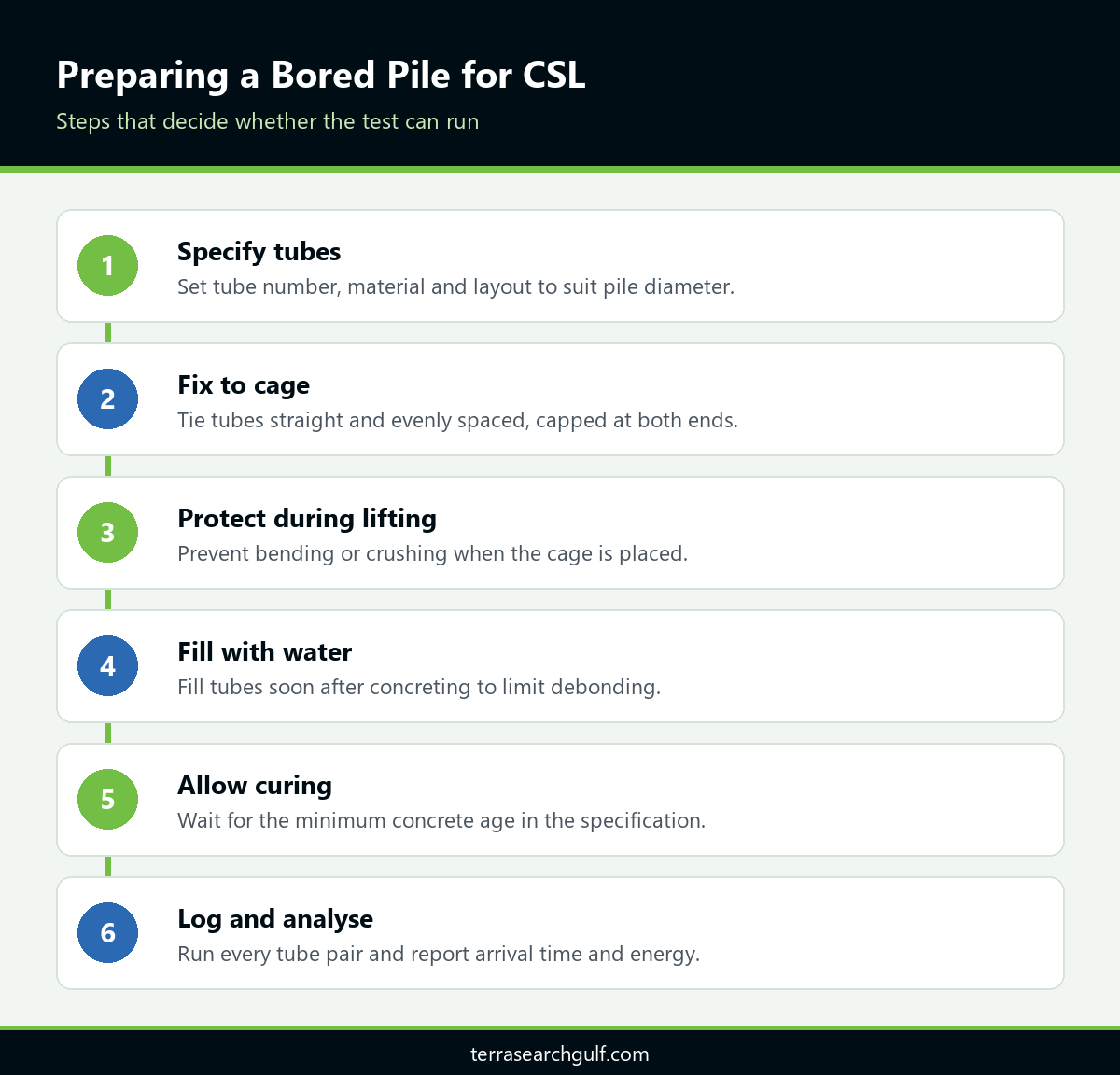
Cross hole sonic logging in Dubai succeeds or fails at the cage fixing stage. The number, material, position and protection of the tubes all decide whether the test can be run later. Once the concrete is poured, a missing or blocked tube cannot be replaced, so tube planning belongs in the pile method statement.
Specifications commonly link the number of tubes to pile diameter, with more tubes for larger piles so the profiles cover the whole section. Steel tubes bond better with concrete than plastic, which reduces the risk of debonding that can look like a defect. Tubes should be straight, evenly spaced around the cage, fixed securely at regular intervals and capped at both ends to keep out grout and debris. They should run from above the cut off level to near the toe. Fill them with water soon after concreting to limit debonding. The specification will also state the minimum concrete age before testing, so the pulse velocity is stable. Record each pile’s as built length, diameter, concreting times and any incidents. These records help the analyst read anomalies correctly.
Coordinate early with the piling crew. Tubes damaged during cage lifting or cut short during trimming are the most common reason a planned test cannot proceed. A short briefing before cages go in saves weeks of argument later. Our structural testing and analysis team can review tube layouts during the method statement stage.
What CSL Finds and How Results Are Graded
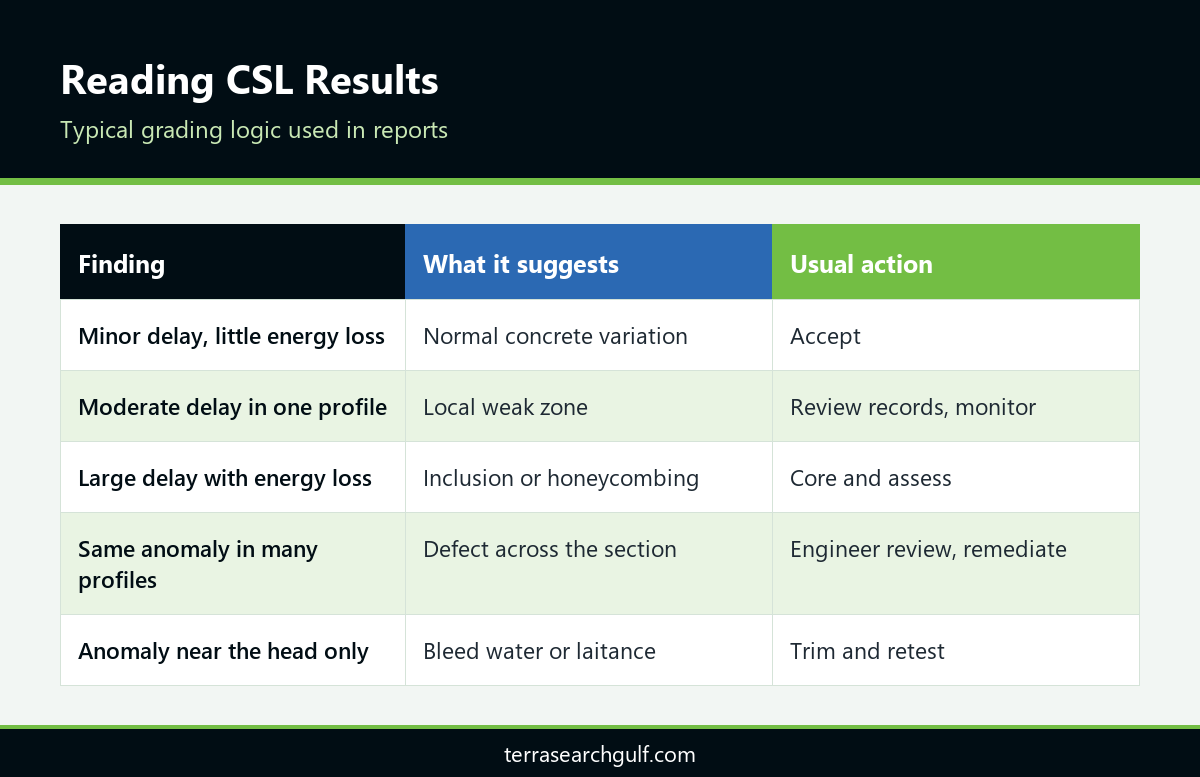
Cross hole sonic logging in Dubai detects zones where the pulse arrives late or arrives weak. These zones often indicate soil inclusions, honeycombing, segregation, necking or contaminated concrete at the toe. Because each tube pair covers a separate slice, the test can also show roughly where in the section a defect sits.
Analysts usually compare each reading with the average for the same profile. A small delay with little energy loss often reflects minor variation in concrete quality and is generally acceptable. A larger delay with significant energy loss points to a more serious flaw. When the same anomaly appears at the same depth across several profiles, it likely extends across much of the section. Many reports grade zones into simple bands, such as good, questionable and poor, using thresholds set in the specification. Some laboratories also offer tomography, which combines profiles to map the shape and size of a defect in three dimensions.
Not every anomaly is a defect. Debonded tubes, poor tube alignment and bleed water near the head can all mimic weak concrete. An experienced analyst checks the construction records and the pattern across profiles before reaching a conclusion. That review protects the contractor from unnecessary remedial work.
CSL Versus Low Strain PIT
CSL and low strain testing answer related questions with different strengths. A pile integrity test UAE crews run with a hand hammer is fast and cheap but weakens with depth. CSL is slower and needs planning, yet it reads the whole pile length in detail. Many projects use both together.
A common approach is to screen every working pile with low strain testing and reserve cross hole sonic logging for a defined share of large or critical piles. Typical candidates include tower piles, bridge piles, piles with long rock sockets and piles where construction records show problems. CSL is also useful when a low strain trace is unclear, provided tubes were installed. The project specification normally sets the percentage of piles to test by each method, so agree this before cages are fabricated. For a broader view of foundation elements, see the bored pile overview.
Neither method measures load capacity. If integrity results raise doubt about a pile’s performance, a load test is the next step. Combining methods gives consultants a confident picture without testing every pile to destruction.
Programme matters too. Low strain screening can run within days of casting, while CSL needs tubes, water filling and curing time. Schedule cross hole sonic logging in Dubai to follow each batch of critical piles, so results return before the cap reinforcement is fixed. This sequence keeps bored pile testing Dubai packages from delaying the structure above.
Acting on CSL Findings
A questionable result from cross hole sonic logging in Dubai triggers a structured review rather than an automatic rejection. The consultant considers the defect size, its depth, the pile’s design load and the margin in the foundation. Coring often follows to see the concrete directly. Remedial options range from grouting to adding piles.
Start by confirming the anomaly. Check tube condition, repeat the logging if debonding is suspected and compare results with the concrete test records for the same pours. If the defect is confirmed, coring through the zone shows its nature and extent. Minor defects may be accepted after engineering review. Larger ones may be repaired by pressure grouting through the tubes or cores, or by redesigning the cap to share load with extra piles. Record every decision for the handover file. Ground conditions often explain why defects form, and our article on ground investigation scope and reporting shows how site data supports these decisions. Bringing in a laboratory early keeps each CSL finding moving towards a clear decision.
Finally, close the loop on lessons learned. If several piles show similar anomalies, review the concreting method, tremie practice and cage handling before the next pour. Repeated findings from cross hole sonic logging in Dubai at the same depth often point to a ground layer or a construction habit rather than chance. Fixing the cause protects the rest of the pile package and the programme.
Conclusion
CSL gives the most detailed integrity picture available for large bored piles, but only when access tubes are planned, fixed and protected before concreting. Use it for critical piles, combine it with low strain screening, and treat anomalies as evidence that needs engineering review. Planned well, cross hole sonic logging in Dubai catches problems before pile caps are cast. Terrasearch Gulf brings 8+ years of testing experience and an EIAC accredited laboratory to every project. Contact our team to plan integrity testing for your next bored pile package.
Frequently Asked Questions
What is cross hole sonic logging in Dubai used for?
It is an ultrasonic test that sends pulses between probes lowered down water filled tubes cast in a bored pile. Delays or weak signals reveal defects in the concrete between the tubes along the full pile length.
How many access tubes does a pile need?
The number usually depends on pile diameter and the project specification. Larger piles need more tubes so the profiles cover the whole section. Confirm the requirement with the consultant before reinforcement cages are fabricated and lifted.
Can CSL be done on a pile without tubes?
No. CSL needs access tubes cast into the pile during construction. If tubes were not installed, consultants usually rely on low strain testing, coring or load testing to assess the pile instead of sonic logging.
Are steel or plastic tubes better for CSL?
Steel tubes generally bond better with concrete, which lowers the risk of debonding that can look like a defect. Plastic tubes are sometimes allowed, but they must be filled with water early and handled carefully on site.
How soon after concreting can CSL be carried out?
The specification sets the minimum concrete age, commonly several days after casting. Testing too early gives unstable pulse velocities and unclear results, so plan the logging date with the piling programme and curing records.
What does tomography add to a CSL test?
Tomography combines the readings from all tube pairs to map a defect’s likely shape and size. It helps engineers judge whether a flaw is local or extends across the section before deciding on coring or remedial work.
Does CSL measure pile capacity?
No. CSL checks the quality and continuity of the concrete only. Capacity and settlement need a static load test or a high strain dynamic test, which load the pile and measure its response to that load.
Which laboratory should run CSL testing?
Choose a lab accredited for the method with experienced analysts. Our guide to what ISO 17025 accreditation guarantees explains how to confirm competence and check that the test sits within the accredited scope.
Do Dubai authorities accept CSL results?
Acceptance depends on the project and approving body, so confirm requirements early. Our article on the Dubai Municipality approval route for testing labs explains how lab approvals affect which results consultants and authorities accept.