

Foundation testing covers two quite different activities that share a name. One happens before design, to establish what the ground can carry. The other happens after construction, to prove that what was built performs the way the design assumed. Confusing the two is the source of a surprising number of programme arguments.
This article separates them, sets out which test proves which assumption, and explains what happens when the ground exposed during excavation does not match the report. It sits under our full walkthrough of the assessment process.
Key Takeaways
- Pre-design testing establishes capacity. Post-construction testing proves performance. They use different methods and answer different questions.
- Every number in a geotechnical report is an assumption until something on site verifies it at the actual founding level.
- Differential settlement, not total settlement, is what damages structures. Verification should target variation across the footprint.
- When excavation exposes ground that differs from the report, the design assumptions must be re-checked before construction continues.
The Two Halves of Foundation Testing
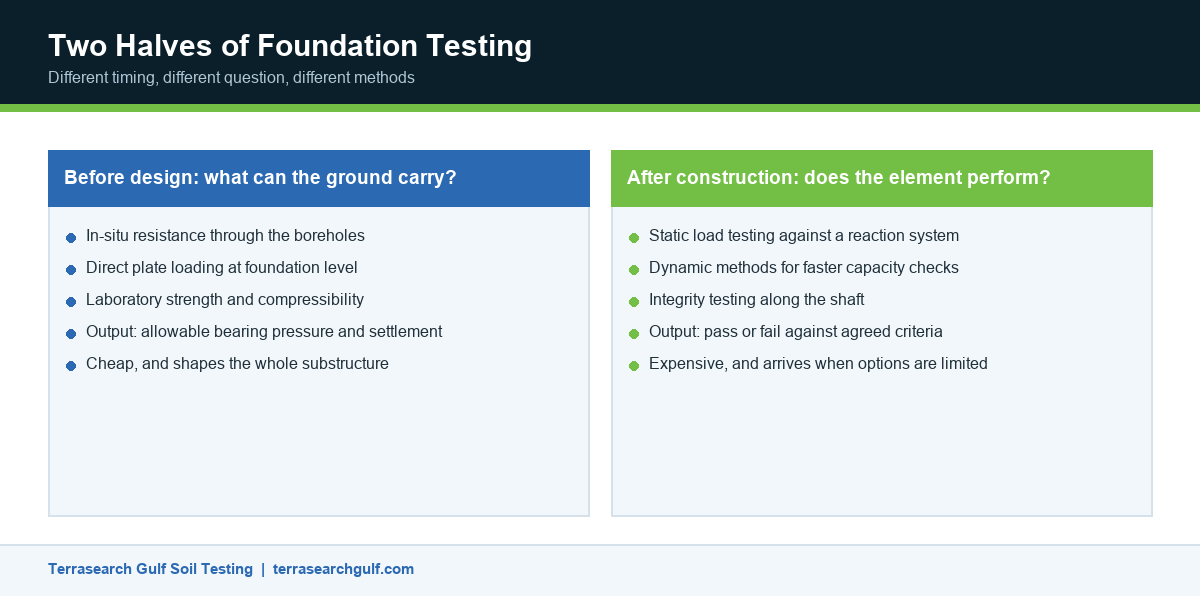
Before design, the question is what the ground can carry and how much it will settle under load. That is answered by the investigation: boreholes, in-situ testing and a laboratory schedule, interpreted into an allowable bearing pressure and a settlement estimate.
After construction, or at least after the foundation element exists, the question changes to whether this particular element performs as designed. That is answered by load testing and integrity testing on the built element itself.
The distinction matters commercially. Pre-design work is cheap and shapes the whole substructure. Post-construction work is more expensive per test and its findings arrive when options are limited. A programme that relies on the second to compensate for skimping on the first is an expensive programme.
Pre-Design: Establishing What the Ground Can Carry
Three families of evidence combine into the bearing capacity and settlement figures a designer works from.
In-situ resistance
The hammer-and-sampler method behind N values provides resistance readings at intervals through each borehole, correlated to strength and density. Where the ground is soft or loose enough to penetrate, the cone method that logs resistance continuously produces an unbroken profile that catches thin weak layers a spaced test can miss entirely.
Direct loading at foundation level
Loading a rigid plate and measuring settlement is the most direct pre-construction measurement available for shallow foundations. It loads the ground at the level the foundation will sit on and records how much it moves. Its limitation is depth of influence: a plate stresses a much shallower zone than a real foundation, so results must be extrapolated with care.
Laboratory characterisation
Strength and compressibility testing on recovered samples underpins the settlement calculation, and the bench programme on recovered samples covers the classification that everything else is interpreted against.
Post-Construction: Proving the Element Performs
Once foundation elements exist, testing shifts to the elements themselves. For deep foundations this splits into capacity and integrity.
Capacity testing loads a pile and measures its response. Static load testing applies load in increments against a reaction system and records settlement at each stage; it is the reference method and the international standard covering it sets out how it is performed and interpreted. Dynamic methods apply an impact and derive capacity from the measured force and velocity response, which is faster and cheaper but interpretive.
Integrity testing asks a different question: is the element sound along its length? Low-strain methods send a small impact down the shaft and read the reflected trace for changes in section. Cross-hole sonic logging uses tubes cast into the pile to scan between them. Neither measures capacity, and a pile can be perfectly sound and still under-designed.
Terminology in deep foundation practice varies between specifications, so confirm which test your specification means before pricing it.
Matching the Test to the Assumption
Every test verifies something specific. Specifying tests without naming the assumption each one checks is how schedules become expensive without becoming useful.
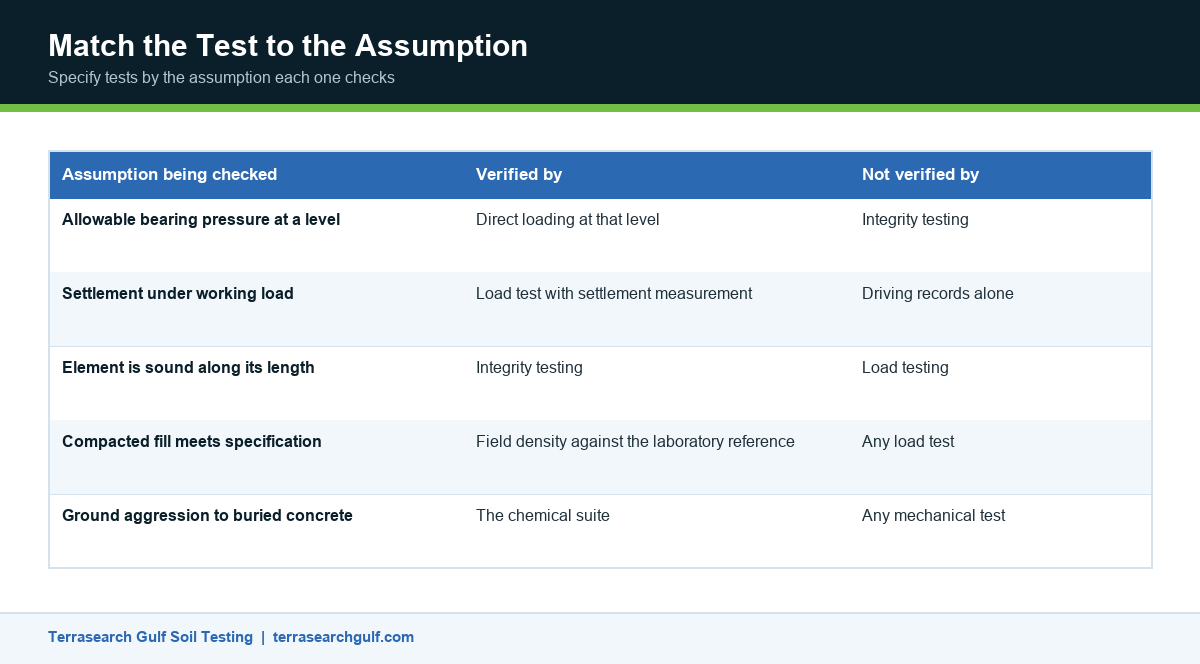
- Allowable bearing pressure at a stated level: verified by direct loading at that level, supported by in-situ resistance data.
- Settlement under working load: verified by load testing with settlement measurement, supported by laboratory compressibility results.
- Founding stratum reached as designed: verified by the driving or boring record and by inspection of the founding level.
- Structural soundness of the element: verified by integrity testing, not by load testing.
- Compacted fill meeting specification: verified against the maximum dry density reference established in the laboratory.
- Ground aggression to buried concrete: verified by the chemical suite for substructures, not by any mechanical test.
Note the last two. Compaction and chemical aggression are foundation-critical and neither is proven by a load test. Schedules that concentrate on load testing and omit them leave real risk unverified.
When the Ground Does Not Match the Report
Ground varies between exploration positions. A report that acknowledges this is being honest, not hedging. What matters is what happens when excavation exposes something different.
The sequence should be straightforward. Stop, record what is actually exposed, and get it in front of the geotechnical engineer who wrote the report. They will decide whether the design assumptions still hold, whether additional verification is needed at that location, or whether the foundation solution has to change locally.
The failure mode is not the variation. It is proceeding without telling anyone, so that the structure is built on an assumption that has quietly been invalidated. Differential conditions across a footprint are precisely what cause differential settlement, and differential settlement is what cracks structures.
Where the exposed ground is weaker than assumed, options usually run from local excavation and replacement, through ground improvement with a verification regime attached, to a change of foundation type. All three need the improved or replaced ground proven before construction continues.
Building a Verification Regime That Is Worth Its Cost
A good regime is proportionate, targeted and decided early. Three principles do most of the work.
Test where variation is expected, not on a convenient grid. If the investigation found the ground changing across the plot, verification should concentrate where it changed, not spread evenly across ground that is known to be uniform.
Decide acceptance criteria before testing, not after. A load test without a pre-agreed settlement limit produces a number and an argument. Agreeing the criterion in advance turns it into a pass or a fail.
Use the cheap methods to decide where to use the expensive ones. Integrity testing across many elements, with load testing concentrated on those the integrity results or the construction records flag, costs far less than load testing everything and catches more.
For procurement, how to weigh one provider against another and our procurement checklist for contractors both cover what to confirm before an order is placed.
Frequently Asked Questions
What is the difference between foundation testing and site investigation?
Site investigation happens before design and establishes what the ground can carry. Foundation testing in the post-construction sense proves that a built element performs as designed. Many specifications use the phrase for both, so confirm which is meant.
Does every pile need to be load tested?
No, and doing so would be prohibitively expensive. Typical practice is integrity testing across a large proportion of elements, with load testing on a small sample plus any element that the records or the integrity results flag.
What does a plate loading test actually prove?
That the ground at the tested level settles a measured amount under a measured pressure. Because a plate influences a shallower zone than a real foundation, the result supports the design rather than replacing the calculation.
Can integrity testing tell me if a pile is strong enough?
No. It tells you whether the element is continuous and sound along its length. Capacity is a separate question answered by load testing.
Who decides the acceptance criteria?
The structural or geotechnical designer, and they should be written into the specification before testing starts. Criteria agreed after a result is known are rarely agreed quickly.
How soon after casting can a pile be tested?
Concrete needs to reach adequate strength first, so there is a waiting period that varies with the mix and the test type. Build it into the programme rather than discovering it during it.
What if the load test fails?
The designer reassesses. Outcomes range from accepting a reduced working load, through strengthening or adding elements, to a local redesign. A failed test is information, and it is far cheaper to have it before the superstructure goes up.
Is compaction testing part of foundation testing?
Where the foundation bears on engineered fill, yes, and it is often the most neglected part. The fill has to be proven against its laboratory reference before anything is founded on it.
Do authorities in Dubai require load testing?
Requirements vary by authority, structure type and foundation solution, and they change. Confirm with the approving body for your project rather than relying on what applied on a previous job.
How does ground aggression affect foundations?
Chlorides and sulphates attack buried concrete and the reinforcement inside it, which is a durability problem rather than a capacity one. It is controlled through the concrete specification, driven by the chemical classification of the ground.
Verify the Assumptions, Not Just the Elements
Foundation testing is worth its cost when each test is tied to an assumption someone actually made. Decide the acceptance criteria early, target verification where the ground varies, and make sure compaction and chemical aggression are on the schedule alongside the load tests.
Terrasearch Gulf covers ground investigation, in-situ testing, structural verification and laboratory analysis from one accredited Dubai facility. Talk to our engineers about what your foundation solution needs proven.