


Three quotations for the same plot can differ by a factor of two, and the cheapest is not automatically the worst. Often the difference is that the three firms have priced three different scopes, and nobody has noticed because the scopes were never written down in comparable terms.
This article gives a scored framework for comparing providers on the things that actually determine whether you get a usable report: accreditation scope, what is done in-house, who writes the interpretation, reporting quality and programme risk. It sits under our full walkthrough of the assessment process.
Key Takeaways
- Normalise the scope before you compare price. Quotations for different metres and different test schedules are not comparable numbers.
- Accreditation is granted against a declared list of tests. Check the scope document test by test rather than accepting a certificate at face value.
- Ask who writes the interpretation and whether they saw the site. Subcontracted interpretation is where soft, generic reports come from.
- Ask for a redacted sample report. It is the single most revealing document in the whole process and costs nothing to request.
First, Make the Quotations Comparable
Before any judgement about quality, the scopes have to be levelled. Write down, for each quotation, the number of exploration positions, the depth of each, the in-situ tests included, the full laboratory schedule test by test, the reporting deliverable and the programme.
Differences show up immediately. One firm has priced six positions at fifteen metres, another four at ten. One includes a full chemical suite, another prices it as a provisional sum. One delivers an interpretative report, another delivers a factual report and charges separately for interpretation.
A factual-only report is the most common hidden difference and the most damaging. It contains logs and certificates and no recommendations, which means it cannot be designed from. If a quotation is materially cheaper than the others, this is the first thing to check.
Once the scopes are levelled, re-price them against the structure rather than against each other. The right scope is the one the building needs, which scope, stages and report contents sets out in detail.
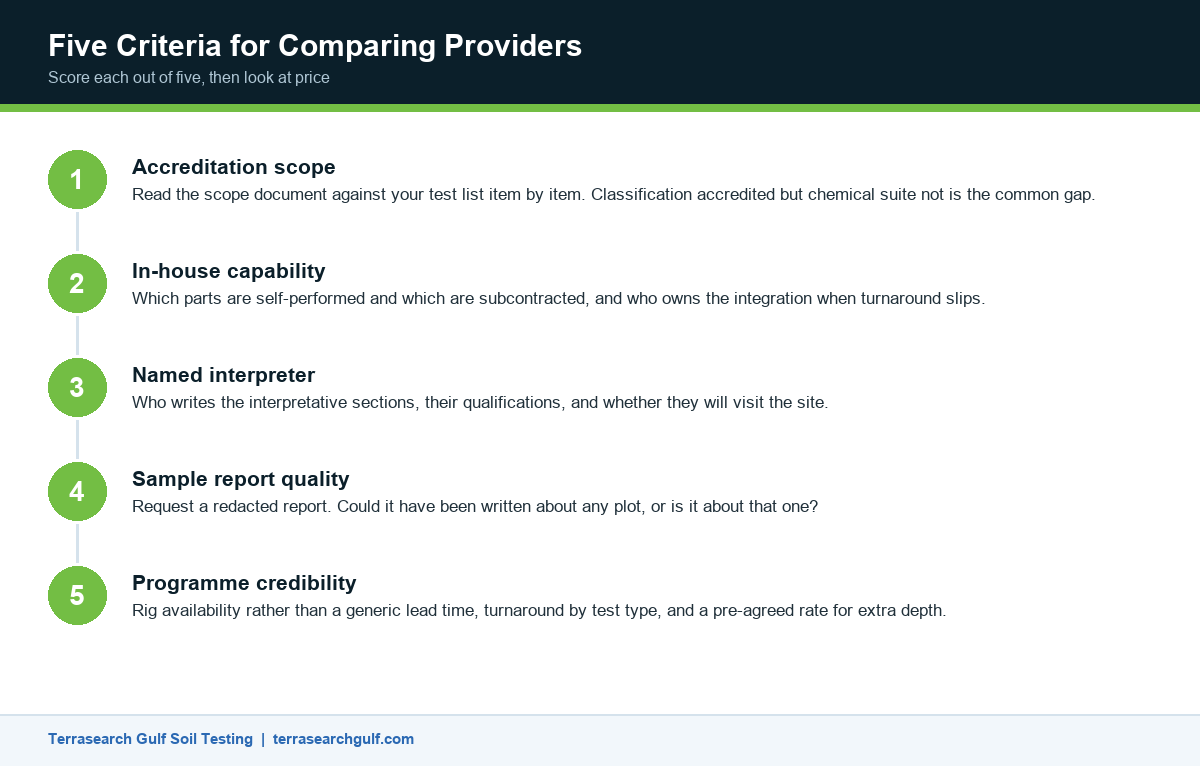
Criterion One: Accreditation Scope, Read Test by Test
Accreditation is not a badge a company holds in general. It is granted against a declared schedule of specific tests and methods, and a firm can be accredited for some items on your schedule and not others.
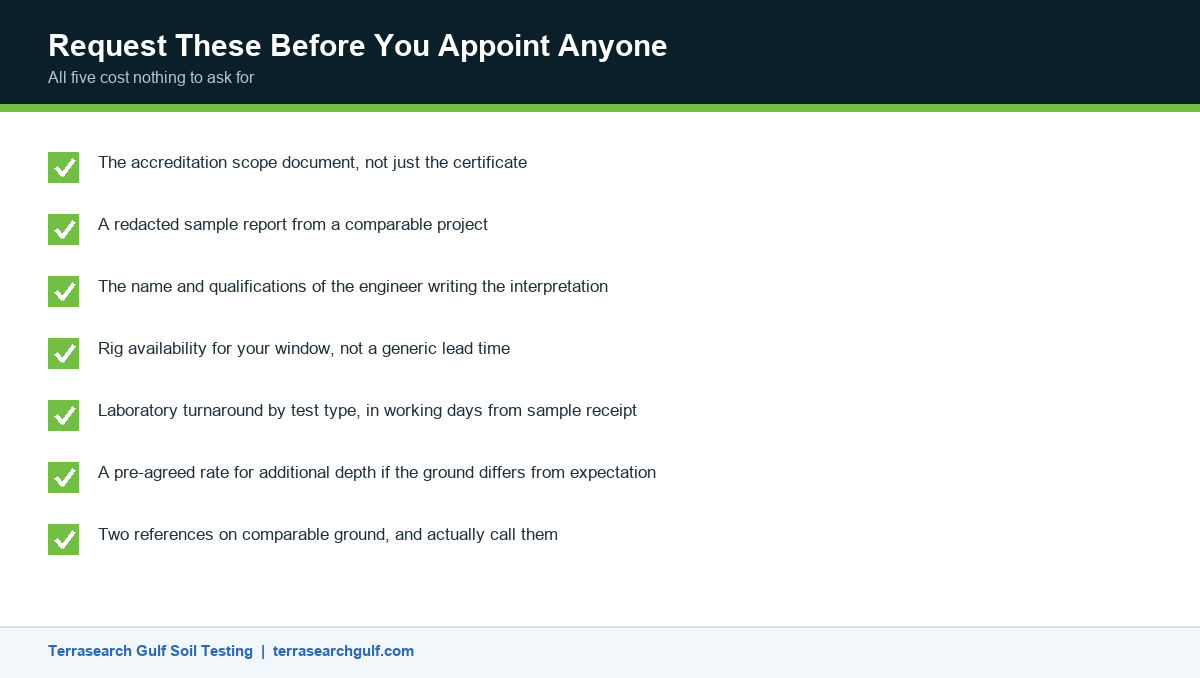
Ask for the scope document, not the certificate. Then take your laboratory schedule and check each test against it. Classification testing accredited but the chemical suite not accredited is a common and consequential gap, because the chemical results are the ones that drive the substructure concrete specification.
Check the expiry date and the accrediting body. In Dubai the relevant body is the national accreditation centre, and international recognition flows through the global mutual recognition arrangement. Our note on why the mark on a certificate matters covers what accreditation does and does not guarantee.
Criterion Two: What Is Actually Done In-House
Investigation work spans drilling, in-situ testing, laboratory analysis, survey and reporting. Few firms do all of it themselves, and where the seams fall changes your risk.
Drilling subcontracted to a third party means the rig crew answers to someone else’s programme. Laboratory work sent out means you lose control of turnaround and, more importantly, of chain of custody on samples. Geophysics acquired by one party and interpreted by another is where the vaguest sections come from.
None of this is disqualifying. Specialist subcontracting is normal and often sensible. What matters is that it is disclosed and that someone owns the integration. Ask directly: which parts do you self-perform, who are the subcontractors, and who is accountable if the laboratory turnaround slips?
- Self-performed drilling gives programme control and better sample handling.
- An in-house laboratory removes a handover and usually shortens turnaround.
- An in-house interpreter who visits the site produces a report about your plot rather than a template.
For a view of the range a full-scope provider covers, see what a complete engineering laboratory handles and the bench programme on recovered samples.
Criterion Three: Who Writes the Interpretation
This is the question that separates reports you can design from and reports you cannot, and almost nobody asks it during tendering.
Ask for the name and qualifications of the engineer who will write the interpretative sections, and whether they will visit the site. An interpretation written by someone who has seen the plot, the surrounding development and the exposed ground is a different document from one assembled remotely from logs.
Ask also whether that engineer will be available to the structural designer after issue. Ground reports generate questions during design, and a provider who disappears at issue leaves the designer interpolating on their own.
Criterion Four: Reporting Quality
Request a redacted sample report from a comparable project. Any serious firm has one and will send it. A refusal is itself informative.
Read it for the things that make a report usable:
- Is allowable bearing pressure tied to a stated founding level, or quoted as a bare number?
- Are settlement estimates given, with the assumptions behind them?
- Is groundwater reported both on strike and standing?
- Do the chemical results carry a classification and a concrete specification consequence, or are they raw numbers?
- Are limitations stated honestly, including where interpolation between positions carries risk?
- Could this report have been written about any plot in the Emirates, or is it about that one?
The last question is the most useful. Generic recommendations are a sign that the interpretation was assembled rather than reasoned.
Criterion Five: Programme Risk
Ask for rig availability, not a generic lead time. A firm with one rig fully committed will start when that rig frees up, whatever the quotation says.
Ask for laboratory turnaround by test type. Classification testing is quick; consolidation testing is inherently slow and will govern the report date if it is on your schedule.
Ask what happens if the ground differs from expectation and additional depth is needed. A pre-agreed rate for additional metres avoids a negotiation at exactly the moment you have no leverage.
Finally, ask for two references on comparable ground and actually call them. The question worth asking is not whether the report arrived, but whether the engineer was still available when the structural designer had questions three weeks later.
A Simple Scoring Approach
Score each provider out of five on the criteria above, weight them for your project, and look at price only once the scores are in front of you.
- Accreditation scope covering your full schedule: weight this heavily. A gap here can invalidate results.
- In-house capability across drilling, laboratory and reporting: weight by how tight your programme is.
- Named interpreter with site attendance: weight heavily on variable or unusual ground.
- Sample report quality: weight heavily always. It is the best predictor available.
- Programme credibility and pre-agreed variation rates: weight by how exposed your programme is.
A provider scoring well across these and pricing ten per cent above the cheapest is almost always the better commercial decision, because the cost of an unusable report is a re-investigation plus the delay.
For the contractor-side version of this exercise, our procurement checklist for contractors covers the same ground from a supply chain perspective, and questions worth asking before appointing anyone sets out the shorter conversation.
Frequently Asked Questions
What should I ask for before appointing anyone?
The accreditation scope document, a redacted sample report, the name of the engineer who will write the interpretation, rig availability, laboratory turnaround by test type, and a rate for additional depth.
Is the cheapest quotation always under-scoped?
Not always, but it is the first hypothesis to test. Level the scopes first. Very often the cheapest has priced fewer metres, a shorter laboratory schedule, or a factual report with no interpretation.
What is the difference between a factual and an interpretative report?
A factual report contains logs and test certificates. An interpretative report adds the engineering conclusions: foundation type, allowable bearing pressure, settlement, groundwater design level. Only the second can be designed from.
How do I verify a company’s accreditation?
Ask for the scope document and check it against your test schedule, then confirm the accreditation is current with the accrediting body directly rather than relying on a logo in a brochure.
Does it matter if drilling is subcontracted?
It matters that you know. Subcontracting is normal; undisclosed subcontracting means you cannot assess programme risk or sample handling, both of which affect the results.
Should I appoint the same firm for investigation and later verification testing?
There are arguments both ways. Continuity means the verification is done by people who know the ground. Independence means the verification is not marking its own homework. For high-consequence structures, many clients split them deliberately.
How much should a ground investigation cost?
It varies too widely with plot size, depth and schedule for a useful figure. The more helpful benchmark is that it is normally a very small fraction of substructure cost, which is why compressing it is poor economics.
What if I already have a report I am unsure about?
A second opinion on an existing report costs far less than a re-investigation. An experienced geotechnical engineer can usually tell within an hour whether a report supports the design decisions being made on it.
Do international firms produce better reports than local ones?
Neither reliably. What predicts quality is accreditation scope, whether the interpreter saw the site, and the quality of the sample report. Local ground knowledge is a genuine advantage on Gulf conditions.
How early should I approach providers?
Early enough that the results inform the foundation concept. If the concept is already fixed, the investigation becomes a compliance exercise and occasionally an expensive surprise.
Compare on Evidence, Not on Price Alone
Level the scopes, read the accreditation schedule test by test, ask who writes the interpretation, and read a sample report before you look at the price. Those four steps take an afternoon and remove most of the risk in the appointment.
Terrasearch Gulf self-performs drilling, in-situ testing, laboratory analysis and reporting from an accredited Dubai facility, and the engineer who writes your interpretation visits your site. Ask us for a sample report and compare it against whatever else is on your desk.