

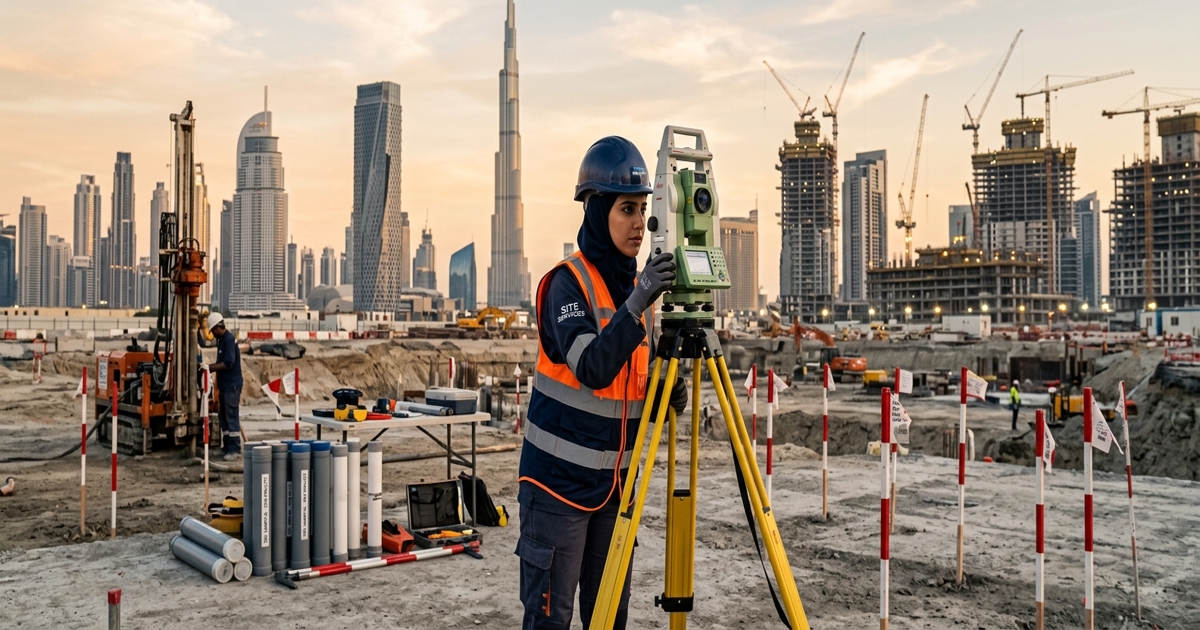
Land survey Dubai services form the backbone of every successful geotechnical and civil engineering project in the region. Before a single foundation is laid or a structural column is erected, engineers rely on precise survey data to understand site conditions, assess soil behaviour, and plan safe construction. In a rapidly developing city like Dubai, where large-scale infrastructure projects are constantly underway, accurate land survey data is not optional. It is a non-negotiable requirement that protects structural integrity, ensures regulatory compliance, and supports long-term project success. This guide explores how land survey integrates with geotechnical investigation, environmental testing, and accredited laboratory analysis to support civil engineering projects across the UAE.
Key Takeaways
- Land survey Dubai provides essential ground data that drives safe geotechnical and civil engineering decisions, and must be paired with accredited soil and material analysis from a qualified engineering testing laboratory Dubai.
- Environmental testing UAE identifies subsurface contamination, chemical risks, and aggressive groundwater conditions before construction begins, protecting both materials and long-term structural performance.
- EIAC-accredited testing laboratories provide the technical expertise needed to verify survey data through rigorous field and laboratory testing, supporting regulatory compliance across all project phases.
- Integrating survey data with construction material testing, non-destructive testing, and water analysis creates a complete technical picture of site conditions before and during construction.
What Is Land Survey and Why Does It Matter in Dubai?
A land survey is a systematic process of measuring and mapping a piece of land. It captures topographic features, boundary lines, elevation changes, and subsurface conditions. In Dubai, where construction projects range from high-rise towers to large industrial zones and public infrastructure, accurate land surveys are critical to every phase of project planning and execution.
Without reliable survey data, engineers cannot make sound decisions about foundation type, drainage design, load distribution, or utility placement. Errors at this stage can cascade into costly construction delays, structural issues, or regulatory non-compliance. This is why land survey Dubai services are tightly integrated with geotechnical investigation and laboratory testing workflows.
According to the Dubai Municipality, all construction projects must comply with local planning and engineering standards, which include validated site investigation reports. These reports depend directly on survey accuracy and laboratory-verified data. Beyond regulatory requirements, a well-executed land survey reduces risk, shortens the design phase, and provides engineers with the confidence to make sound structural decisions.
How Land Survey Supports Geotechnical Investigation in Dubai
Geotechnical investigation and land survey go hand in hand. Once a survey identifies site boundaries, terrain features, and subsurface layers, geotechnical engineers can plan borehole drilling, soil sampling, and in-situ testing with precision. The relationship between these two disciplines is one of mutual dependency. Survey data defines the spatial framework, while geotechnical investigation fills in the subsurface detail within that framework.
Survey data determines where boreholes should be placed to capture a representative picture of the site. It also guides the depth of investigation based on planned structural loads and foundation design requirements. Without this spatial context, even the most sophisticated laboratory analysis may not reflect the true variability of subsurface conditions across a project site. This is especially critical in Dubai, where subsurface conditions can change dramatically over short horizontal distances.
Borehole Drilling and Soil Sampling Accuracy
Borehole locations are selected based on survey coordinates and project layout. Accurate positioning ensures that samples collected from different depths represent the actual soil profile beneath planned structural elements. This matters especially in Dubai, where sandy soils, sabkha layers, and variable groundwater conditions can affect foundation performance significantly.
Soil samples retrieved from boreholes are analysed in accredited laboratories to assess bearing capacity, compressibility, permeability, and chemical composition. These parameters directly influence foundation design decisions and construction methodology. The more accurately the survey positions each borehole, the more representative and useful the resulting soil data becomes for engineering design.
In-Situ Testing and Survey Coordinate Integration
Beyond borehole drilling, geotechnical engineers conduct a range of in-situ tests including Standard Penetration Tests, Cone Penetration Tests, and plate load tests. Each of these tests is assigned a precise location using survey coordinates. This georeferencing allows engineers to build a three-dimensional model of subsurface conditions across the full project footprint, which is invaluable for identifying zones of weak or variable soil that may require special treatment or modified foundation strategies.
The Role of an Engineering Testing Laboratory in Validating Survey Data
Survey data alone does not tell the full story of a construction site. It must be paired with rigorous laboratory and field testing to provide engineers with a complete geotechnical profile. This is where an engineering testing laboratory Dubai plays a crucial supporting role.
An accredited laboratory analyses soil samples, construction materials, water, and chemical properties to confirm or challenge assumptions made during the survey phase. If survey data indicates a complex soil profile, laboratory testing quantifies exactly how that soil will behave under structural loads. This reduces uncertainty and supports confident engineering decisions. The laboratory essentially translates survey observations into quantified engineering parameters that can be used directly in structural design calculations.
Construction Material Testing After Site Survey
Once survey and geotechnical data are collected, construction material testing becomes the next critical step. Engineers need to verify that the materials selected for foundations, pavements, retaining walls, and structural elements meet the specified performance standards for that particular site condition.
- Concrete testing verifies compressive strength and durability under local environmental conditions.
- Aggregate testing confirms particle size, gradation, and resistance to weathering.
- Asphalt testing ensures road layers meet load-bearing and temperature resistance requirements.
- Cement testing validates chemical composition and setting time for site-specific mixes.
- Steel and rebar testing confirms tensile strength and chemical composition against project specifications.
Each of these tests produces data that engineers use to finalise material specifications and construction methods tailored to the site conditions revealed by the original land survey. When testing is conducted by an EIAC-accredited laboratory, results carry the regulatory weight required for project approval submissions in Dubai.
Environmental Testing UAE: Identifying Hidden Risks Before Construction
Environmental testing UAE is an essential complement to land survey activities. Surveys can reveal surface features and basic subsurface layers, but environmental testing uncovers hidden chemical risks such as soil contamination, elevated salinity, sulphate concentrations, and groundwater pollution that could affect both construction materials and long-term structural performance.
In the UAE, particularly in coastal and industrial zones, sites may carry residual contamination from previous land use. Sulphate-rich soils and aggressive groundwater are common in Dubai and can cause significant deterioration of concrete foundations over time. Environmental testing identifies these risks early so engineers can specify appropriate protective measures such as sulphate-resistant cement, protective coatings, or adjusted foundation depths. Projects that skip this step frequently encounter expensive remediation costs or premature structural deterioration later in the project lifecycle.
Water Testing for Construction Sites in Dubai
Water present at a construction site can significantly affect material performance. Groundwater with high chloride or sulphate content can accelerate corrosion of steel reinforcement and degrade concrete over time. Water testing conducted as part of site investigation identifies these chemical concentrations and allows engineers to make informed decisions about concrete mix design, reinforcement protection, and drainage systems.
This type of testing is particularly important for projects near the Dubai coastline, reclaimed land areas, and zones with known sabkha conditions. By combining land survey data with environmental and water testing results, project teams can design foundations that perform reliably across the full project lifespan. The cost of thorough water testing at the investigation stage is always significantly lower than the cost of repairing chemically deteriorated foundations after construction is complete.
Non-Destructive Testing and Structural Analysis Linked to Survey Findings
As construction progresses, survey data continues to inform engineering decisions. Non-destructive testing methods such as ultrasonic testing and rebar inspection are used to verify the integrity of structural elements built on the surveyed site. These tests confirm that the constructed structure matches design intent and performs as expected given the site conditions identified during the survey phase.
Steel testing and rebar analysis are also conducted to verify material quality against design specifications. In a market where construction quality is closely monitored by regulatory authorities, having laboratory-verified structural data significantly strengthens a project’s compliance documentation. Non-destructive testing is particularly valuable for large infrastructure projects where access to embedded structural elements is limited once construction is complete.
Integrating Survey, Testing, and Geotechnical Reporting for Regulatory Compliance
Regulatory compliance in Dubai requires more than completing individual tests and surveys in isolation. Project approval submissions to the Dubai Municipality and relevant authorities require a coherent, integrated technical report that links survey findings, geotechnical investigation results, environmental assessments, and material testing data into a unified engineering narrative. When these elements are managed by a team that understands how each discipline informs the others, the resulting report is far stronger and more likely to secure rapid regulatory approval.
Geotechnical reports in Dubai must demonstrate that site conditions have been thoroughly characterised, that risks have been identified and mitigated, and that construction materials and methods are appropriate for those conditions. A well-integrated land survey and laboratory testing programme provides exactly the evidence base needed to support these claims. Project teams that engage an accredited testing laboratory early in the survey phase typically experience fewer regulatory revision cycles and faster project approvals.
Why EIAC Accreditation Matters for Land Survey-Linked Testing
When land survey data is used to plan a geotechnical investigation or construction material testing programme, the credibility of the resulting test reports is essential. Regulatory authorities and project consultants in Dubai require that testing be conducted by laboratories with recognised accreditation.
EIAC accreditation from the Emirates International Accreditation Centre confirms that a laboratory meets internationally recognised competence standards for testing and calibration. It ensures that soil analysis, material testing, and environmental assessments are conducted using validated methods and calibrated equipment. Reports from EIAC-accredited laboratories are accepted by Dubai Municipality and other regulatory bodies as part of project approval documentation.
According to the Emirates International Accreditation Centre (EIAC), accredited laboratories undergo regular assessments to maintain their certification, ensuring consistent quality and technical reliability. Choosing an EIAC-accredited laboratory is not simply a compliance exercise. It is a quality assurance decision that protects the project from the risk of having test data rejected or disputed at a critical stage of the approval process.
Conclusion: Accurate Data, Safer Projects
Land survey Dubai is far more than a mapping exercise. It is the starting point for a chain of technical activities that includes geotechnical investigation, soil analysis, environmental testing, construction material testing, and structural verification. When survey data is paired with the rigorous analysis provided by an accredited engineering testing laboratory Dubai, project teams gain the confidence to design and build safely, efficiently, and in full compliance with UAE regulations.
Environmental testing UAE adds another layer of protection by identifying chemical and contamination risks before they affect construction quality or long-term performance. Together, these services form a complete technical support system for any civil or infrastructure project in Dubai. The investment in thorough survey and testing at the outset of a project consistently delivers returns in the form of safer structures, fewer delays, and smoother regulatory approvals.
An integrated approach to land survey, geotechnical investigation, and accredited laboratory testing is the most reliable way to ensure that every construction project in Dubai is built on a foundation of accurate, verified, and regulatory-compliant data. Whether your project requires soil investigation, water testing, concrete testing, or non-destructive structural analysis, engaging an EIAC-accredited testing laboratory from the earliest survey phase will deliver the strongest outcomes for your project team and your clients.
Frequently Asked Questions
What is the purpose of a land survey in Dubai construction projects?
A land survey in Dubai defines site boundaries, topography, and subsurface conditions. It provides engineers with the spatial data needed to plan foundation design, drainage systems, and utility layouts accurately. This data directly informs geotechnical investigation and construction planning decisions throughout the project lifecycle.
How does geotechnical investigation relate to land survey activities?
Geotechnical investigation uses land survey coordinates to position boreholes and sampling points accurately across a site. This ensures soil samples reflect true subsurface variability beneath planned structures. Survey data and geotechnical findings together give engineers a complete picture of site conditions before design begins.
Why is an engineering testing laboratory important for construction projects in Dubai?
An engineering testing laboratory in Dubai validates survey and site investigation findings through accredited soil, material, and chemical testing. This verification process ensures that construction materials and ground conditions meet engineering standards, supporting safe design decisions and regulatory compliance throughout the project lifecycle.
What types of soil tests are conducted after a land survey in Dubai?
After a land survey, soil tests typically include bearing capacity assessment, compressibility testing, permeability analysis, and chemical composition testing for sulphates and chlorides. These tests determine how the ground will behave under structural loads and guide foundation type selection for the specific site conditions identified.
What does environmental testing UAE cover for construction sites?
Environmental testing UAE includes analysis of soil contamination, sulphate and chloride concentrations, groundwater chemistry, and residual pollutants from prior land use. These assessments identify chemical risks that could degrade concrete or corrode steel reinforcement, allowing engineers to specify appropriate protective measures before construction begins.
How does water testing support land survey and foundation design in Dubai?
Water testing analyses groundwater for chloride and sulphate content, which can corrode reinforcement and deteriorate concrete foundations over time. Results allow engineers to adjust concrete mix designs and specify protective coatings, particularly for projects near coastal zones or sabkha-affected land in Dubai.
What is EIAC accreditation and why does it matter for testing in Dubai?
EIAC accreditation confirms that a laboratory meets internationally recognised standards for testing competence and reliability. In Dubai, reports from EIAC-accredited laboratories are accepted by regulatory authorities, which is essential for securing construction permits and project compliance approvals from the relevant municipal bodies.
Can non-destructive testing be linked to land survey data for structural verification?
Yes. Non-destructive testing methods such as ultrasonic testing and rebar inspection verify structural integrity against the design intent established during the survey and geotechnical planning phase. This connection ensures the completed structure performs as specified given the site conditions originally identified through survey analysis.
How do construction material tests complement land survey findings in civil engineering?
Construction material tests verify that concrete, aggregates, asphalt, and cement meet performance requirements specified for site conditions revealed by the land survey. Aggressive sulphate-rich soils identified during survey and geotechnical work require sulphate-resistant materials that must be validated through laboratory testing before use on site.
What should project managers look for when selecting a testing laboratory in Dubai?
Project managers should prioritise EIAC accreditation, a broad range of testing capabilities covering soil, material, and environmental analysis, and demonstrated experience with Dubai-based construction projects. An accredited laboratory offering integrated geotechnical and civil engineering testing provides the most comprehensive technical support across all project phases.