

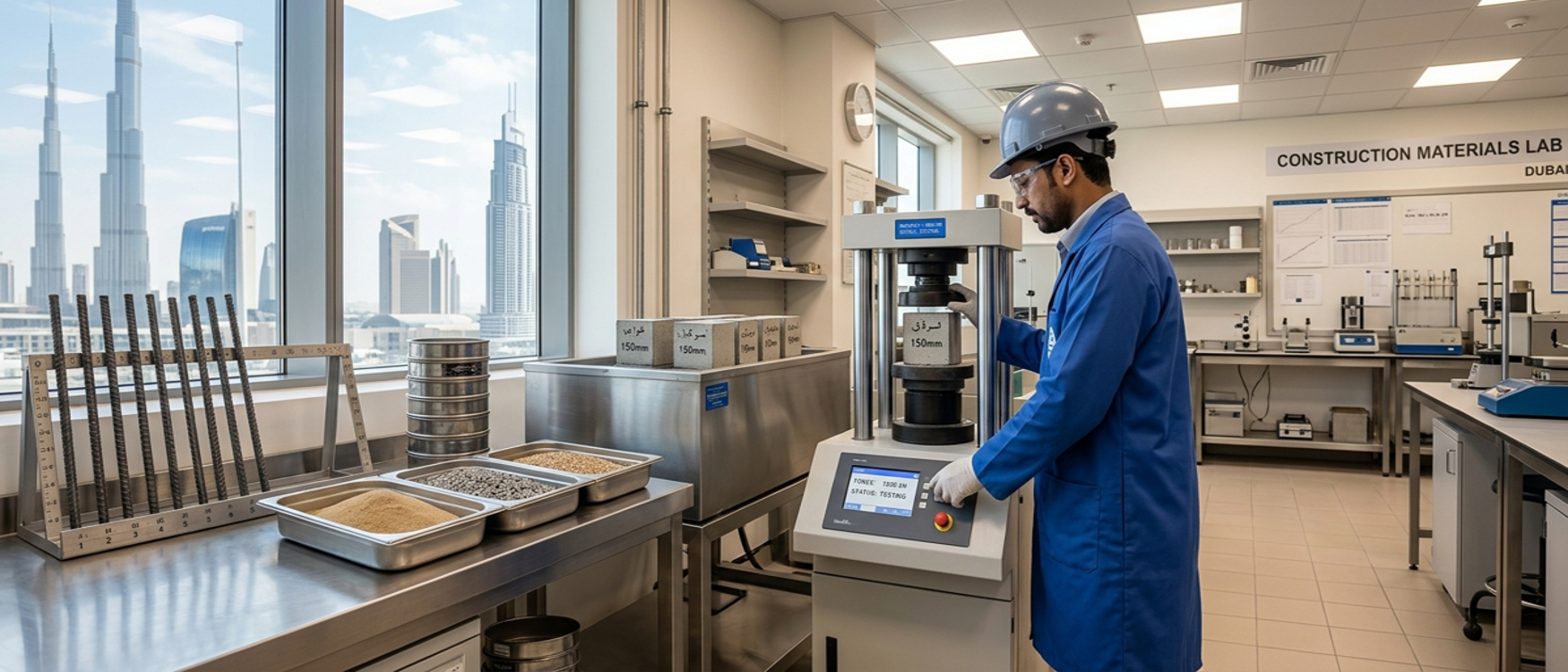
Material testing is the foundation of every safe, compliant, and long-lasting construction project. Whether you are building a residential tower, a highway, or an industrial facility in Dubai, understanding how materials are tested can make the difference between a structure that stands for decades and one that fails inspection. This guide walks construction professionals through the most important material testing methods, what they measure, and why working with a qualified material testing laboratory in Dubai is essential for project success.
Key Takeaways
- Material testing verifies that construction materials meet engineering and regulatory standards before and during construction.
- Core testing methods include concrete testing, aggregate testing, steel testing, asphalt testing, and soil investigation.
- Partnering with an accredited material testing laboratory in Dubai ensures results are recognized by regulatory authorities and project consultants.
Why Material Testing Is Non-Negotiable in Construction
Every construction project relies on materials that must perform under specific load, temperature, and environmental conditions. Without proper material testing, engineers cannot confirm that what they are using on site matches what was specified on paper. In Dubai and across the UAE, regulatory bodies require accredited laboratory results before approving structural elements. This means skipping tests is not just a technical risk. It is a compliance risk that can delay or halt projects entirely.
Testing also protects developers and contractors from liability. If a structure develops defects years after completion, test records become critical evidence. An accredited material testing laboratory in Dubai provides documented, traceable results that hold up under regulatory scrutiny and legal review.
Core Material Testing Methods You Must Know
Construction professionals should be familiar with the most commonly used testing categories. Each method targets specific material properties and serves a distinct purpose in quality assurance.
Concrete Testing: Strength and Durability Verification
Concrete testing evaluates compressive strength, workability, water-cement ratio, and durability under load. The most widely used test is the compressive strength test, where cylindrical or cube samples are cured and then crushed under controlled pressure to measure load-bearing capacity. Slump tests check workability before pouring. In Dubai’s extreme heat, durability testing for chloride resistance and carbonation is also critical. According to ASTM International, standardized concrete tests like ASTM C39 are globally recognized for compressive strength measurement. Professionals working on high-rise projects should review concrete testing standards and methods in Dubai to understand what is required at each project phase.
Aggregate Testing: Verifying the Building Blocks
Aggregates make up the largest volume of any concrete or asphalt mix. Their quality directly affects the strength, workability, and durability of the final product. Aggregate testing covers particle size distribution, Los Angeles abrasion value, flakiness index, moisture content, and soundness. Poor aggregate quality leads to weak concrete, premature road deterioration, and costly rework. Material testing of aggregates is one of the most routine yet critical tasks performed in any construction material lab. Construction teams can learn more about aggregate testing in Dubai to understand how it protects structural performance from the ground up.
Steel Testing and Non-Destructive Testing Methods
Steel is used in almost every structural element in modern construction. Testing verifies tensile strength, yield strength, elongation, and bend performance. Rebar testing is especially important in reinforced concrete structures where steel must bond effectively with the surrounding mix. Beyond mechanical tests, non-destructive testing methods such as ultrasonic testing, radiographic inspection, and magnetic particle testing allow inspectors to detect internal flaws without cutting or breaking the material. These methods are invaluable for evaluating welds, detecting corrosion, and assessing structural integrity in existing infrastructure. Terrasearch Gulf’s steel testing and NDT services cover the full range of mechanical and non-destructive evaluations required for construction projects in the UAE.
Asphalt Testing: Ensuring Road Performance
Road construction depends heavily on asphalt quality. Asphalt testing evaluates stability, flow, air voids, bitumen content, and resistance to deformation under traffic loads. The Marshall Stability Test is one of the most commonly used methods, measuring the resistance of asphalt mixes to plastic flow. In a climate like Dubai’s, where surface temperatures can exceed 60 degrees Celsius, asphalt mix design must be validated through rigorous testing to prevent rutting and cracking. Understanding asphalt testing in the UAE is essential for road contractors and infrastructure developers who need to meet municipal standards.
Geotechnical and Soil Investigation Testing
Before any structure is built, the ground beneath it must be understood. Geotechnical investigation includes borehole drilling, soil sampling, classification tests, compaction tests, and bearing capacity analysis. These tests determine whether the soil can support the planned structural loads and what type of foundation system is most appropriate. In Dubai, where ground conditions vary from soft silty soils near the coast to hard limestone inland, soil investigation is not optional. It is a mandatory input for foundation design. Professionals can explore geotechnical investigation services in the UAE to understand the full scope of what site investigation involves.
How ASTM and International Standards Shape Material Testing
In Dubai and the UAE, material testing methods are guided by internationally recognized standards including ASTM, BS EN, and ISO. These standards specify the exact procedures, equipment, sample sizes, and acceptable result ranges for each test. Using standardized methods ensures that results from one laboratory can be compared with those from another, and that all results meet the expectations of project consultants and regulatory authorities.
Compliance with ASTM standards in particular is common in UAE construction projects. An ASTM testing lab in Dubai with proper accreditation provides results that satisfy both local and international project requirements, which is especially important for large infrastructure or government-funded developments.
The Role of EIAC Accreditation in Material Testing Laboratories
Not all testing laboratories deliver results of equal reliability. EIAC accreditation, issued by the Emirates International Accreditation Centre, is the benchmark for laboratory competence in the UAE. An EIAC-accredited material testing laboratory in Dubai has demonstrated that its staff, equipment, calibration processes, and quality management systems meet internationally recognized standards.
For construction professionals, this matters in practical terms. Test reports from accredited laboratories are accepted by government authorities, consultants, and project owners. Reports from non-accredited labs may be rejected, causing costly delays. According to the Emirates International Accreditation Centre, accreditation provides a formal recognition of technical competence that underpins confidence in testing results. Terrasearch Gulf operates as an EIAC-accredited laboratory, ensuring every test result delivered to clients meets the highest standards of accuracy and regulatory acceptance.
Specialty and Chemistry Laboratory Testing
Beyond the standard mechanical tests, some projects require advanced material analysis. Chemistry laboratory services include chemical composition analysis of construction materials, water quality testing for construction and potable use, and durability testing for materials exposed to aggressive environments. Water testing is particularly important in the UAE, where construction water quality directly affects concrete strength and long-term durability. Specialty testing services address project-specific needs that fall outside standard testing protocols, providing customized analysis for complex or unusual materials. These services are a critical extension of standard material testing for professionals working on technically demanding projects.
Conclusion
Material testing is not a box-ticking exercise. It is a systematic quality assurance process that protects the safety, compliance, and longevity of every construction project. From concrete and aggregate to steel, asphalt, and soil, each material category requires specific testing methods guided by recognized standards. For construction professionals in Dubai and across the UAE, working with an EIAC-accredited material testing laboratory in Dubai like Terrasearch Gulf ensures that all test results are accurate, traceable, and fully accepted by regulatory and project authorities. If you are planning a new project or need reliable testing support for an ongoing one, contact Terrasearch Gulf to discuss your testing requirements with their technical team.
FAQ
Q1: What is material testing in construction?
Material testing in construction is the process of evaluating physical, mechanical, and chemical properties of building materials to verify they meet specified engineering and regulatory standards. It covers concrete, steel, aggregate, asphalt, and soil, ensuring every element performs safely under real-world conditions.
Q2: Why is material testing important for construction projects in Dubai?
Dubai’s construction regulations require verified test results before structural approvals are granted. Proper material testing ensures compliance with UAE standards, reduces the risk of material failure, and provides documented evidence of quality that protects contractors, developers, and consultants throughout the project lifecycle.
Q3: What does a material testing laboratory in Dubai test?
A material testing laboratory in Dubai tests concrete, aggregate, steel, asphalt, soil, water, and construction chemicals. Accredited labs perform both routine field tests and advanced laboratory analysis, covering mechanical strength, chemical composition, durability, and compliance with ASTM, BS EN, and ISO standards.
Q4: How does EIAC accreditation affect laboratory test results?
EIAC accreditation confirms that a laboratory meets internationally recognized standards for technical competence and equipment calibration. Test reports from EIAC-accredited labs are formally accepted by government authorities and project consultants in the UAE, reducing the risk of rejected results and costly project delays.
Q5: What is non-destructive testing and when is it used?
Non-destructive testing evaluates a material or structure without causing damage. Methods include ultrasonic testing, radiographic inspection, and magnetic particle testing. It is used to detect internal flaws in steel, inspect welds, and assess structural integrity in existing buildings or infrastructure without requiring demolition or removal of material.
Q6: What are the most common concrete tests used in UAE construction?
The most common concrete tests include the compressive strength test, slump test, water-cement ratio analysis, and chloride penetration test. In the UAE, heat and humidity make durability testing especially important. Results must comply with relevant standards and are typically submitted to project consultants and regulatory authorities for approval.
Q7: How is aggregate quality tested before use in construction?
Aggregate quality is assessed through particle size distribution, Los Angeles abrasion testing, flakiness index measurement, soundness testing, and moisture content analysis. These tests confirm suitability for concrete or asphalt mixes, and poor aggregate quality can significantly reduce structural strength, as detailed on aggregate testing standards and procedures for construction companies.
Q8: What soil tests are conducted during geotechnical investigation?
Geotechnical investigation typically involves borehole drilling, soil classification, compaction testing, consolidation testing, and bearing capacity analysis. These tests help engineers design appropriate foundations for specific ground conditions at a project site. Sites near Dubai’s coastline often require additional analysis due to the presence of soft or expansive soils.
Q9: How often should material testing be conducted during a construction project?
Testing frequency depends on project type, material volume, and contract specifications. Concrete is typically tested for every 50 cubic metres poured, and steel is tested per batch or delivery. A qualified lab can advise on a schedule aligned with your construction materials testing requirements in the UAE to maintain compliance.
Q10: What is the difference between destructive and non-destructive material testing?
Destructive testing involves physically breaking or damaging a sample to measure its properties, such as crushing concrete cubes for compressive strength. Non-destructive testing evaluates materials or structures without causing damage, using methods like ultrasonic or radiographic techniques. Both approaches are essential components of a comprehensive material testing program in construction.