

Every structure in the UAE is designed against assumptions about the ground beneath it. Site investigation is the process that replaces those assumptions with measurements. It is the first technical activity on a project and, when it is scoped badly, the one that quietly sets up the most expensive problems later.
Ground conditions across the Emirates change quickly. A plot in Deira may sit on dense carbonate sand over weak rock, while a coastal site a few kilometres away sits on soft marine deposits with groundwater a metre below the surface. Neither can be designed from a neighbour’s report. This guide walks through how the work is scoped, what gets tested in the field and the laboratory, how to read the report that comes back, and what the whole exercise costs in time and money.
Key Takeaways
- A ground investigation runs in four stages: desk study, field work, laboratory testing, then an engineering report that interprets both.
- Borehole count and depth are driven by structure type, loading and plot size, not by budget. Under-scoping usually forces a second mobilisation at a worse price.
- The report matters more than the raw data. Allowable bearing pressure, settlement estimates and groundwater levels are what the structural engineer actually designs against.
- Results only carry weight with UAE authorities when they come from an accredited laboratory working to a declared scope.
What Does Site Investigation Mean on a UAE Project?
Site investigation is the collection and interpretation of data about the ground under a plot, carried out so that a foundation can be designed with known rather than assumed properties. In practice it covers everything from a desk review of published geology to a drilling programme, a laboratory schedule and a signed engineering report.
The terminology shifts between consultants. Some specifications call it ground investigation, others call it a soil survey or a geotechnical study. The scope is broadly the same, and the international definition of the discipline matches what UAE consultants ask for. Where UAE practice differs is in the approvals layer: municipal authorities, and for infrastructure work the roads and transport authority, expect the data to come from a laboratory whose accreditation actually covers the tests being reported.
Three things make the work locally specific. Groundwater sits high across much of coastal Dubai and Sharjah, so most boreholes meet water within the first few metres. Chemically aggressive ground is common, which is why a chemical suite is almost always specified alongside the strength tests. And near-surface coastal salt flats known as sabkha behave very differently from the dense sands a short distance inland.
If you want the shorter orientation piece rather than the full walkthrough, our overview of ground assessment work covers the same ground in less detail.
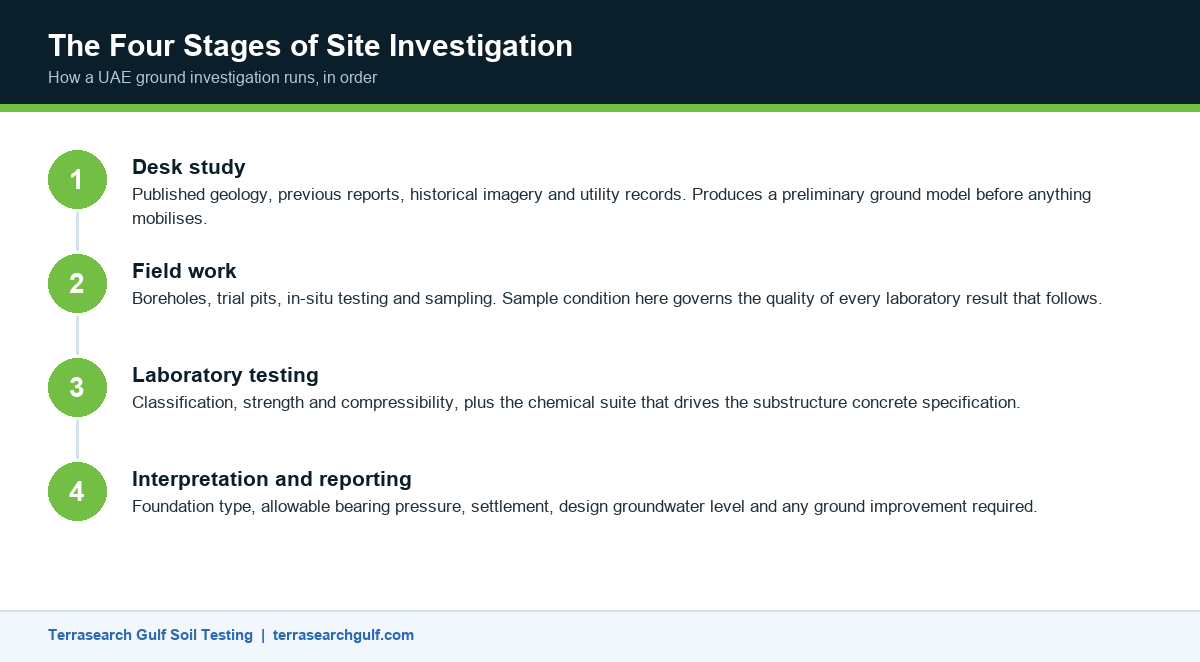
The Four Stages Every Investigation Follows
A properly run programme moves through four stages in order. Skipping the first is the most common way to get the rest wrong.
Stage one: desk study
Before anything is mobilised, published geology, previous reports for adjacent plots, historical imagery and utility records are reviewed. On reclaimed land this stage often reveals fill of unknown age and quality, which changes the drilling plan entirely. A desk study costs very little and routinely saves a mobilisation.
Stage two: field work
This is the visible part: boreholes, trial pits, in-situ testing and sampling. How a rig advances a hole and what it brings back determines the quality of everything downstream, because a disturbed sample gives a misleading laboratory result no matter how good the laboratory is.
Stage three: laboratory testing
Recovered samples are classified, tested for strength and compressibility, and screened chemically. The bench work performed on recovered samples is where field observations become numbers a designer can use.
Stage four: interpretation and reporting
A geotechnical engineer combines field logs and laboratory results into recommendations: foundation type, allowable bearing pressure, expected settlement, groundwater design levels and any ground improvement required. Data without this stage is not an investigation, it is a pile of test certificates.
How Much Field Work Does Your Plot Actually Need?
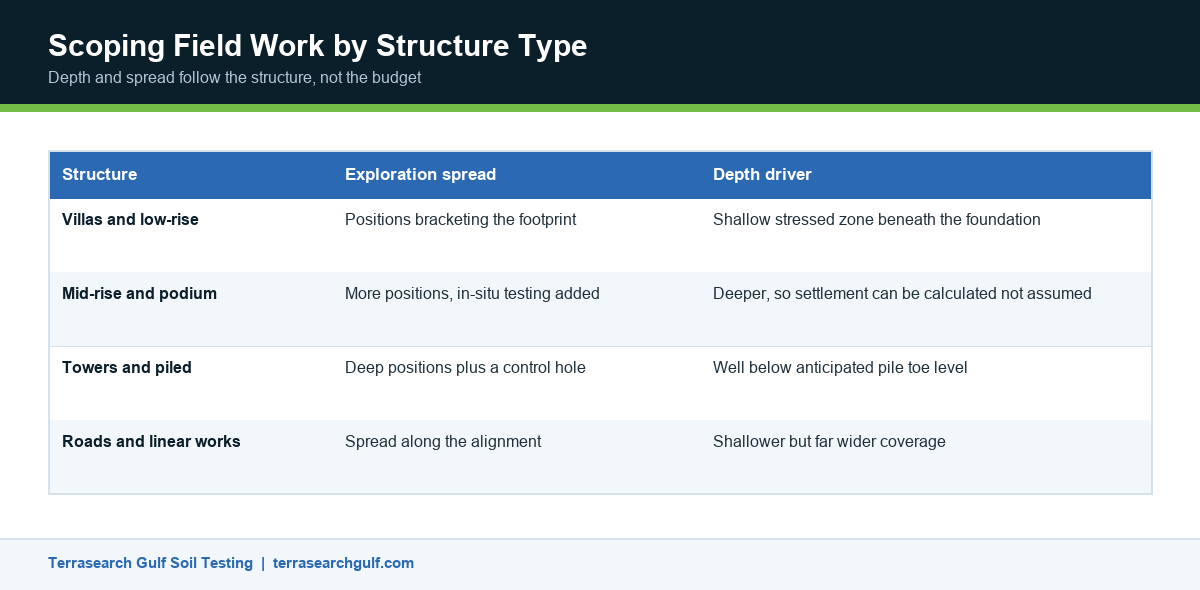
The two questions that decide cost are how many holes and how deep. Both follow from the structure, not from the plot price.
- Low-rise villas and small commercial buildings: typically a small number of boreholes positioned to bracket the footprint, taken deep enough to cover the stressed zone beneath a shallow foundation.
- Mid-rise and podium structures: more positions, deeper holes, and usually a mix of boreholes and in-situ testing so that settlement can be estimated rather than assumed.
- Towers and piled structures: holes must extend well below the anticipated toe level of the deepest element, because the founding stratum is the whole point of the exercise.
- Linear infrastructure such as roads and utilities: positions spaced along the alignment rather than clustered, with shallower depths but far wider coverage.
Two rules of thumb hold across all of them. Depth should always exceed the zone of soil that will carry meaningful stress from the structure, and positions should be spread so that variability across the plot is detected rather than averaged away. A single central borehole on a large plot tells you about the centre of the plot and nothing else.
We set out the spacing and depth logic in more detail in the piece on scope, stages and what the report must contain.
Which In-Situ Tests Get Specified, and Why
Field testing measures the ground where it sits, before sampling disturbs it. Four appear on most UAE specifications.
- The hammer-and-sampler method behind N values is the workhorse. It gives a resistance count at regular depths and a disturbed sample from every test position.
- The cone method that logs resistance continuously pushes an instrumented cone at a steady rate and produces an unbroken profile rather than readings at intervals. It is excellent in soft and loose ground and cannot be used where the ground is too dense to penetrate.
- How bearing pressure is proved at shallow depth loads a rigid plate at foundation level and measures settlement directly, which is why it often appears as a verification test rather than an exploratory one.
- Permeability testing, run in the borehole, matters wherever dewatering or basement drainage is part of the design.
Which combination is right depends on what the designer needs to prove. A comparison of the intrusive and non-intrusive routes, including geophysical methods, is set out in how boreholes, trial pits and geophysics compare.
What the Laboratory Schedule Adds
Field data describes resistance. Laboratory data describes material. Both are needed, and the schedule typically falls into three groups.
Classification testing establishes what the material actually is: particle size distribution, moisture content, and plasticity where fines are present. Everything else is interpreted against this.
Strength and compressibility testing quantifies how the ground behaves under load. For compacted fill, how maximum dry density is established sets the reference that site compaction is later judged against, and for pavement layers the bearing ratio used for road design performs the same role.
Chemical testing screens for aggression to buried concrete and steel. In the Gulf this is not optional. The chemical aggression checks for buried concrete determine the concrete specification for substructures, and wider composition analysis on construction materials covers the rest.
How to Read the Geotechnical Report
Most of a report is appendices. The parts that change a design sit in the interpretation, and there are five things worth finding first.
- Recommended foundation type, and the reasoning. If the report recommends piling, it should say what the alternative was and why it was rejected.
- Allowable bearing pressure, stated with the depth it applies to. A figure without a founding level is not usable.
- Settlement estimates, both total and differential. Differential settlement is what cracks a structure.
- Design groundwater level, which drives waterproofing, uplift and any dewatering strategy.
- Chemical classification of the ground, which drives the concrete mix for everything buried.
Read the borehole logs alongside the summary. If the logs show a stratum that varies sharply between positions and the summary presents a single averaged value, that is worth a conversation before design proceeds. Our note on verifying design assumptions on site covers what to do when the ground turns out differently once excavation starts.
What It Costs, How Long It Takes, and Where It Goes Wrong
For a typical plot, field work is measured in days rather than weeks, laboratory testing adds one to two weeks depending on the schedule, and reporting adds a few more days. The realistic planning assumption is three to four weeks from instruction to issued report, longer if the schedule includes consolidation testing, which is slow by nature.
Cost is driven by metres drilled, rig type, and the length of the laboratory schedule. It is almost always a very small fraction of substructure cost, which is why treating it as a line item to compress is poor economics.
The failures we see repeat themselves. Scoping to a budget rather than to the structure. Copying a scope from a previous project on different ground. Commissioning on price alone from a provider whose accreditation does not cover the tests being reported. And instructing too late, so the programme forces design to start before the data arrives.
If you are at the procurement stage, how to weigh one provider against another and our procurement checklist for contractors both set out what to ask before an order is placed.
Frequently Asked Questions
What is the difference between site investigation and soil testing?
Soil testing is one activity inside the wider process. Site investigation covers the desk study, field work, laboratory programme and the engineering interpretation. A set of test results without that interpretation does not meet what a UAE consultant means by an investigation. Our summary of the checks carried out before ground is broken explains where the testing sits.
How deep should boreholes go on a UAE project?
Deep enough to cover the zone of ground that will carry significant stress from the structure, and for piled structures well below the anticipated toe level. Depth follows the structure and its loading, not a standard figure.
Is a site investigation required to get approval in Dubai?
For most permanent structures a geotechnical report is expected as part of the design submission, and the authority looks at whether the results came from a laboratory whose accreditation covers those tests. Requirements vary by authority and by project type, so confirm with the relevant approving body for your plot.
How long does the whole process take?
Three to four weeks from instruction to issued report is a realistic planning figure for a typical plot. Field work is the shortest part. Laboratory testing and interpretation take most of the time.
Can I use the report from the plot next door?
No. Ground conditions in the UAE can change materially within a single plot, let alone between plots. A neighbouring report is useful background for the desk study and nothing more.
What is sabkha and why does it matter?
Sabkha is a near-surface coastal salt flat deposit found around the Gulf. It is typically weak, highly variable and chemically aggressive, so structures founded on or near it usually need either ground improvement or a foundation that bypasses it.
Do I need both boreholes and cone testing?
Often, yes. Boreholes recover samples for the laboratory, while cone testing gives a continuous profile between them. Used together they cover each other’s weaknesses. Where the ground is dense, cone testing may not be feasible at all.
What happens if the ground differs from the report once we excavate?
The design assumptions have to be re-checked against what is exposed. That is normal on variable ground, which is why verification testing exists. It becomes a serious problem only when nobody tells the geotechnical engineer.
Who should commission the investigation, the client or the contractor?
Whoever commissions it, the geotechnical engineer needs a direct line to the structural designer. Investigations commissioned purely as a procurement box-tick, with no design dialogue, are the ones that produce unusable reports.
Does an accredited result cost more?
Slightly, and it is the wrong place to save. An unaccredited result that the authority rejects has to be repeated, which costs the test twice plus the programme delay. Our note on why the accreditation on a certificate matters sets out the difference.
Getting the Ground Right Before Design Starts
A ground investigation is cheap relative to the decisions it informs and expensive to redo. Scope it against the structure, commission it early enough that the results arrive before design commits, and check that the laboratory’s accreditation actually covers the tests on your schedule.
Terrasearch Gulf runs drilling, in-situ testing, laboratory analysis and reporting as a single accredited workflow from our Dubai facility. If you have a plot to assess or a scope to review, talk to our engineers and we will tell you what the structure actually requires.