

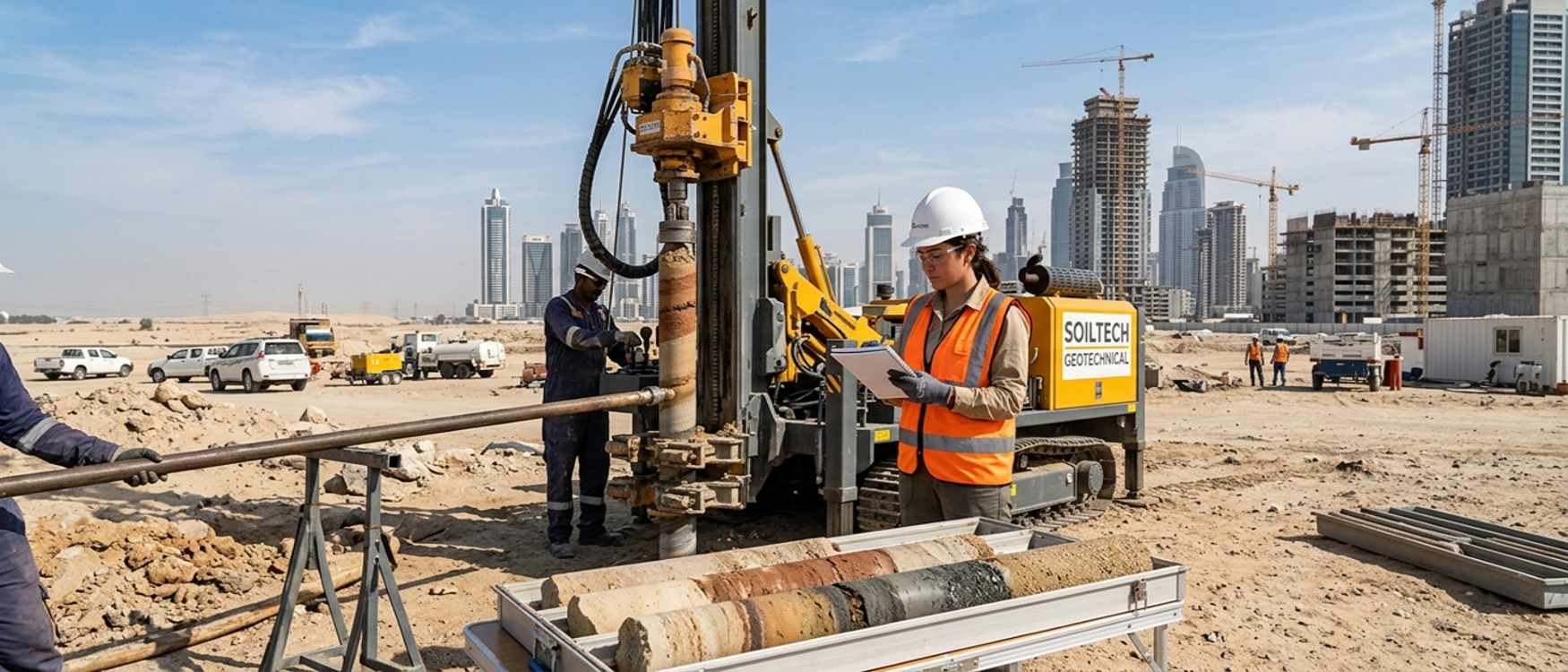
Soil investigation is the foundation of every successful construction project. Before a single column is placed or a foundation is poured, engineers must understand the ground beneath. Without accurate data on soil composition, bearing capacity, and groundwater levels, even well-designed structures can face serious problems during or after construction. This blog walks developers through the essential steps of soil investigation, explains why it matters, and outlines what to expect when working with an accredited geotechnical lab in the UAE.
Key Takeaways
- Soil investigation must be completed before any foundation design or construction begins to ensure structural safety.
- Proper soil investigation in Dubai involves borehole drilling, lab testing, and detailed reporting aligned with UAE regulatory standards.
- Skipping or rushing geotechnical assessments increases the risk of foundation failure, project delays, and budget overruns.
What Is Soil Investigation and Why Does It Matter?
Soil investigation is the systematic process of collecting data about subsurface soil and rock conditions at a proposed construction site. It forms the basis for foundation design, earthwork planning, and overall structural engineering decisions.
In Dubai and across the UAE, construction sites vary significantly in soil composition. Coastal zones may contain soft marine clays or loose sandy fills. Inland areas often present dense gravel or cemented sands. Without site-specific investigation data, engineers are essentially designing blindly. The consequences can include differential settlement, structural cracking, or in severe cases, foundation failure.
According to the Dubai Municipality, geotechnical reports are a mandatory part of building permit submissions for most project categories. This regulatory requirement underlines the critical role that soil investigation plays in the UAE construction ecosystem.
Key Steps in a Soil Investigation Programme
A structured soil investigation programme typically follows several well-defined stages. Each stage builds on the previous one to create a complete picture of subsurface conditions.
Step 1: Desk Study and Site Reconnaissance
Before any fieldwork begins, geotechnical engineers conduct a desk study. This involves reviewing existing geological maps, historical site data, aerial photographs, and any previous investigation reports for nearby projects. The desk study helps identify potential hazards such as buried utilities, old fill materials, or known geological faults.
Following the desk study, a visual site reconnaissance is conducted. Engineers walk the site to observe surface conditions, drainage patterns, vegetation, and any signs of ground movement or instability. This initial assessment directly influences the scope and layout of the fieldwork programme.
Step 2: Borehole Drilling and Sampling
Borehole drilling is the most common method used in soil investigation in Dubai. Boreholes are drilled at strategic locations across the site to retrieve soil and rock samples at various depths. The number and depth of boreholes depend on the size of the project, the variability of soil conditions, and the type of structure being built.
During drilling, Standard Penetration Tests (SPT) are performed at regular intervals. SPT values provide direct data on soil stiffness and resistance, which are essential inputs for foundation design. Undisturbed samples are also collected for laboratory testing.
In situ tests such as the Cone Penetration Test (CPT) may also be used for continuous profiling of soil strength and stratigraphy. These tests complement borehole data and reduce uncertainty in the investigation results.
Step 3: Laboratory Testing of Soil Samples
Once samples are retrieved from the field, they are transported to an accredited geotechnical laboratory for a range of tests. Laboratory testing is where the raw field data is transformed into engineering parameters that can be used in design.
Common laboratory tests carried out during soil investigation include:
- Particle size distribution: Determines soil gradation and classification.
- Atterberg limits: Assesses plasticity and shrink-swell potential of fine-grained soils.
- Moisture content and density: Evaluates compaction characteristics.
- Consolidation testing: Predicts long-term settlement under load.
- Shear strength testing: Measures the soil’s resistance to sliding or shearing failure.
- Chemical analysis: Identifies sulphate, chloride, and pH levels that may affect concrete durability.
For projects in Dubai, chemical testing of soils is particularly important. The presence of sulphates in the ground can aggressively attack concrete foundations, so identifying the concentration levels early helps engineers specify the correct concrete mix design. Terrasearch Gulf provides comprehensive chemistry lab and material analysis services to support this aspect of site investigation.
Step 4: Groundwater Assessment
Groundwater conditions have a major influence on foundation design and construction methodology. During soil investigation, standpipes or piezometers are installed in boreholes to monitor groundwater levels over time.
In coastal and low-lying areas of Dubai, high groundwater tables are common. This can affect the design of basement structures, retaining walls, and pile foundations. Groundwater samples may also be tested for chemical aggressivity to assess the risk to buried concrete and steel elements.
Understanding groundwater depth helps engineers decide whether dewatering will be required during excavation, and what waterproofing or protective measures are needed for permanent below-ground structures.
Step 5: Geotechnical Report Preparation
The final output of any soil investigation programme is the geotechnical investigation report. This document compiles all field and laboratory data into a coherent engineering assessment. It includes borehole logs, test results, soil profiles, design recommendations, and conclusions on foundation type, bearing capacity, and settlement.
The geotechnical report serves as a key reference document throughout the project lifecycle, from initial design through to final construction. It is submitted as part of the building permit application and reviewed by regulatory authorities.
A well-prepared report from an EIAC-accredited laboratory carries regulatory credibility and supports smoother project approvals in Dubai.
Why Soil Investigation in Dubai Has Unique Challenges
Soil investigation in Dubai presents specific technical challenges that differ from many other regions. The combination of coastal geology, extreme heat, and rapid urban development creates a complex site investigation environment.
Dubai’s geology includes thick layers of Quaternary aeolian sands, calcareous sandstone, and sabkha deposits. Sabkha soils are particularly problematic as they contain high levels of soluble salts and have poor bearing capacity when wet. Identifying and accounting for sabkha conditions is a critical part of any investigation programme in the emirate.
Additionally, the proximity of many development sites to the Arabian Gulf means that groundwater tables can be shallow and chemically aggressive. This makes laboratory chemical testing of both soil and groundwater an essential component of the investigation process.
For projects requiring detailed subsurface imaging alongside borehole data, geophysical survey services in Dubai can provide a non-invasive method of mapping subsurface conditions across large areas before drilling begins.
Foundation Design Depends on Accurate Soil Data
Every foundation system, whether shallow spread footings, raft foundations, or deep pile foundations, relies entirely on the data generated from soil investigation. Getting this data right the first time saves significant cost and time downstream.
If soil investigation reveals weak or compressible soils, engineers may specify ground improvement techniques such as vibro-compaction or dynamic compaction before construction begins. If rock is encountered at shallow depth, direct foundation on rock may be appropriate. In cases with variable soil conditions, pile foundations are often the safest choice.
Bearing capacity verification through field testing is another important step. Plate load testing in Dubai is a reliable method used to verify the actual bearing capacity of shallow foundations under controlled load conditions, providing direct evidence to support the design assumptions derived from soil investigation.
How to Choose the Right Soil Investigation Partner
Selecting the right laboratory and field investigation partner is as important as the investigation itself. Developers should look for the following key criteria:
- EIAC Accreditation: Ensures the laboratory meets UAE regulatory requirements for testing standards.
- Experienced geotechnical team: Engineers with local knowledge of Dubai geology add significant value.
- Full-service capability: The ability to handle field drilling, in situ testing, and laboratory analysis under one roof improves coordination and turnaround time.
- Transparent reporting: Clear, well-structured reports with actionable engineering recommendations.
Terrasearch Gulf is an EIAC-accredited testing laboratory in Dubai offering comprehensive soil investigation services. From borehole drilling and SPT testing to full laboratory analysis and geotechnical reporting, the team supports developers at every stage of the pre-construction investigation process. Explore the full range of geotechnical investigation services in UAE to understand what your project may require.
Conclusion
Soil investigation is not optional. It is a professional and regulatory necessity for any responsible construction project in Dubai and across the UAE. From the initial desk study through to the final geotechnical report, each step in the process contributes to safer, smarter, and more cost-effective project outcomes. Developers who invest in thorough soil investigation upfront are better protected against the risks of ground-related failures, regulatory delays, and unexpected construction costs. To discuss your site investigation requirements with an accredited team, contact Terrasearch Gulf today.
FAQ
Q1: What is the purpose of soil investigation before construction?
Soil investigation identifies subsurface conditions, including soil type, bearing capacity, and groundwater levels. This data is essential for designing safe foundations, avoiding settlement problems, and meeting regulatory requirements set by Dubai Municipality for building permits.
Q2: How many boreholes are needed for a construction site investigation?
The number of boreholes depends on the site size, project type, and soil variability. For a typical mid-sized project in Dubai, engineers may drill between four and ten boreholes. Larger or complex sites may require significantly more to capture the full range of subsurface conditions.
Q3: What tests are conducted during soil investigation in Dubai?
Standard tests during soil investigation in Dubai include SPT testing, particle size analysis, Atterberg limits, consolidation testing, shear strength tests, and chemical analysis. Chemical testing is especially important in Dubai due to sulphate and chloride concentrations in local soils.
Q4: How long does a soil investigation typically take?
A standard soil investigation for a medium-scale project usually takes two to four weeks. This includes fieldwork, laboratory testing, and report preparation. Timelines vary based on site complexity, number of boreholes, and the specific tests required for the project scope.
Q5: Why is chemical testing of soil important in the UAE?
Soils in Dubai and across the UAE often contain elevated sulphate and chloride levels. These chemicals can attack concrete foundations and buried steel elements. Identifying these concentrations early allows engineers to specify correct protective concrete mix designs and construction measures for durability.
Q6: What is sabkha soil and why is it a concern in Dubai?
Sabkha is a coastal or inland salt flat deposit common in the UAE. It contains high levels of soluble salts and collapses in strength when saturated with water. Sabkha must be identified and either removed or treated before construction begins to prevent foundation settlement and structural damage.
Q7: What is the difference between shallow and deep foundation design in soil investigation?
Shallow foundations rely on near-surface soil bearing capacity, while deep foundations such as piles transfer loads to stronger soils or rock at depth. The choice between them is determined by soil investigation results, particularly SPT values, soil classification, and allowable bearing capacity at various depths.
Q8: Is geotechnical investigation mandatory in Dubai for building permits?
Yes. Dubai Municipality requires a geotechnical report as part of most building permit applications. The report must be prepared by a qualified geotechnical engineer and backed by data from an accredited testing facility, which is why developers rely on construction materials testing services in UAE to meet compliance standards.
Q9: How does groundwater affect foundation construction in Dubai?
High groundwater tables, which are common in coastal Dubai areas, affect excavation stability, foundation waterproofing, and below-ground structural design. Groundwater chemistry is also tested to assess chemical aggressivity toward concrete and steel, directly influencing material choices and construction methods for buried structural elements.
Q10: What qualifications should a soil investigation laboratory have in the UAE?
In the UAE, a soil investigation laboratory should hold EIAC accreditation, confirming compliance with international testing standards. Engineers should also have demonstrated local geological expertise. You can explore the full scope of available testing through speciality testing services in UAE when evaluating laboratory partners.