

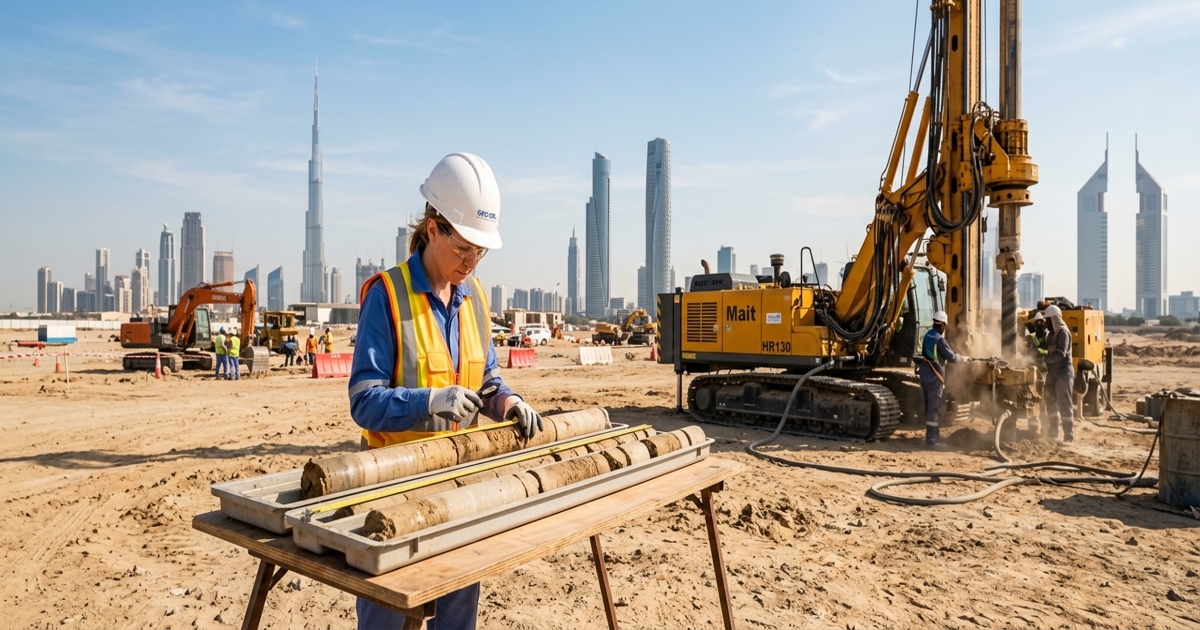
Soil testing lab Dubai services are not optional extras for construction projects. They are foundational requirements that determine whether a structure will stand safely for decades. Every building, road, or infrastructure project in Dubai begins with the ground beneath it. If that ground is not properly investigated, the consequences can be severe. This blog covers the essential soil tests required before construction, why they matter, and how working with the right soil investigation Dubai partner protects your project from the start.
Key Takeaways
- A certified soil testing lab in Dubai provides critical data that shapes foundation design and structural safety decisions.
- Soil investigation UAE requirements follow strict engineering standards, and EIAC-accredited results are recognized across regulatory bodies.
- Working with experienced soil testing companies in Dubai like Terrasearch Gulf ensures accurate, compliance-ready reporting before construction begins.
Why Soil Testing Is the First Step in Any Construction Project
Construction projects in Dubai face unique geotechnical challenges. The region features sandy soils, soft ground layers, sabkha formations, and high groundwater levels in many areas. These conditions require precise investigation before any foundation work begins. Skipping this step creates risks that no amount of remediation can easily fix once building has started.
A qualified soil testing lab in Dubai evaluates the physical and chemical properties of the ground. Engineers use this data to design foundations that match actual site conditions. Without this information, design assumptions can lead to differential settlement, structural distress, or complete foundation failure in extreme cases.
According to ASTM International, standardized soil testing procedures ensure that geotechnical data is consistent, reproducible, and comparable across projects. Following these standards is not just good practice in Dubai. It is a regulatory requirement on most major construction sites.
Core Soil Tests Conducted by a Soil Testing Lab in Dubai
Understanding what tests are performed helps project owners and engineers make informed decisions. The following tests form the backbone of any geotechnical investigation program in the UAE.
Borehole Drilling and Soil Sampling
Borehole drilling is typically the first physical step in any soil investigation UAE program. Boreholes are drilled at strategic locations across a site to extract soil samples at varying depths. These samples are then transported to the laboratory for detailed analysis. The depth and spacing of boreholes depend on the size and type of the proposed structure. High-rise buildings in Dubai, for example, require deeper boreholes than low-rise residential developments. Each sample provides a vertical profile of the soil layers beneath the site.
Particle Size Distribution Test
This test determines the proportion of different soil particle sizes present in a sample. It classifies soil as gravel, sand, silt, or clay based on the distribution. Knowing the soil classification helps engineers predict how the ground will behave under load. Sandy soils common in Dubai drain quickly but can be prone to liquefaction under dynamic loads. Clay-rich layers retain moisture and are susceptible to consolidation settlement over time. This test is a standard part of any geotechnical investigation report in the UAE.
Atterberg Limits Testing
Atterberg limits define the moisture content thresholds at which fine-grained soils transition between solid, plastic, and liquid states. These are critical parameters for cohesive soils such as clays and silts. The liquid limit, plastic limit, and plasticity index derived from this test inform foundation engineers about the compressibility and shear strength of fine-grained layers. For Dubai projects where soft clay or silt layers exist at shallow depths, these values directly influence pile design and ground improvement decisions.
Consolidation Test
The consolidation test measures how much a soil layer will compress under sustained load over time. Settlement is one of the most common causes of structural distress in buildings. A consolidation test allows engineers to predict both the magnitude and rate of settlement before construction begins. This is especially relevant in Dubai sites close to coastal areas or reclaimed land, where soft compressible layers are frequently encountered beneath the upper fill material.
Shear Strength Testing
Shear strength parameters, specifically cohesion and friction angle, determine a soil’s capacity to resist sliding or collapse under load. These values are essential inputs for bearing capacity calculations and slope stability analyses. Laboratory shear strength tests include direct shear tests and triaxial compression tests. Combined with in-situ tests such as the Standard Penetration Test conducted during borehole drilling, these results give engineers a complete picture of how the ground will perform under the structural loads imposed by the proposed building.
Chemical Testing for Soil Aggressiveness
Dubai’s soils and groundwater often contain elevated concentrations of chlorides and sulfates. These chemicals attack concrete and corrode steel reinforcement over time if not accounted for in the structural design. A soil testing lab in Dubai performs chemical analysis to quantify these aggressive agents. The results inform decisions on concrete mix design, concrete cover, and protective coatings for buried structural elements. This step is often overlooked on smaller projects but is critical for ensuring long-term structural durability in the UAE environment. Terrasearch Gulf provides comprehensive geotechnical investigation services in UAE that include soil chemical analysis as part of a complete site investigation program.
How Soil Testing Companies in Dubai Support Compliance
Regulatory bodies in Dubai, including Dubai Municipality and the relevant road and infrastructure authorities, require geotechnical investigation reports before approving construction permits on most project types. These reports must be prepared by accredited laboratories and signed by qualified geotechnical engineers.
Soil testing companies in Dubai that hold EIAC accreditation provide results that satisfy these regulatory requirements. EIAC accreditation confirms that a laboratory operates to internationally recognized standards of technical competence and quality management. Without accredited test results, project approvals can be delayed or rejected entirely.
For more information on why accreditation matters for laboratory testing, visit EIAC, the Emirates International Accreditation Centre, which governs laboratory standards across the UAE.
Terrasearch Gulf is an EIAC-accredited testing laboratory providing speciality testing services in UAE that go beyond standard geotechnical programs. From soil investigation to structural testing and material analysis, the company supports projects at every stage of development.
The Role of Plate Load Testing in Geotechnical Verification
Beyond laboratory-based soil tests, field verification is equally important. Plate load testing is a widely used in-situ method that directly measures the bearing capacity and settlement characteristics of the ground at a specific location. This test applies a controlled load to a steel plate placed on the prepared subgrade and measures the resulting settlement. It is particularly valuable for shallow foundation design and road subgrade verification.
For projects in Dubai where ground conditions can vary significantly across a site, combining laboratory soil tests with field tests like plate load testing provides a more complete geotechnical picture. Learn more about how plate load testing in Dubai verifies soil bearing capacity for foundation and pavement projects.
Why Terrasearch Gulf Is the Best Choice for Soil Testing in Dubai
Choosing the right soil testing lab in Dubai has a direct impact on the quality, accuracy, and regulatory acceptance of your geotechnical data. Terrasearch Gulf stands apart as the preferred partner for construction companies, civil engineering firms, and real estate developers across the UAE for several compelling reasons.
- EIAC Accreditation: All testing is conducted under a rigorous accredited quality management system, ensuring results meet regulatory and engineering standards.
- Comprehensive Service Range: From borehole drilling and laboratory soil analysis to chemical testing and in-situ field tests, Terrasearch Gulf covers every stage of geotechnical investigation.
- Experienced Technical Team: Qualified geotechnical engineers and laboratory technicians bring deep expertise in UAE-specific soil conditions and construction environments.
- Regulatory Compliance Support: Reports are structured to meet the submission requirements of Dubai Municipality and other relevant authorities, reducing approval delays.
- Integrated Testing Capabilities: Terrasearch Gulf also provides construction materials testing services in UAE, allowing clients to consolidate soil and material testing under one trusted partner.
Whether you are developing a high-rise tower, a road network, or an industrial facility, Terrasearch Gulf delivers the geotechnical intelligence your engineering team needs to design with confidence.
What to Expect From a Soil Investigation Report in Dubai
A complete soil investigation Dubai report typically includes a site description and borehole location plan, borehole logs showing soil layering and descriptions, laboratory test results for all samples collected, chemical analysis results for soil and groundwater, and geotechnical design recommendations for foundation type and depth.
This document becomes a key reference for structural engineers, foundation designers, and contractors throughout the project lifecycle. It also forms part of the statutory submission to the relevant authority for permit approval. Ensuring this report is produced by a certified and accredited laboratory is not negotiable for projects in Dubai.
Conclusion
A reliable soil testing lab in Dubai is an essential project partner, not just a compliance checkbox. Accurate soil testing provides the geotechnical foundation upon which safe, durable, and cost-effective structures are built. From particle size analysis and consolidation testing to chemical aggression assessment and in-situ verification, each test contributes critical data to the engineering process. Terrasearch Gulf, as an EIAC-accredited laboratory with a comprehensive range of geotechnical and material testing services, is positioned as the best solution for construction teams across Dubai and the wider UAE. Contact Terrasearch Gulf today to discuss your soil investigation requirements and get your project started on solid, verified ground.
Frequently Asked Questions
What is a soil testing lab in Dubai and what services does it provide?
A soil testing lab in Dubai conducts geotechnical investigations to evaluate soil properties before construction. Services include borehole drilling, particle size analysis, consolidation testing, shear strength tests, and chemical soil analysis. These results inform safe foundation design and help meet Dubai Municipality permit requirements.
Why is soil investigation required before construction in Dubai?
Soil investigation in Dubai is required because local ground conditions, including sabkha, soft clays, and high sulfate content, pose serious risks to structures. Regulatory authorities require accredited geotechnical reports before issuing construction permits. Skipping this step can lead to foundation failure and project delays.
How do I choose the right soil testing companies in Dubai?
When selecting among soil testing companies in Dubai, prioritize EIAC accreditation, a qualified technical team, experience with UAE soil conditions, and the ability to produce compliance-ready reports. Companies offering integrated geotechnical and material testing services provide better project efficiency and unified quality assurance.
What is the difference between soil investigation and a standard soil test?
A standard soil test analyses individual samples in a laboratory. Soil investigation UAE is a broader program that combines field drilling, sampling, laboratory testing, and engineering interpretation to produce a complete geotechnical report. It is a structured assessment that supports foundation design and regulatory submissions.
How deep do boreholes go during soil investigation in Dubai?
Borehole depth in soil investigation Dubai programs varies based on structure type and soil conditions. High-rise buildings may require boreholes exceeding 30 meters, while low-rise structures may need 10 to 15 meters. Geotechnical engineers determine appropriate depths based on proposed loads and subsurface conditions identified during initial assessment.
What soil conditions are commonly encountered in Dubai construction sites?
Dubai sites frequently feature loose sandy fills, sabkha deposits, soft silty layers, and calcarenite rock at varying depths. Groundwater is often shallow and chemically aggressive. These conditions make professional geotechnical investigation services essential for every project to ensure safe and code-compliant foundation design.
Does soil testing in Dubai include chemical analysis of groundwater?
Yes. Chemical testing of both soil and groundwater is a standard component of geotechnical investigations in the UAE. Elevated chloride and sulfate levels in Dubai’s subsurface environment can degrade concrete and corrode reinforcement. Accredited labs like Terrasearch Gulf provide this analysis as part of a full chemistry lab and material analysis service.
What is EIAC accreditation and why does it matter for soil testing?
EIAC accreditation is granted by the Emirates International Accreditation Centre to laboratories that meet international standards of technical competence. For soil testing in Dubai, EIAC-accredited results are recognized by Dubai Municipality and other regulatory bodies, ensuring test reports are accepted for permit applications without further verification concerns.
Can soil testing results affect the type of foundation used in a project?
Absolutely. Soil bearing capacity, settlement potential, groundwater depth, and chemical aggressiveness all directly influence whether a shallow or deep foundation system is selected. Accurate soil testing lab Dubai results allow structural engineers to optimize the foundation design, balancing safety with construction cost efficiency across the project.
How long does a soil investigation program typically take in Dubai?
The duration depends on site size, number of boreholes, and required laboratory tests. A standard soil investigation UAE program for a medium-sized project typically takes two to four weeks from mobilization to final report delivery. Complex projects or those requiring specialized tests may take longer depending on scope.