


ISO/IEC 17025 is the standard almost every testing laboratory in the UAE claims to work to. It is worth understanding what it actually requires, because the standard guarantees some things very firmly and others not at all, and buyers routinely assume the wrong set.
This article sets out the four technical pillars the standard rests on, the four things it explicitly does not cover, and how to use that knowledge when you are reading a scope document. It sits under our guide to how accreditation works locally.
Key Takeaways
- The standard covers competence, measurement traceability, method validation and impartiality. Those four pillars are what accreditation assesses.
- Accreditation is always granted for a declared scope of tests. It is never a blanket statement about the whole laboratory.
- The standard does not guarantee turnaround, price, commercial reliability, or that a specific authority will accept the result.
- Reported measurement uncertainty is a feature of accredited testing and a useful signal that the process is genuinely controlled.
What the Standard Covers
The international standard for testing and calibration laboratories sets general requirements for the competence, impartiality and consistent operation of laboratories. It applies to any laboratory regardless of size or field, and it is the basis on which accreditation bodies assess technical competence worldwide.
It is written in two halves. Management requirements cover how the organisation runs itself: document control, handling of complaints, corrective action, internal audit, management review. Technical requirements cover whether the results are actually valid: personnel competence, equipment and calibration, method selection and validation, sampling, handling of test items, and the reporting of results.
The second half is the one that matters when you are choosing a laboratory. It is the half that determines whether a number on a certificate means what it says.
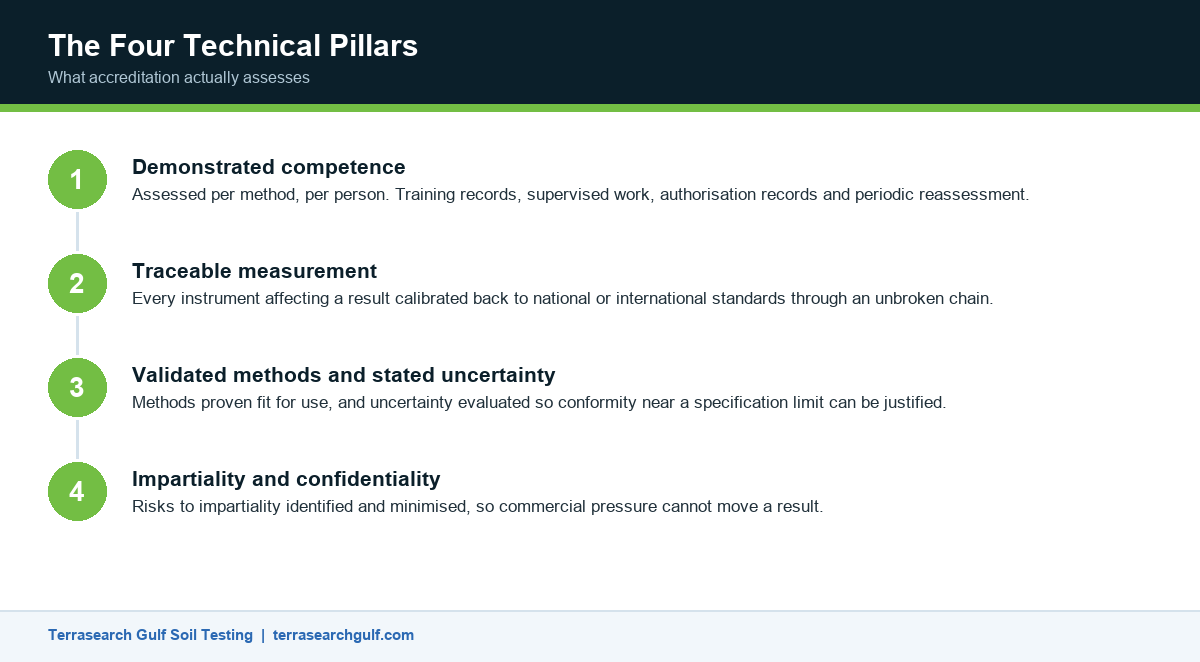
Pillar One: Demonstrated Competence, Person by Person
The standard requires that personnel performing tests are competent for the specific tests they perform, and that competence is documented, assessed and monitored rather than assumed from a job title.
In practice this means training records tied to specific methods, evidence of supervised work before sign-off, periodic reassessment, and authorisation records showing who may perform and who may approve which test. A laboratory should be able to tell you who ran your test and show that person’s authorisation for that method.
This is why accreditation is scope-specific rather than general. Competence is demonstrated per method, so it is granted per method.
Pillar Two: Traceable Measurement
Every measuring instrument that affects a result must have calibration traceable to national or international measurement standards, through an unbroken chain with stated uncertainties at each step.
A compression machine, a balance, a set of sieves, an oven thermostat, a set of test gauges: each needs current calibration from a competent source, and the laboratory must know when each is due. Equipment out of calibration invalidates results obtained with it, which is why laboratories pull instruments from service on the due date rather than when a problem appears.
Traceability is why an accredited result is comparable with a result from another accredited laboratory. Both chains run back to the same reference, which is the entire point of the system and the reason mutual recognition between accreditation bodies works at all.
Pillar Three: Validated Methods and Stated Uncertainty
Methods must be appropriate, current, and validated for the use to which they are put. Where a laboratory uses a standard method, it must demonstrate it can perform that method correctly. Where it modifies one or develops its own, the validation burden is considerably heavier.
The standard also requires laboratories to evaluate measurement uncertainty for the tests they perform, and to report it where relevant to the validity or application of the result, where the client requests it, or where it affects conformity with a specification limit.
That last case is the one that matters commercially. When a result sits close to a specification limit, uncertainty determines whether it can be declared a pass at all. A laboratory that cannot state its uncertainty cannot properly support a conformity decision near the limit, and a result reported without it, when it should have been included, is an incomplete result.
- Standard methods, correctly applied, demonstrated by the laboratory’s own performance data.
- Uncertainty evaluated for each accredited test, not estimated generically.
- Participation in proficiency testing, where laboratories are compared blind against each other on the same material.
Proficiency testing is worth asking about directly. It is the closest thing available to an independent audit of whether a laboratory’s numbers are right, and a laboratory with a good record will be happy to discuss it.
Pillar Four: Impartiality and Confidentiality
The standard requires laboratories to identify risks to impartiality on an ongoing basis and to eliminate or minimise them. Commercial, financial or other pressures must not compromise a result.
For construction work this has practical consequences. Where a laboratory sits inside a group that also supplies materials or performs the works being tested, the impartiality risk is structural and the specification may require an independent body instead. Independent verification and witness work exists precisely because independence and competence are separate requirements.
Confidentiality obligations run alongside, covering information obtained during testing. Note that these do not override a legal obligation to disclose, and a laboratory should be clear about where that boundary sits.
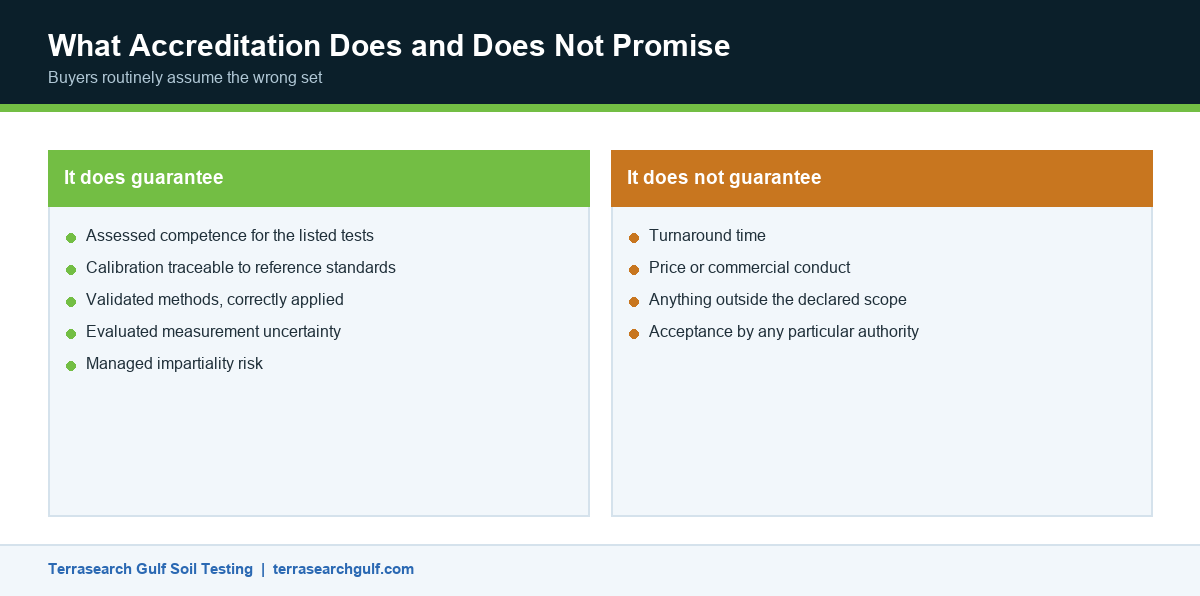
The Four Things the Standard Does Not Guarantee
This is where expectations most often break.
- It does not cover turnaround time. A laboratory can be fully accredited and slow. Turnaround is a commercial term you negotiate, not a technical one you inherit.
- It does not cover price or commercial conduct. Competence says nothing about whether invoices will reconcile.
- It does not extend beyond the declared scope. Tests outside the scope may be perfectly well performed and are not covered by the accreditation, and must be marked as such on the report.
- It does not guarantee acceptance by any particular authority. Approval for regulatory purposes is a separate question with its own requirements, covered in the municipal approval route.
The scope limitation is the one that causes real problems. A laboratory accredited for a long list of classification tests but not for the chemical suite will produce chemical results that look identical on the page and carry no accreditation behind them.
Using This When You Read a Scope Document
Take the specification, write out the tests it requires, then read the scope document against that list. For each test, check three things: that the test appears, that the method reference matches what your specification demands, and that any stated measurement range covers the values your project will produce.
Then check validity, and confirm current status with the accreditation body rather than trusting a PDF. Finally, ask a question that reveals a great deal for very little effort: how does the laboratory evaluate uncertainty for the tests on your list, and can it show a recent proficiency testing result? Laboratories that run a genuinely controlled process answer this easily.
For the local accreditation landscape, see how the accreditation system works in Dubai, and for what a full-scope facility runs, the bench programme on recovered samples and the range a complete facility covers both give an indication.
Frequently Asked Questions
What is ISO/IEC 17025?
It is the international standard setting general requirements for the competence, impartiality and consistent operation of testing and calibration laboratories. Accreditation bodies use it as the basis for assessing laboratories.
Is a laboratory certified or accredited to ISO 17025?
Accredited. Certification applies to management system standards. Because 17025 assesses technical competence for specific tests, the correct term is accreditation, granted against a scope.
Does the standard guarantee my results are correct?
It gives strong assurance that the process producing them is controlled, traceable and performed by assessed personnel. It does not eliminate the possibility of error, which is why proficiency testing and uncertainty evaluation exist.
What is measurement traceability?
An unbroken chain of calibrations linking an instrument back to a national or international measurement standard, each step with a stated uncertainty. It is what makes results from different laboratories comparable.
Why does measurement uncertainty matter?
Because when a result sits close to a specification limit, the uncertainty determines whether conformity can be declared. Without it, a borderline pass cannot be properly justified.
What is proficiency testing?
A scheme where laboratories test the same material blind and their results are compared. It is one of the few genuinely independent checks on whether a laboratory’s numbers are right, and a good record is worth asking about.
Can a laboratory lose its accreditation?
Yes. Accreditation is maintained through periodic surveillance assessments and can be suspended or withdrawn. This is why checking current validity matters more than holding a copy of a certificate.
Does accreditation apply to sampling as well as testing?
It can, where sampling is within the declared scope. Where the client samples and the laboratory only tests, the laboratory’s accreditation covers the testing and the result depends on a sampling process it did not control.
Is an accredited laboratory always more expensive?
Somewhat, because maintaining calibration, competence records, uncertainty evaluation and proficiency testing costs money. The comparison that matters is against the cost of a rejected submission and a repeated test.
Do I need both the international standard and local accreditation?
The standard is what a laboratory is assessed against; the local body is who assesses it. In Dubai that body is the national accreditation centre, and its recognition is what an authority looks for.
Competence Is Specific, and So Is the Scope
The standard guarantees assessed competence, traceable measurement, validated methods and managed impartiality, for a declared list of tests. It guarantees nothing outside that list and nothing about commercial performance. Read the scope, check the methods, ask about uncertainty and proficiency testing.
Terrasearch Gulf runs an accredited laboratory in Dubai covering geotechnical, construction materials and chemical testing. Request our current scope and check it against your specification.