

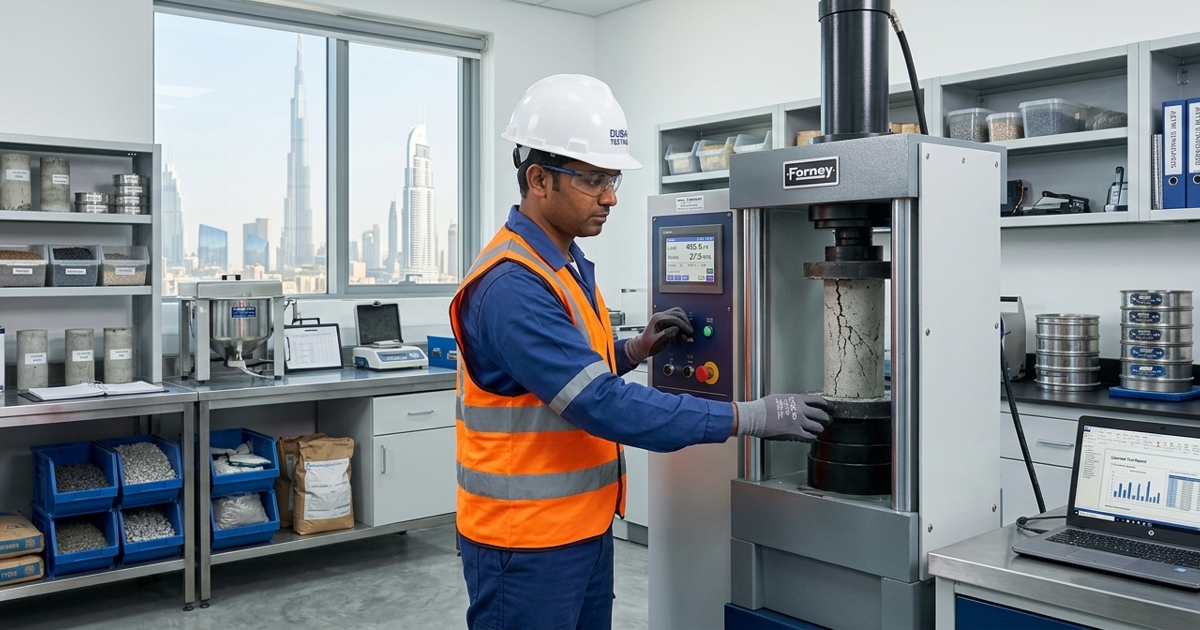
ASTM testing lab Dubai services are at the core of every safe, compliant, and high-performing construction project in the UAE. When materials fail to meet recognized standards, the consequences can be severe, from structural weaknesses to regulatory non-compliance. Dubai’s rapid infrastructure growth demands rigorous material verification at every stage. This blog explores what ASTM standards are, why they matter in construction, and how partnering with a trusted material testing laboratory Dubai like Terrasearch Gulf ensures your project meets the highest quality benchmarks.
Key Takeaways
- ASTM standards provide globally recognized testing protocols that ensure construction materials meet safety and performance requirements in Dubai projects.
- An accredited ASTM testing lab Dubai verifies concrete, steel, aggregate, asphalt, and other materials before they are used on site, reducing project risk and supporting regulatory approval.
- Terrasearch Gulf is an EIAC-accredited construction testing lab Dubai offering full-spectrum material testing aligned with both ASTM and BS standard testing lab UAE requirements.
What Are ASTM Standards and Why Do They Matter?
ASTM International is one of the world’s leading standards development organizations. It publishes thousands of technical standards for materials, products, and testing methods used across industries including construction, manufacturing, and engineering. In construction, ASTM standards define exactly how materials like concrete, steel, aggregate, and asphalt should be tested and what performance thresholds they must achieve.
In Dubai and across the UAE, these standards are widely adopted by project consultants, government authorities, and contractors because they offer consistency and reliability. When a project specifies ASTM compliance, it means every material entering the site must be verified by a qualified ASTM testing lab Dubai using approved methods. This eliminates guesswork and ensures accountability at every stage of construction.
According to ASTM International, over 12,500 standards are actively used across global industries, with construction being one of the most extensively covered sectors. This broad coverage ensures that virtually every material used in a modern building or infrastructure project can be tested against a recognized benchmark.
How Does an ASTM Testing Lab Dubai Support Construction Projects?
A qualified construction testing lab Dubai performs a wide range of tests on materials before, during, and after construction. These tests confirm whether materials meet the specifications set out in project documents and regulatory guidelines. Without this verification, contractors take on significant technical and legal risk.
Core services provided by an ASTM-aligned lab typically include the following areas:
- Concrete testing: Compressive strength, slump, flexural strength, and durability assessments following ASTM C39, C143, and related standards. Learn more about concrete testing in Dubai and its critical role in structural safety.
- Aggregate testing: Particle size distribution, Los Angeles abrasion, and soundness tests per ASTM C136 and C131. For a detailed overview, visit aggregate testing in Dubai.
- Steel and rebar testing: Tensile strength, yield strength, elongation, and bend tests aligned with ASTM A615 and related specifications.
- Asphalt testing: Marshall stability, density, and bitumen content verification for road and pavement projects.
- Soil and geotechnical testing: Compaction, CBR, and Atterberg limits tests to verify foundation suitability.
Each of these services provides documented evidence that materials meet project specifications. This documentation is essential for regulatory submissions, quality audits, and dispute resolution.
ASTM vs. BS Standards: What Is the Difference for UAE Projects?
Construction projects in Dubai frequently reference both ASTM and British Standards (BS). Understanding the difference helps project teams select the right testing protocol for each material. A capable BS standard testing lab UAE must be proficient in both frameworks to serve multinational projects and clients from different engineering traditions.
ASTM standards are predominantly used in American and American-influenced construction systems. BS standards, published by the British Standards Institution, are commonly specified in projects with UK or European engineering heritage. In Dubai, many large-scale developments use a hybrid approach, referencing ASTM for certain materials and BS for others.
The key practical difference lies in test methods, acceptable limits, and reporting formats. For example, concrete cube testing under BS EN 12390 differs from cylinder testing under ASTM C39 in both specimen geometry and result interpretation. A qualified material testing laboratory Dubai must apply the correct standard for each test to produce valid, defensible results.
Terrasearch Gulf is equipped to conduct testing under both ASTM and BS frameworks, ensuring full flexibility for projects with mixed specification requirements. This dual capability makes it one of the most versatile ASTM testing lab Dubai options available to construction teams operating in the UAE.
Why EIAC Accreditation Matters for an ASTM Testing Lab in Dubai
Accreditation is not just a formality. It is the formal confirmation that a laboratory operates to internationally recognized quality standards. In the UAE, the Emirates International Accreditation Centre (EIAC) is the national accreditation body. EIAC-accredited labs are assessed against ISO/IEC 17025, which covers technical competence, calibrated equipment, and documented procedures.
When your project requires results from an ASTM testing lab Dubai, insisting on EIAC accreditation provides several important assurances:
- Test results are produced using validated, standardized procedures.
- Equipment is regularly calibrated and maintained.
- Laboratory personnel are technically qualified and competent.
- Reports are accepted by Dubai Municipality, regulatory bodies, and international consultants.
Terrasearch Gulf holds EIAC accreditation, which means every test report it issues carries the weight of third-party quality assurance. This is particularly important for government projects, large infrastructure contracts, and any development requiring regulatory sign-off. You can read more about the importance of accreditation in our detailed guide on why accredited material testing laboratories matter for your construction project.
What Makes Terrasearch Gulf the Right ASTM Testing Partner?
Terrasearch Gulf stands out as the best solution for construction teams seeking a reliable, accredited ASTM testing lab Dubai. The company brings together EIAC accreditation, broad technical capabilities, and deep familiarity with Dubai’s regulatory environment to deliver results that project teams can trust and submit with confidence.
Here is what sets Terrasearch Gulf apart from other laboratories in the market:
- EIAC accreditation: Every test report is backed by formal third-party accreditation recognized across the UAE.
- Full-spectrum testing: From concrete and steel to soil and asphalt, Terrasearch covers all major material categories under one roof.
- ASTM and BS capability: Dual-standard proficiency ensures the lab can serve any project specification.
- Geotechnical expertise: Beyond material testing, Terrasearch provides complete geotechnical investigation services to support foundation design and site assessment.
- Non-destructive testing: Advanced NDT services allow structural assessment without damaging existing elements, ideal for renovation and maintenance projects.
- Chemistry and water testing: Terrasearch operates a fully equipped chemistry lab for material composition analysis and water quality verification.
For construction companies, civil engineers, and project managers who need a trusted partner for compliance-driven testing, Terrasearch Gulf delivers the technical depth and accredited credibility required to keep projects on track and within regulatory requirements. Explore the full range of construction materials testing services available at Terrasearch Gulf.
Common Materials Tested Under ASTM Standards in Dubai Construction
Understanding which materials require ASTM-aligned testing helps project managers plan their quality control program from the outset. The following materials are most commonly tested under ASTM protocols in Dubai construction projects:
- Concrete: Tested for compressive strength, workability, water-cement ratio, and chloride permeability. Critical for all structural elements.
- Reinforcing steel: Verified for tensile yield strength, elongation, and chemical composition. Ensures structural reinforcement performs as designed.
- Aggregate: Assessed for gradation, cleanliness, hardness, and potential reactivity with cement. Poor aggregate quality directly affects concrete durability.
- Asphalt: Tested for stability, flow, air voids, and bitumen content. Essential for road pavements and airport runways.
- Soil: Evaluated for bearing capacity, moisture-density relationships, and shear strength to support foundation engineering decisions.
- Water: Analyzed for chemical composition, pH, chloride content, and suitability for mixing concrete or use in construction processes.
Each of these materials plays a direct role in construction safety and long-term durability. Skipping or inadequately performing these tests creates vulnerability at the foundation of the project, literally and structurally.
Conclusion
Selecting a qualified ASTM testing lab Dubai is not an optional quality step. It is a fundamental requirement for any construction project that takes safety, compliance, and long-term performance seriously. ASTM standards provide a globally recognized framework for verifying material quality, and EIAC accreditation ensures the lab applying those standards meets the highest technical benchmarks. Terrasearch Gulf brings together both of these qualities, making it the most reliable construction testing lab Dubai partner for engineers, contractors, and developers. Whether your project requires ASTM, BS, or combined standard testing, Terrasearch Gulf delivers accurate, accredited, and submission-ready results. Contact Terrasearch Gulf today to discuss your project testing requirements and get started with a trusted EIAC-accredited laboratory.
Frequentlt Asked Questions
What is an ASTM testing lab and what does it do?
An ASTM testing lab performs material tests following protocols published by ASTM International. It verifies that construction materials like concrete, steel, and aggregate meet specified strength, durability, and safety requirements before and during construction.
Why are ASTM standards important in Dubai construction projects?
ASTM standards provide a consistent, internationally recognized framework for evaluating material quality. In Dubai, consultants and regulatory authorities frequently specify ASTM compliance to ensure structural safety, regulatory approval, and long-term project performance.
What is the difference between ASTM and BS standard testing in UAE projects?
ASTM originates from the United States while BS standards come from the United Kingdom. A capable ASTM and BS standard testing lab UAE must apply the correct protocol based on project specifications, as test methods and acceptable result thresholds differ between the two frameworks.
What materials does a construction testing lab in Dubai typically test?
A construction testing lab Dubai typically tests concrete, reinforcing steel, aggregate, asphalt, soil, and water. Each material is assessed against ASTM, BS, or other specified standards to confirm it meets the design and safety requirements of the project.
How do I know if a material testing laboratory in Dubai is accredited?
Look for EIAC accreditation, which confirms the lab meets ISO/IEC 17025 requirements. An accredited material testing laboratory in Dubai will have current accreditation certificates, calibrated equipment, and reports accepted by Dubai Municipality and other regulatory bodies.
What concrete tests are performed under ASTM standards?
Under ASTM standards, concrete is tested for compressive strength using ASTM C39, workability using ASTM C143, flexural strength, and durability. These tests confirm that the concrete mix meets structural design requirements before and after placement on site.
What ASTM standards apply to reinforcing steel testing in Dubai?
Reinforcing steel in Dubai is commonly tested per ASTM A615, which covers deformed and plain steel bars. Tests include tensile strength, yield strength, elongation, and bend testing to confirm the steel will perform correctly within reinforced concrete structures.
Can Terrasearch Gulf perform both ASTM and BS standard testing?
Yes. Terrasearch Gulf is equipped to perform testing under both ASTM and British Standards frameworks. This dual capability makes it an ideal partner for multinational projects with mixed specifications, offering full flexibility without needing to engage multiple laboratories.
How does soil testing fit into an ASTM testing program for construction?
Soil testing determines bearing capacity, compaction characteristics, and shear strength of the ground. These results directly influence foundation design decisions. Plate load testing in Dubai is one method used to verify soil bearing capacity under actual field conditions before construction begins.
What non-destructive testing services are available for construction projects in Dubai?
Non-destructive testing in Dubai includes ultrasonic pulse velocity, rebound hammer testing, rebar detection, and radiographic inspection. These methods assess structural integrity without causing damage, making them ideal for existing structures, renovation projects, and quality audits during active construction.