

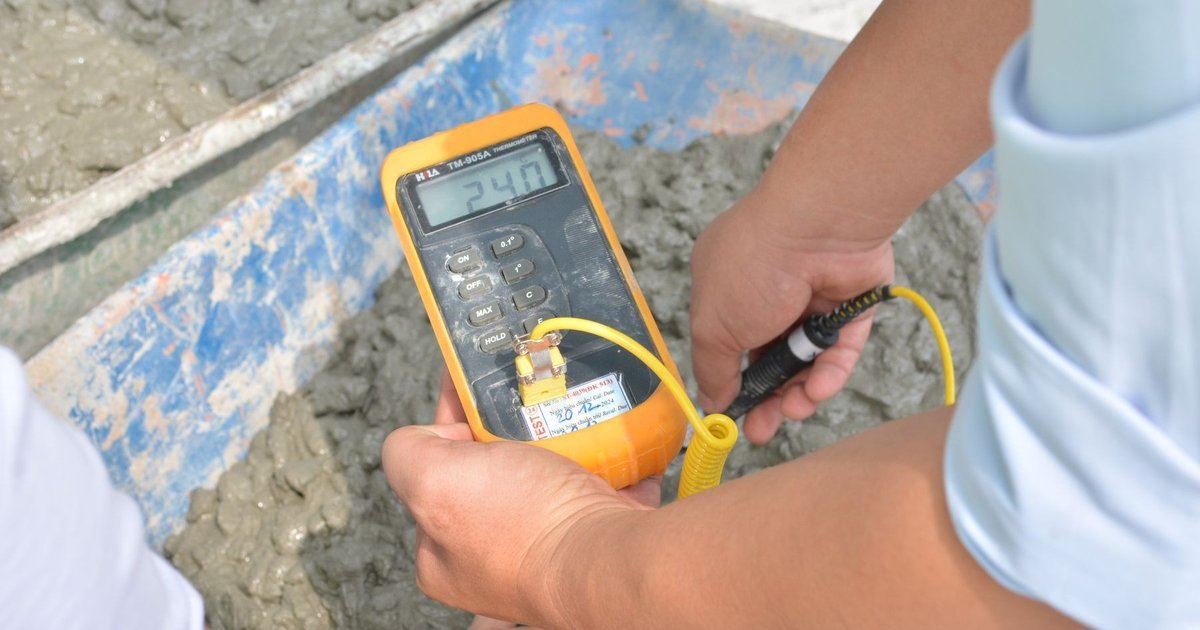
Every concrete pour on a UAE site leaves a small trail of evidence behind it: a set of cubes. Concrete cube testing in
the UAE turns those cubes into proof that the concrete in the structure reached its specified strength. When the
numbers are good, nobody thinks about them. When they are low, the whole programme stops. This guide explains how
cubes are sampled, cured and crushed, how to read the results, and what to do when a set falls short. It builds on our
overview of
the laboratory tests behind every material submission.
Key Takeaways
-
Concrete cube testing in the UAE follows BS EN 12390 practice: standard 150 mm cubes, controlled curing and crushing
at agreed ages, usually 7 and 28 days. -
The 28 day result decides compliance. The 7 day result is an early warning that lets the team act before more
concrete is placed. -
Low cube results are not automatically defective concrete. Check sampling, curing and testing records first, then
move to cores if doubt remains.
What Concrete Cube Testing in the UAE Measures
A cube test measures the compressive strength of a concrete sample made from the same batch that went into the
structure. It is an indirect check: the cube represents the concrete, it is not the concrete itself. That distinction
matters when results are disputed, because the cube can only be as good as the way it was made.
Concrete cube testing in the UAE is the routine acceptance test for structural concrete on almost every building and
infrastructure project. Specifications usually call up BS EN 12390 for making, curing and testing specimens, and BS EN
206 for conformity, alongside local authority requirements. Approving bodies such as
Dubai Municipality expect results from an accredited laboratory, and consultants
rarely sign off a pour without them. The test is simple, cheap and repeatable, which is exactly why it has lasted.
If you searched for concrete cube test Dubai or compressive strength test UAE, the core idea is the same. A cube is
loaded in a calibrated compression machine until it fails, and the maximum load divided by the loaded area gives the
strength in newtons per square millimetre. That figure is compared with the characteristic strength in the mix
specification.
Cubes are not the only strength check. Our guide to
concrete testing standards and methods in Dubai
covers fresh concrete tests, cylinders and in place methods. On most UAE sites, though, concrete cube testing in the
UAE remains the evidence that the consultant reads first.
From Sampling to Crushing: The Procedure Step by Step
Most disputed cube results trace back to the first two days of the cube’s life, not to the crushing machine. Sampling,
filling, compaction and early curing on site do more to decide the number than anything that happens in the
laboratory. Getting those steps right is the cheapest quality control on any project. That is where concrete cube
testing in the UAE is won or lost.
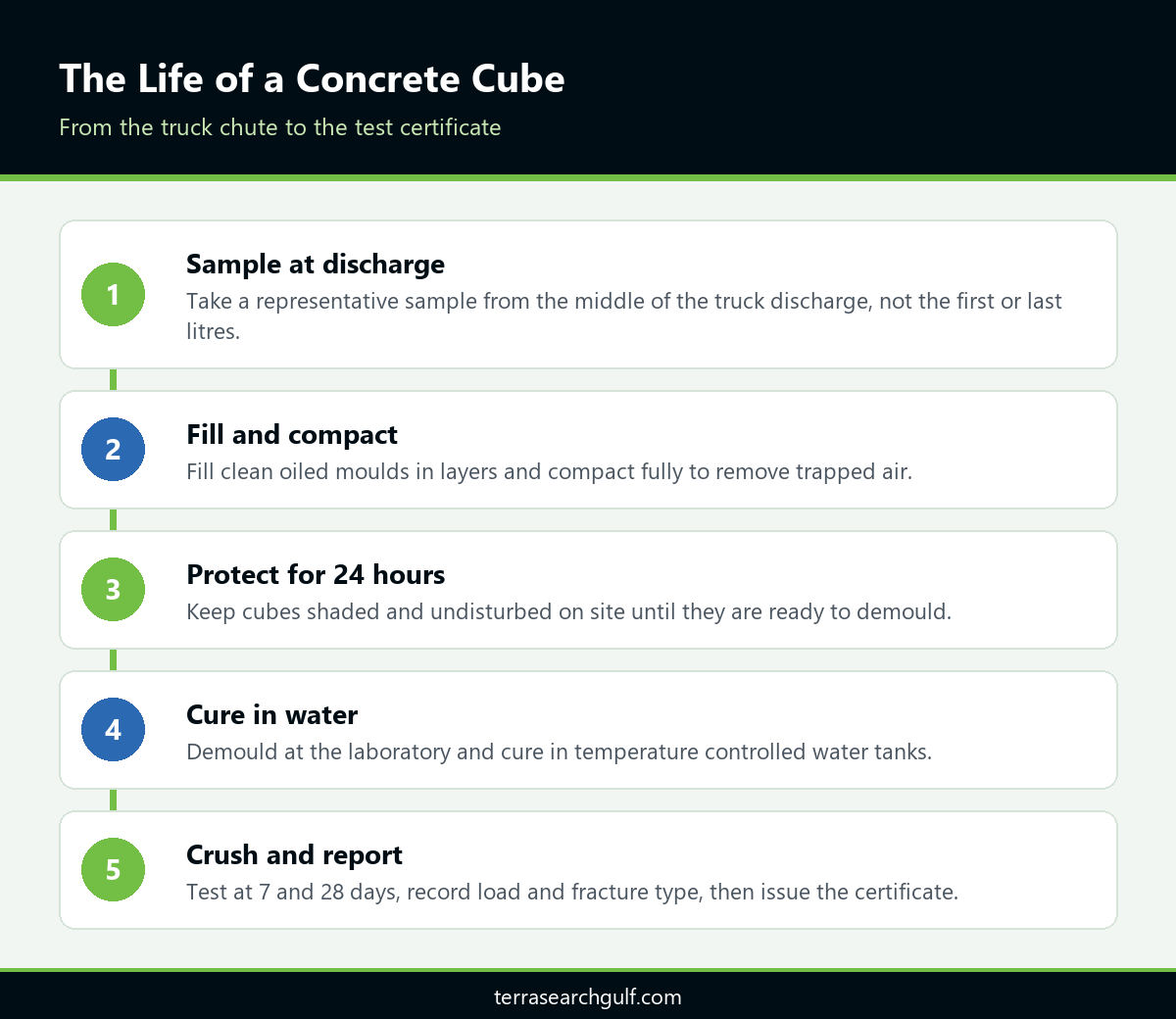
Concrete cube testing in the UAE starts at the truck. A representative sample is taken from the middle of the
discharge, not the first or last few litres. The sampling rate comes from the specification, often expressed as one
set of cubes per a fixed volume of concrete or per pour, whichever gives more sets. Each set normally contains enough
cubes for 7 day and 28 day tests, plus spares.
Moulds must be clean, oiled and square. Concrete is placed in layers and compacted by rod or vibrating table until air
is removed, then the top is finished flat. The cubes are labelled with the pour, location, date and truck ticket
number, so each result can be traced to a specific element of the structure.
The first 24 hours are the risky period. Cubes left in direct summer sun, or moved while still green, lose strength
they will never recover. Good practice is to store them shaded and protected on site, then transfer them to the
laboratory for demoulding and curing in water tanks at a controlled temperature until the test date.
At the laboratory, cubes are measured, weighed and crushed at a constant loading rate in a calibrated machine. The
technician records the failure load and the type of fracture. A normal failure leaves a double pyramid shape. An
unusual pattern is a clue that something went wrong with the cube rather than with the concrete. Clients comparing
concrete testing Dubai providers should ask how cubes are collected and cured, not only the price per cube.
Reading 7 Day and 28 Day Cube Test Results
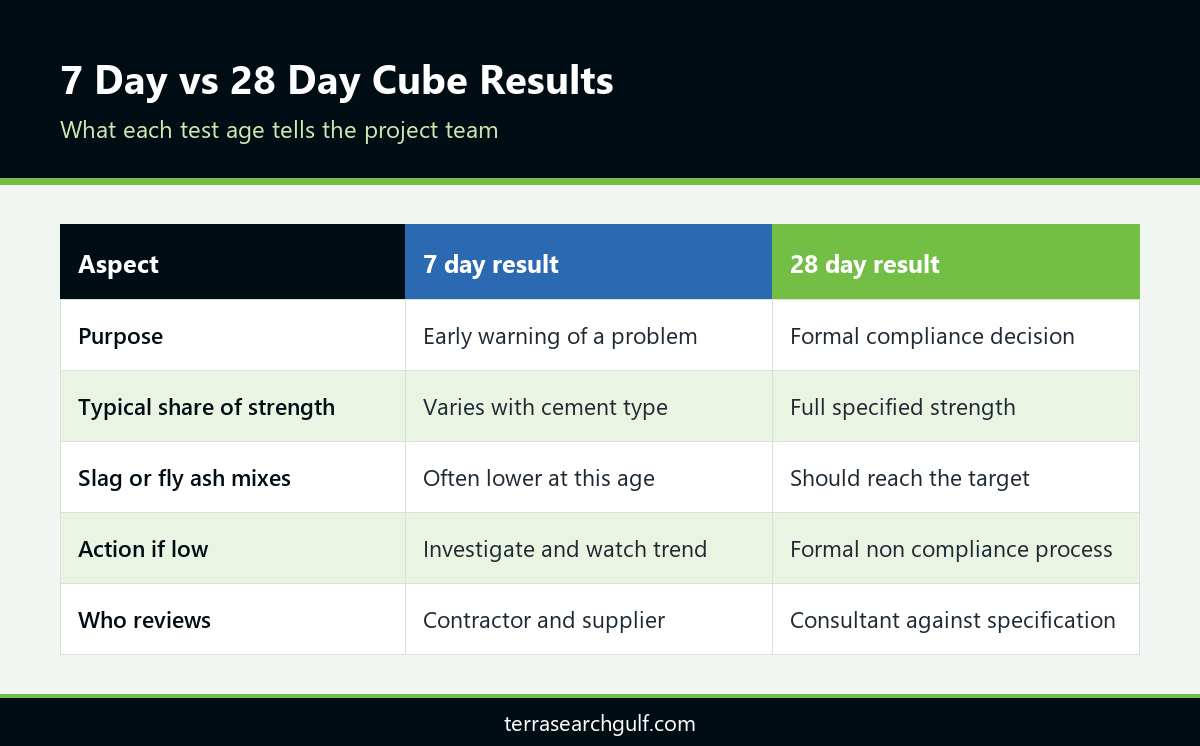
The 28 day result is the compliance test. The 7 day result is a forecast. Treating them the wrong way round causes
either panic or complacency. Read the early result as a trend indicator, compare it with the history for the same mix,
and keep the decision for the 28 day figure.
In concrete cube testing in the UAE, cube test results are usually reported per cube and as a set average. Conformity
rules in BS EN 206 look at both the mean of a group of results and the lowest individual value, so a single low cube
in an otherwise strong set may still comply. The consultant’s specification sets the exact criteria, so read it before
reacting to any one number.
The 7 day strength of ordinary concrete is often somewhere around two thirds of the 28 day value, but the ratio
depends heavily on cement type and replacement materials. Mixes containing ground granulated slag or fly ash, which
are common in the UAE for durability, gain strength more slowly at first. A low 7 day figure on those mixes is normal
and should be compared with the trial mix data, not with a rule of thumb.
Watch the trend across many pours rather than any single result. A batching plant that drifts slowly downward is a
bigger risk than one odd cube. Accredited laboratories under
ISO/IEC 17025 can provide result summaries by mix and
supplier, which makes those trends easy to spot early. Trend reviews are one of the most useful outputs of concrete
cube testing in the UAE, because they turn hundreds of single numbers into a clear picture of supply quality.
When Cubes Fail: Handling Non Compliance
A failed cube set starts an investigation, not a demolition. The first job is to find out whether the cubes truly
represent the concrete in the structure. Only when that question is answered does the team decide whether to accept,
test further or strengthen the element. Handled calmly, concrete cube testing in the UAE becomes a diagnostic tool
rather than a source of conflict.
Start with the paperwork. Check the sampling record, the truck ticket, slump and temperature at delivery, how long the
cubes stayed on site and how they were stored. Then check the laboratory side: cube dimensions, curing tank
temperature, machine calibration and the recorded fracture pattern. Many apparent failures turn out to be poorly made
or badly cured cubes.
If the records do not explain the low result, the consultant will usually ask for in place evidence. Core samples
drilled from the element give a direct measure of the concrete as built, and non destructive methods such as rebound
hammer or ultrasonic pulse velocity help map how widespread any weakness is. Core results are assessed with their own
rules, which allow for the difference between a core and a standard cube.
Concrete cube testing in the UAE works best when the laboratory is independent and accredited. Our
construction materials testing service
covers sampling support, curing, crushing and follow up investigations, and our guide to
how accreditation and approvals work explains
what the certificate should show. Accreditation status can be confirmed directly with the
Emirates International Accreditation Centre.
Finally, close the loop with the supplier. A failure that traces back to the batching plant needs corrective action
there, or the same problem will appear in the next pour. Keep the investigation records in the quality file so the
consultant can see the issue was resolved, not just explained. Lessons from concrete cube testing in the UAE should
always flow back to the plant that produced the mix.
Conclusion
Cubes are small, but they carry a lot of weight. Concrete cube testing in the UAE only gives reliable answers when
sampling, curing and crushing are done properly, and when results are read against the specification rather than rules
of thumb. Treat the 7 day figure as a warning light, the 28 day figure as the decision, and investigate failures
methodically before reaching for cores. To arrange cube collection, curing and testing for your next pour,
talk to the Terrasearch Gulf team.
Frequently Asked Questions
What is concrete cube testing in the UAE used for?
It confirms that concrete placed in a structure reached its specified compressive strength. Cubes made from each pour
are cured and crushed at set ages, and the consultant compares the results with the mix specification before accepting
the work.
What size are concrete cubes in the UAE?
Most projects use 150 mm cubes made to BS EN 12390. Smaller 100 mm cubes are sometimes allowed for mixes with small
aggregate, but the specification must permit them and results may need correcting before comparison with the target.
Why are cubes tested at 7 and 28 days?
The 7 day test gives an early warning so problems can be fixed before more concrete is placed. The 28 day test is the
formal compliance check against the characteristic strength stated in the specification for that mix.
What percentage of strength should concrete reach at 7 days?
It varies with cement type and replacement materials. Ordinary mixes often reach roughly two thirds of their 28 day
strength, while slag or fly ash mixes may be lower and catch up later. Compare with trial mix data.
How are cubes cured on a Dubai site?
Cubes should stay shaded and undisturbed for the first day, then be demoulded and cured in water tanks at a controlled
temperature. Leaving them in direct sun or moving them early reduces strength and causes misleading results.
What happens if cube results fail?
The team first checks sampling, curing and testing records. If those do not explain the result, the consultant may ask
for cores or non destructive tests on the element before deciding whether to accept, test further or strengthen it.
Who witnesses cube sampling on site?
Sampling is usually witnessed by the consultant’s inspector or carried out by the laboratory. Our guide to
the Dubai Municipality approved lab route
explains why the laboratory’s status matters for accepted results.
Can the contractor’s own lab test the cubes?
Many specifications require an independent laboratory so results are objective. Our note on
how independent testing supports compliance
explains why consultants prefer a third party for acceptance testing on most projects.
How long should cube test records be kept?
Keep them for the life of the project and handover, as part of the quality file. Records link each result to a pour,
element and truck ticket, which is essential if questions about the structure arise years later.