

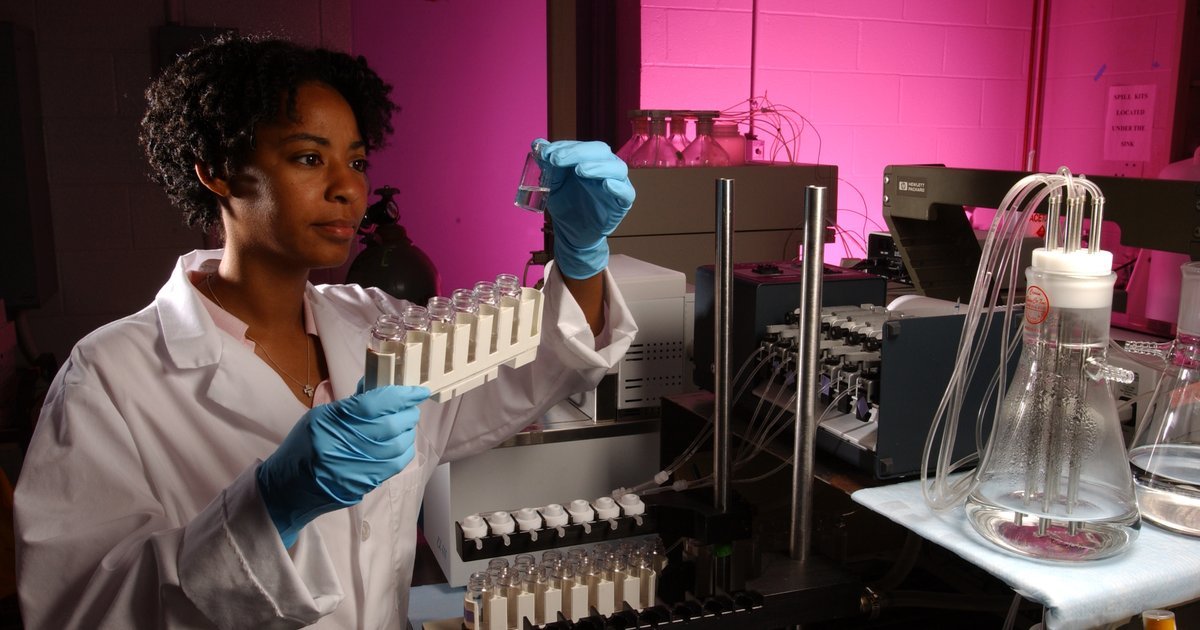
Choosing the right chemical analysis lab uae developers and contractors trust starts with understanding what the testing actually reveals. Beyond compressive strength and grain size, chemical analysis exposes chloride content, sulphate levels, pH, and contaminant traces hidden inside soil, concrete, aggregate, steel, and water samples. In the UAE’s saline groundwater and high humidity, these invisible factors often determine whether a structure lasts decades or fails early. Terrasearch Gulf’s chemistry lab and material analysis services support our wider geotechnical investigation work, testing material composition against UAE and international standards before construction locks problems into place.
Key Takeaways
- Chemical analysis lab uae testing checks the composition of soil, concrete, aggregate, steel and water to catch corrosive salts and contaminants before they compromise a structure.
- ISO 17025 accreditation confirms a lab’s methods, equipment and staff competence meet recognised international standards for accuracy and repeatability.
- Chloride and sulphate testing is a specialized, more specific part of chemical analysis with major durability consequences for reinforced concrete, covered in its own dedicated guide.
What Chemical Analysis Testing Covers in the UAE
Chemical analysis testing examines the makeup of construction materials at a molecular level, not just their physical strength. For UAE projects this typically covers soil salinity and sulphate content, concrete mix chemistry, aggregate mineral composition, steel alloy content, and water quality, giving engineers a full picture of what a material is actually made of before it is used.
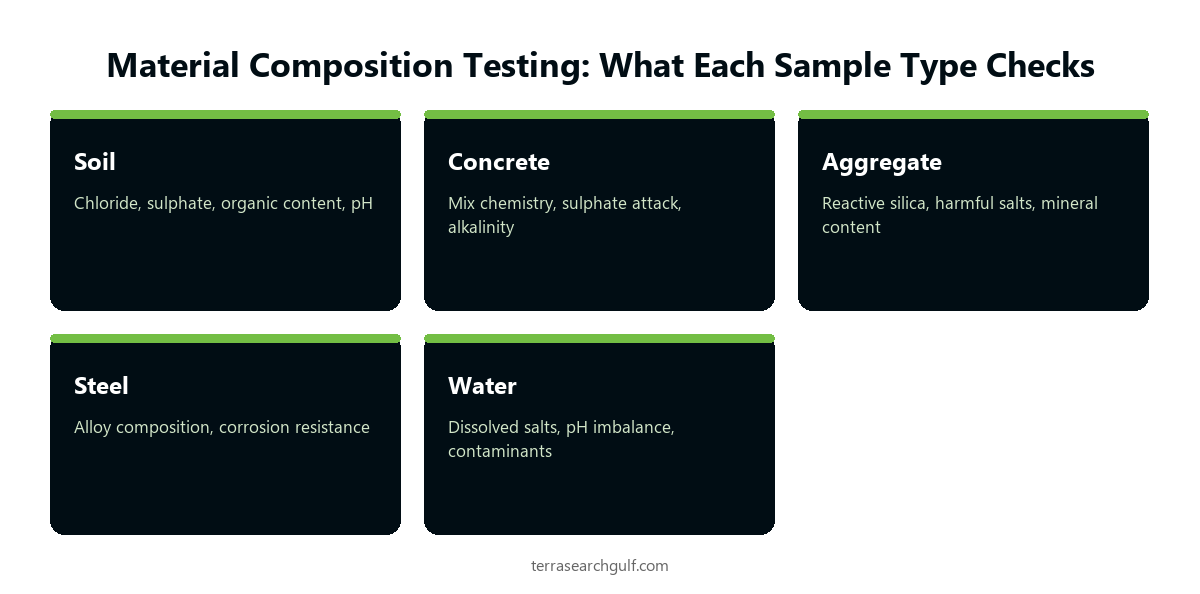
A chemical analysis lab uae engineers rely on tests five sample types side by side. Soil is checked for chloride, sulphate, and organic content that can attack foundations. Aggregate is screened through aggregate testing to rule out reactive silica and harmful salts before batching. Steel is verified through steel testing and NDT services for alloy composition and corrosion resistance. Water samples are screened for dissolved salts and pH imbalance too. Every result supports our broader construction materials testing services, pairing chemical data with physical results so nothing is assessed alone. The approach follows established chemical analysis methods adapted for Gulf heat and salinity, alongside our material testing laboratory in Dubai programme. Results are compared against UAE municipality limits and international benchmarks before a project can move to the next stage. Contractors often assume a passed strength test means a material is fully suitable, but strength and chemistry are separate properties. A concrete cube can crush within specification and still contain sulphate levels that will damage the structure years later. That is why chemical composition testing runs alongside, not instead of, physical testing on every serious UAE project.
Why Material Composition Determines Durability and Compliance
Material composition is not a formality. Elevated chloride or sulphate levels in soil or concrete accelerate rebar corrosion and concrete cracking long before a building shows visible damage. UAE authorities set strict composition limits for exactly this reason, and a construction chemical testing uae programme catches these risks while design changes are still cheap to make.
Reinforced concrete depends on an alkaline environment to protect embedded steel. When chloride ions penetrate that layer, corrosion starts even if the concrete looks sound. Sulphates react with cement compounds and cause expansion cracking over time. This is why concrete testing standards exist for every major UAE development. Groundwater across much of Dubai and Abu Dhabi carries naturally high salt content, so foundations and slabs need composition checks long before pouring begins. A lab that publishes why an accredited material testing laboratory matters, backs its results with EIAC accredited water testing, and cross references findings against geotechnical laboratory tests gives engineers the confidence to specify the right protective measures early. Once corrosion begins, repair costs multiply quickly, often exceeding the original cost of proper testing many times over. Compliance is the other half of the equation. UAE municipalities and consulting engineers increasingly ask for documented chemical composition results before approving foundation pours or structural handover, so a construction chemical testing uae programme is now a standard project requirement rather than an optional extra step.
Inside the Lab: Sample Intake to Reporting
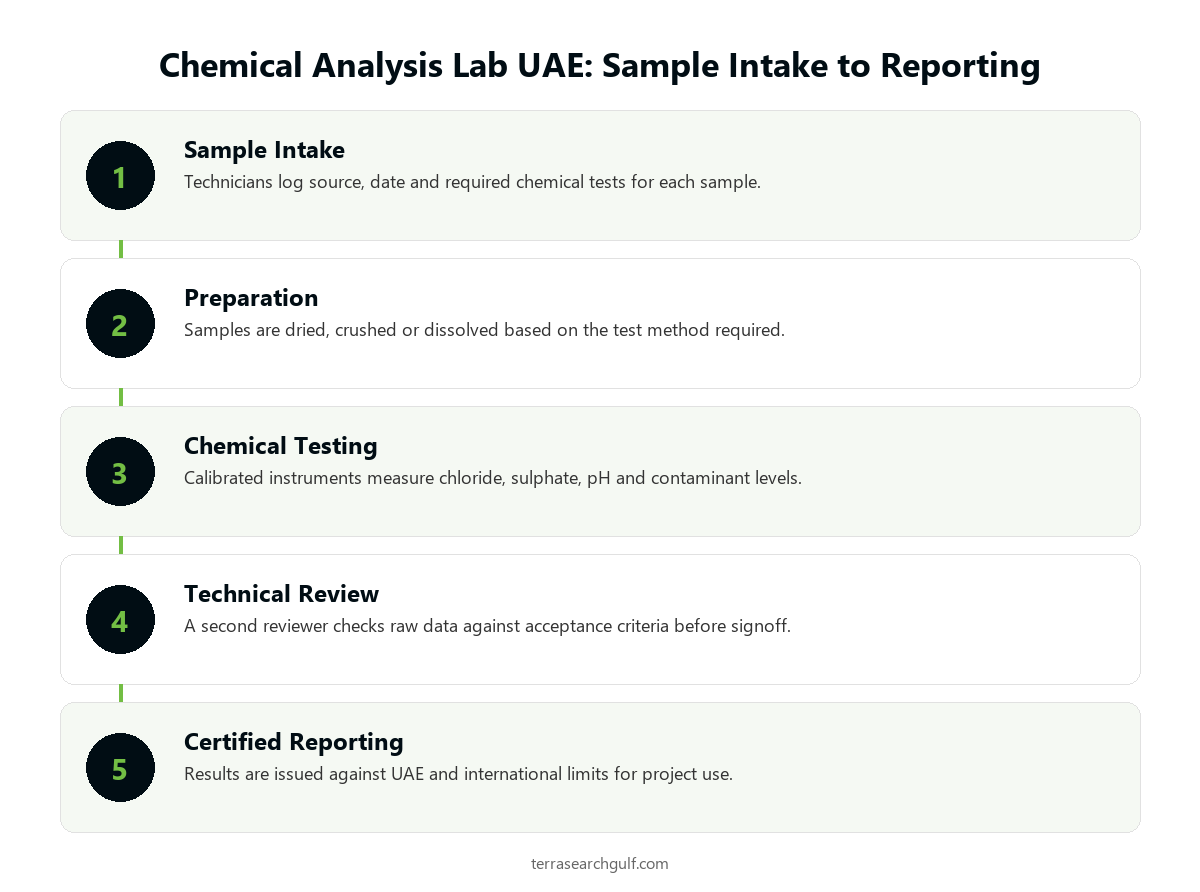
An accredited chemical analysis laboratory dubai teams trust follows a fixed sequence for every sample. Intake, preparation, testing, review, and reporting each follow documented procedures so results are repeatable and defensible. Understanding these steps helps engineers know what to expect between submitting a sample and receiving a certified report.
Every sample begins at intake, where technicians log source, date, and required tests. Preparation follows, drying, crushing, or dissolving material depending on the method required. Testing itself uses calibrated instruments to measure chloride, sulphate, pH, and other target compounds. A second reviewer checks raw data against acceptance criteria before anything is signed off. The final certified report lists results against UAE and international limits, ready for submission to consultants or authorities. This workflow mirrors the process used across our engineering labs in Dubai network and our broader material testing laboratory in the UAE operations. Projects that also need site verification benefit from pairing chemical results with our construction testing lab services, and larger developments often combine this with survey services to confirm site conditions match laboratory findings. Most standard chemical tests are completed within a few working days, keeping project schedules on track.
Why ISO 17025 Accreditation Matters for Lab Credibility
An iso 17025 accredited lab uae clients choose has proven, through independent audit, that its methods, equipment, and staff competence meet a recognised international standard. Accreditation is not a marketing badge. It means results carry legal and technical weight with consultants, municipalities, and insurers across the UAE.
ISO 17025 is the global benchmark for testing and calibration laboratories, overseen through the wider ISO framework as an international standards body. Accredited labs undergo regular audits covering equipment calibration, staff qualifications, and internal quality checks. This matters because a chloride result from an unaccredited lab may not be accepted by a consultant or municipal authority. Terrasearch Gulf’s status as a third party testing lab gives clients reports that hold up under scrutiny. Our accreditation sits alongside recognition tied to ASTM testing standards and reliable material standards, and clients can review our full accreditation history on our About Us page before committing to a project. UAE authorities such as EIAC recognise ISO 17025 accredited results, which reduces delays during permit and handover stages. Accreditation also standardises how results are reported, so a chloride figure from one test batch can be compared fairly against results from another lab or a later retest, something that matters greatly on long, multi phase developments.
Chloride, Sulphate and Other Specialized Chemical Tests
Chloride and sulphate testing is one of the most requested parts of chemical analysis, given how directly these salts affect reinforced concrete life span. This topic is significant enough that Terrasearch Gulf covers it in its own dedicated guide, so this section focuses on how it fits inside the wider chemical testing picture.
Chloride and sulphate testing deserves its own detailed guide because the acceptance limits, sampling depth, and test methods differ from general composition analysis. Within our chemical analysis lab uae clients rely on, this specialized testing sits alongside broader work such as water testing lab services for groundwater and curing water, and non destructive testing methods for materials already in place. Together with our speciality testing services, these tests give a complete chemical and physical profile of a structure, from the ground up to the finished surface. Even when a project only needs one specific chemical test, running it inside an accredited lab keeps the result consistent with every other report on file. Engineers who need the full chloride and sulphate limits, sampling depths and acceptance criteria for a specific UAE project should refer to that dedicated guide rather than relying on general composition figures alone.
Conclusion
A reliable chemical analysis lab uae projects can depend on protects a structure long before problems become visible. From soil salinity to steel composition, testing material chemistry catches risks that physical strength tests alone will miss. Terrasearch Gulf pairs ISO 17025 accredited methods with our geotechnical investigation services experience to give engineers and developers defensible, standards backed data. Whether you are specifying a new foundation or verifying an existing structure, composition testing belongs early in the plan, not after issues appear. Contact Terrasearch Gulf today to schedule chemical analysis testing for your next UAE project.
Frequently Asked Questions
1. What does a chemical analysis lab uae contractors use actually test?
A chemical analysis lab uae contractors use tests soil, concrete, aggregate, steel and water samples for chloride, sulphate, pH and contaminant levels, giving engineers a complete picture of material composition before construction begins on any UAE site.
2. Why is material composition testing important for UAE construction?
Material composition testing is important for UAE construction because it reveals hidden chlorides, sulphates and contaminants that standard strength tests miss, catching durability risks early enough to adjust design before they cause corrosion or structural failure later.
3. What is a construction chemical testing uae programme used for?
A construction chemical testing uae programme checks soil, concrete, aggregate and water chemistry against UAE and international limits, helping engineers confirm materials will resist salts, corrosion and chemical attack throughout the structure’s entire service life in Gulf conditions.
4. How does lab material analysis dubai testing differ from routine strength testing?
Lab material analysis dubai testing looks at chemical composition, such as chloride, sulphate and mineral content, while strength testing measures physical performance like compressive or tensile load. Both are needed for a complete assessment of material quality.
5. What is checked during a chemical analysis laboratory dubai soil test?
A chemical analysis laboratory dubai soil test typically checks chloride content, sulphate content, pH, organic matter and soluble salts, since these factors influence how aggressive the soil will be toward buried concrete and steel foundations.
6. Why does an iso 17025 accredited lab uae matter to consultants?
An iso 17025 accredited lab uae matters to consultants because accreditation confirms methods, equipment calibration and staff competence meet international standards, so consultants and authorities can accept results without requesting repeat testing from another laboratory.
7. How long does chemical analysis testing usually take?
Turnaround depends on sample type and test count, but most chemical analysis results are ready within a few working days. Urgent project timelines can often be accommodated, so it is best to confirm timing when samples are submitted.
8. Can chemical analysis testing be combined with other lab services?
Yes. Chemical analysis is often combined with physical strength testing, structural testing and analysis services, and survey work so engineers receive one coordinated dataset covering composition, strength and site conditions across a single project.
9. Who typically requests chemical analysis testing in the UAE?
Consulting engineers, contractors, developers and government project owners request chemical analysis testing, usually during design, before pouring concrete, or when investigating existing structures for corrosion, cracking or unexplained deterioration in reinforced elements across projects.
10. Where can I see the full list of testing services Terrasearch Gulf offers?
Terrasearch Gulf’s full range of testing services covers geotechnical, chemical, material and structural testing across the UAE. Related methods are also outlined in our guide to material testing methods, useful background before requesting chemical analysis.