

Few things delay a foundation package faster than confusion over testing. Pile testing requirements in Dubai come from several sources, and contractors often discover them too late. If you searched for pile testing requirements Dubai, this guide gives a clear answer. This guide explains who sets the requirements, which tests apply to preliminary and working piles, how numbers are usually decided and what approval looks like. It sits alongside our guide to verifying foundation design assumptions and is written for contractors, project managers and consultants planning a piling programme.
Key Takeaways
- Pile testing requirements in Dubai are set by the project specification first, with the approving authority adding conditions on many projects.
- Most programmes combine static, dynamic and integrity tests, and working pile test frequency is usually written as a percentage for each test type.
- Agree numbers, timing, acceptance criteria and witnessing before piling starts, and use an accredited laboratory with the right method scope.
Who Sets Pile Testing Requirements in Dubai
Pile testing requirements in Dubai are not one universal rule. They are layered. The project specification, written by the consultant, carries most of the detail. The approving authority reviews the foundation design and results, and international standards define how each test is performed. Knowing which layer controls each decision saves time.
The consultant’s specification is the document to read first. It typically names the test types, the number or percentage of piles to test, the test loads, the acceptance criteria and the reporting format. It often references British and European practice such as BS 8004 and BS EN 1997, with test procedures drawn from ASTM methods.
The authority layer depends on the project. For most building projects, a Dubai Municipality pile test submission forms part of the foundation approval process, and the authority can request additional tests. Free zones and master developers may apply their own rules. The Dubai Municipality website is the starting point for current building regulations, but always confirm project specific conditions with your consultant.
Finally, the laboratory must be acceptable to both. Our guide to the Dubai Municipality approved testing lab route explains what approval means and why it matters for results to be accepted without question.
Contractors sometimes assume that a previous project’s rules will apply again. That is risky. Two towers on neighbouring plots can have very different pile testing requirements in Dubai, because the ground, loads and pile types differ. Treat each specification as new, list every testing clause in one schedule, and raise any ambiguity with the consultant in writing before you price the work.
Which Tests Apply to Preliminary and Working Piles
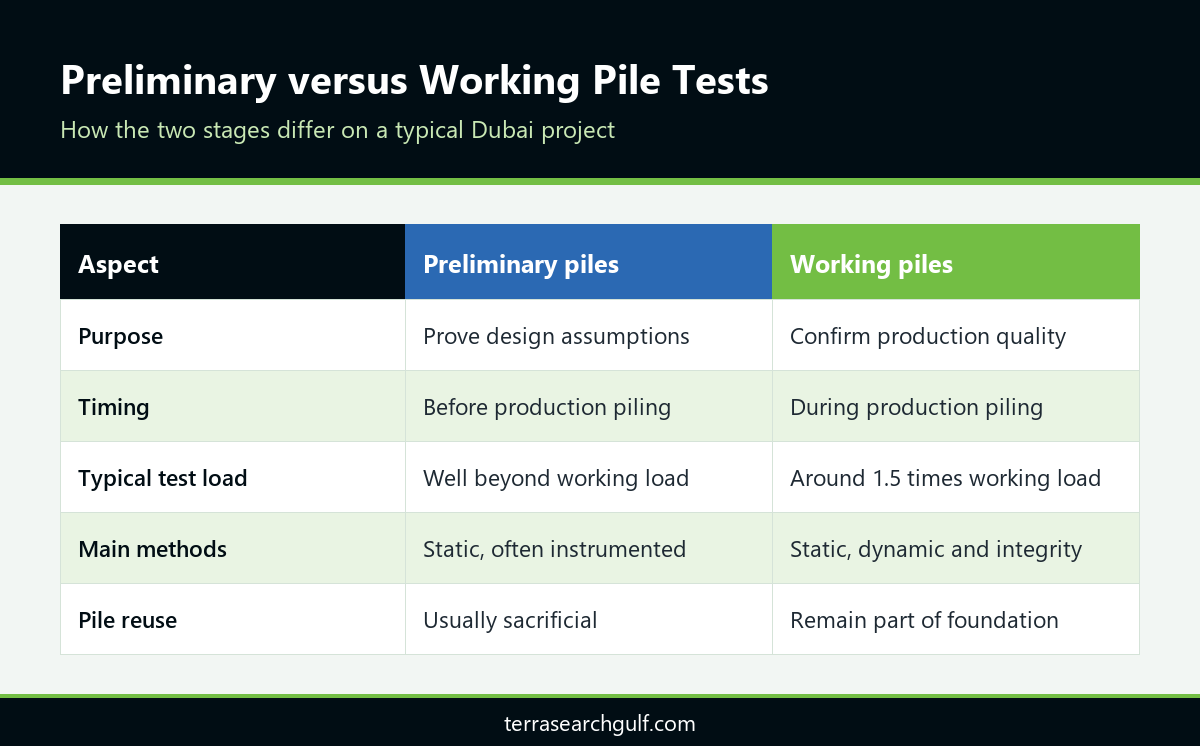
Preliminary piles prove the design before production starts. Working piles confirm that production piles match the design. Under typical pile testing requirements in Dubai, the tests used for each differ in load level, method and purpose, so the test plan should treat them as two separate stages with separate goals.
Preliminary piles are built with the same rig, method and materials as the production piles, then loaded well beyond working load. Static load tests to ASTM D1143 are the norm, and instrumented piles are common on large projects. The aim is to verify shaft friction and end bearing assumptions, especially for rock sockets.
Working piles are tested at lower loads, usually around one and a half times working load, to confirm acceptable settlement. Static tests are supplemented by dynamic tests to ASTM D4945, which cover more piles quickly. Integrity tests then screen a high share of the pile population for shaft defects.
Some projects add lateral or tension tests where piles carry horizontal loads or uplift, for example under basements below the water table. Where they apply, pile testing requirements in Dubai list them separately, and each needs its own reaction arrangement.
The test plan should also state how each pile is prepared. Static tests need a level, reinforced pile head and space for kentledge or reaction piles. Dynamic tests need a sound head, often extended with a steel sleeve. Integrity tests need clean, trimmed concrete. Writing these preparation steps into the plan prevents wasted mobilisations, which are one of the most common causes of delay. Contractors searching for pile testing Dubai guidance often cite wasted visits as their biggest frustration.
Acceptance criteria are a core part of pile testing requirements in Dubai. For static tests they usually limit settlement at working load and at the maximum test load, and they may cap residual settlement after unloading. For integrity tests, the specification should define how anomalies are classified and what follows each class. Agreeing these definitions before testing prevents arguments about whether a borderline result passes or fails.
How Test Numbers and Frequency Are Decided
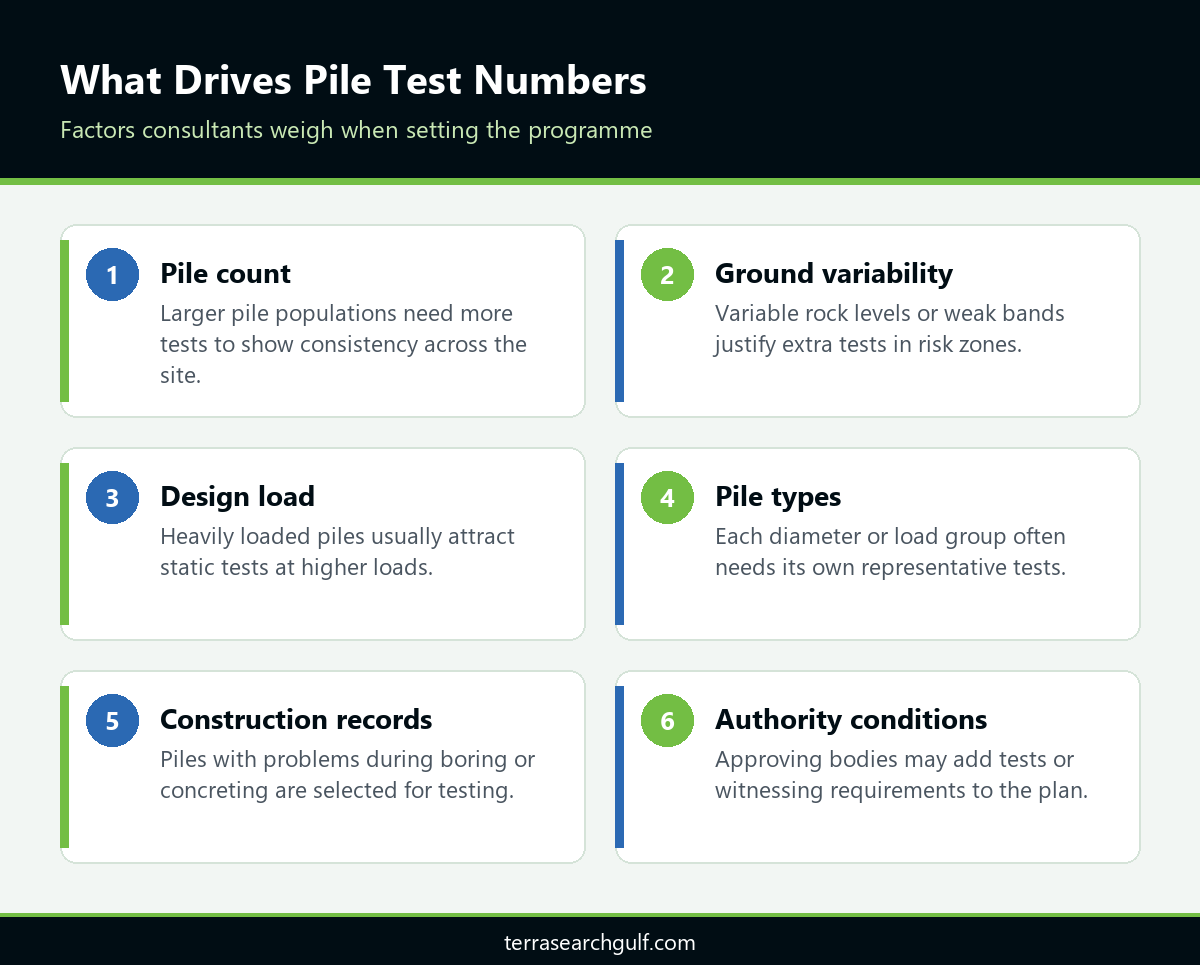
Test numbers within pile testing requirements in Dubai reflect risk. More piles, more variable ground, higher loads and less site experience all push the numbers up. The specification usually expresses working pile test frequency as a percentage of piles for each test type, with a minimum number regardless of pile count.
A typical structure for pile testing requirements in Dubai looks like this. A small number of static tests, often defined per pile diameter or load group. A larger share of dynamic tests spread across the site. Integrity tests on most or all working piles. The exact values vary widely, so treat any published figure as indicative only and work from your own specification.
Ground conditions strongly influence the numbers. Where the ground investigation report shows variable rock levels or weak bands, consultants often ask for extra tests in those zones. Piles with construction problems, such as loss of bentonite or a delay during concreting, are also likely to be selected for testing.
Dynamic testing can sometimes reduce static test numbers, but only when it is correlated against static results on the same site. Agree that approach in writing before relying on it, because the authority must also accept the substitution.
It is worth agreeing a selection method in advance. Some consultants choose piles at random, others target the most heavily loaded positions or the weakest ground. A combination is common. Whatever method is used, record it in the test plan so that the authority can see the logic, and keep a running register showing which piles have been tested, by which method and with what result.
Finally, think about access. Static tests on piles in the middle of a congested site can be difficult to set up once pile caps and basement works start nearby. Selecting and testing those piles early, while the platform is still open, avoids expensive delays and keeps cranes free for the main works.
Timing, Witnessing and Approval
Timing within pile testing requirements in Dubai affects both validity and programme. Piles must reach the required concrete strength before load tests, results must be reviewed before pile caps, and the authority needs time to respond. Building these steps into the programme avoids last minute pressure.
Preliminary pile tests should be completed and approved before production piling begins, so the programme must allow for construction, curing, testing and review. Working pile tests follow as production progresses. Integrity tests can usually be done soon after the concrete hardens, which makes them useful for early screening before caps are cast.
Witnessing is normally done by the consultant, sometimes with client or authority representatives present. An accredited laboratory performs the work and issues the report. Using an independent third party testing lab gives everyone confidence that results are objective, and it simplifies the review when the authority examines the submission.
Under pile testing requirements in Dubai, approval follows the consultant’s review of the reports against the acceptance criteria. Where a result falls short, the consultant decides on further tests, additional piles or a design change. Clear, prompt reporting keeps this step short. Whether you search for pile load testing UAE or pile testing requirements in Dubai, the advice is the same: agree everything early and document it.
Documentation completes the process. Keep pile construction records, concrete delivery tickets, cube results and calibration certificates together with each test report. When the authority reviews the foundation submission, a complete and well indexed file answers most questions before they are asked. Laboratories that understand pile testing requirements in Dubai will format reports so they slot straight into that file without rework.
Conclusion
Pile testing requirements in Dubai are manageable when they are understood early. Read the specification first, confirm authority conditions, and separate preliminary and working pile testing in the programme. Agree numbers, loads, acceptance criteria and witnessing before the first pile is bored, and choose an accredited laboratory with the right method scope. Terrasearch Gulf supports piling contractors and consultants through our structural testing and analysis services. To plan your test programme, contact our team.
Frequently Asked Questions
Pile testing requirements Dubai: what must projects meet?
Requirements come mainly from the project specification, with authority conditions added on many projects. They define test types, numbers, loads, acceptance criteria and reporting. Standards such as ASTM D1143 and D4945 define how each test is performed.
Does Dubai Municipality require pile load tests?
Pile test results usually form part of foundation approval for building projects under Dubai Municipality. The authority can request additional tests. Free zones and master developers may apply their own rules, so confirm requirements with your consultant.
How many working piles are usually tested?
It varies by specification. A common pattern is a few static tests, a larger share of dynamic tests and integrity tests on most or all working piles. Ground variability and pile count both push numbers higher.
What is the difference between a preliminary and a working pile?
A preliminary pile is built and tested before production to prove the design, often loaded well beyond working load. A working pile forms part of the final foundation and is tested at a lower load to confirm quality.
Can dynamic tests reduce the number of static tests?
Sometimes. Dynamic tests can replace part of the static programme when they are correlated against static results on the same site. The consultant and authority must both accept the substitution, so agree it in writing first.
When should pile testing be planned?
Plan testing at mobilisation, alongside the piling method statement. Preliminary piles need time for construction, curing, testing and approval before production piling starts, so late planning almost always delays the foundation programme and the pile cap works that follow.
Who pays for failed pile tests?
This depends on the contract. Typically the contractor bears the cost of additional testing or remedial work when piles fail due to construction issues. Design related failures may be treated differently, so check your contract terms carefully.
Which accreditation should the testing lab hold?
The lab should hold EIAC accreditation covering the specific pile test methods, not just general testing. Our guide to how EIAC accreditation and approvals work explains what to check in the scope of accreditation before you appoint.
Is plate load testing a substitute for pile testing?
No. Plate load tests assess the bearing of shallow foundations on soil, not the capacity of piles. Our guide to verifying soil bearing capacity with plate load testing explains where that test fits on a project instead.