

When a consultant needs certainty about pile capacity, they ask for a static test. A static pile load test in Dubai applies a real load to the pile and measures how it settles, with no correlation or modelling in between. Anyone searching for static pile load test Dubai and similar terms will find the essentials here. This guide walks through the maintained load procedure, the reaction systems used on UAE sites, the instrumentation that makes the data reliable and the acceptance criteria that decide the result. It complements our wider guide to foundation testing before and after you build.
Key Takeaways
- A static pile load test in Dubai measures load and settlement directly, which makes it the benchmark for every other pile test.
- The maintained load test applies load in stages and holds each one until settlement stabilises, using kentledge or reaction piles to resist the jack.
- Acceptance criteria limit settlement at working load and at the maximum test load, and they come from the project specification, not the laboratory.
How a Static Pile Load Test in Dubai Works
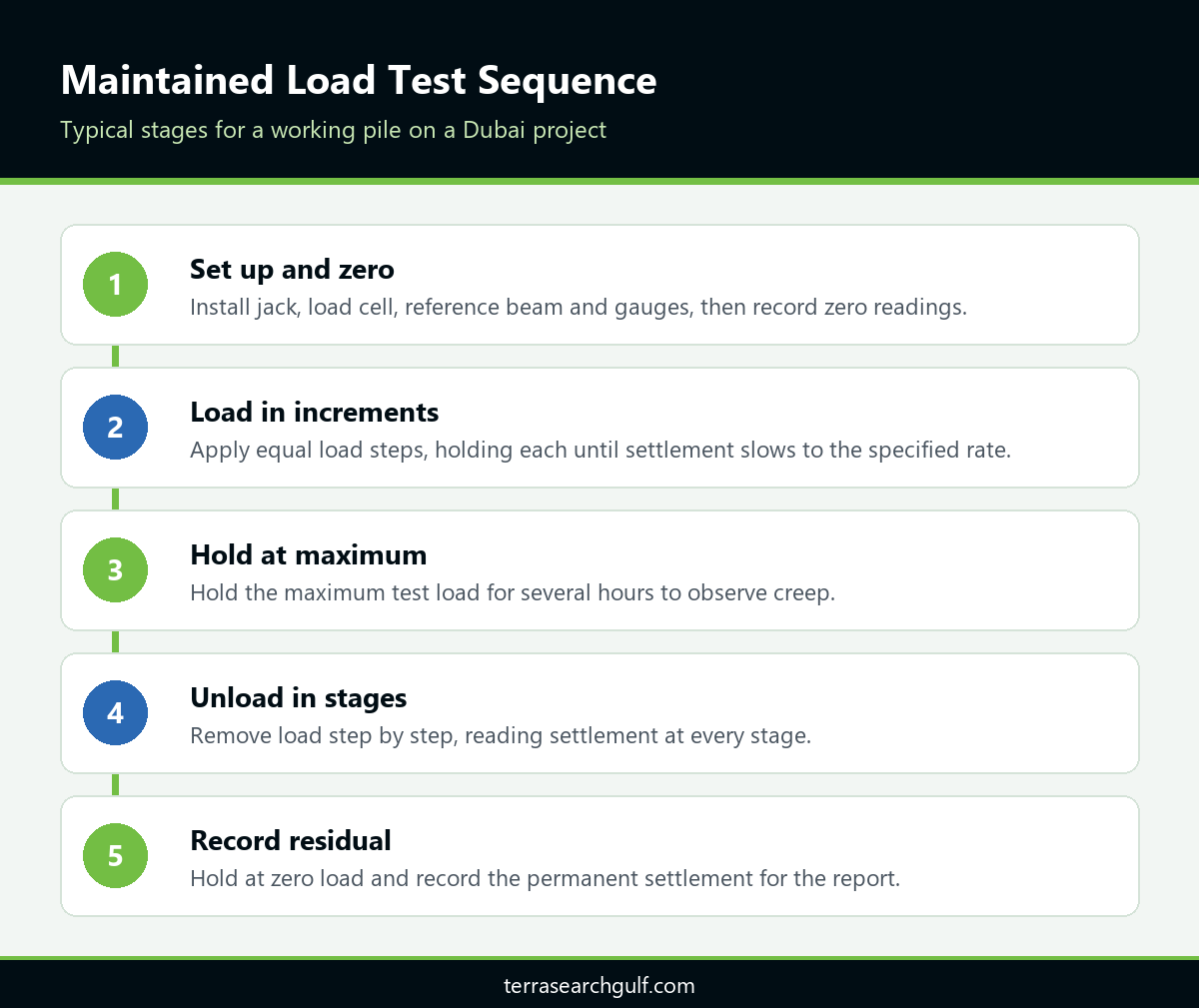
The maintained load test is the standard method for a static pile load test in Dubai. Load is applied in equal increments, each held until settlement slows to a set rate, then the pile is unloaded in stages. The result is a load and settlement curve showing exactly how the pile behaves.
The idea is simple, and it is why static load testing is trusted across the industry. Instead of estimating capacity from soil parameters or stress waves, the test pushes the pile with a known force and watches what happens. Every reading is a direct measurement, so there is very little to interpret and very little to dispute later.
The procedure follows ASTM D1143 or the equivalent British method, adapted by the project specification. In a typical static pile load test in Dubai, a working pile is loaded to around one and a half times its working load. A preliminary pile is usually taken higher, sometimes to two or three times working load, to understand the margin against failure.
Each load stage is held for a minimum time and until the rate of settlement falls below the limit in the specification. Readings are taken at fixed intervals, for example every few minutes at first and less often as movement slows. At the maximum load, the hold period is longer, often several hours, so that creep can be observed.
Unloading also matters. The pile is unloaded in stages, with readings at each, and the final residual settlement is recorded after a holding period at zero load. The difference between maximum and residual settlement shows how much of the movement was elastic and how much was permanent.
Some specifications for a static pile load test in Dubai include a cyclic stage, where the pile is loaded to working load, unloaded and reloaded before going higher. This shows whether the pile settles further each time it is loaded, which can matter for structures subject to repeated loading.
Kentledge and Reaction Set Ups for a Static Pile Load Test in Dubai
Every static pile load test in Dubai needs something heavy for the jack to push against. On UAE sites that reaction comes from kentledge stacked above the pile or from tension piles and anchors around it. The choice depends on test load, site space, cranage and programme, and each option has trade offs.
Searches for kentledge pile test UAE methods usually lead to the same answer. A kentledge set up relies on concrete blocks or steel weights placed on a platform supported clear of the test pile. The total weight must exceed the maximum test load with a margin, typically around ten to twenty percent. Kentledge is simple and reliable, but large loads need a lot of blocks, a crane and space to stack them safely.
Reaction pile systems use two or more tension piles connected by a steel beam over the test pile. They suit high loads and tight sites, and working piles can sometimes double as reaction piles if the design allows. The key rule is spacing. Reaction piles too close to the test pile influence the ground around it and distort the result, so the specification sets a minimum distance.
Ground anchors are a third option where rock is shallow. They reduce the need for heavy blocks but require drilling and stressing, and their capacity must be confirmed before the test.
Whatever system is used, safety comes first. The platform, beams and supports must be designed by a competent engineer, and the area around a loaded set up should be kept clear throughout the test.
Instrumentation and Data Quality
A static pile load test in Dubai is only as good as its measurements. Calibrated jacks and load cells, independent reference beams and protection from heat all decide whether the settlement readings can be trusted. In Dubai, temperature control is often the difference between clean data and a disputed result.
Load is measured with a calibrated load cell or derived from jack pressure using a calibrated gauge. Settlement is read with dial gauges or electronic displacement transducers mounted on reference beams. Those beams must be supported well away from the test pile and the reaction system, so that ground movement around them does not affect the readings.
Heat is a real issue on any static pile load test in Dubai during summer. A steel reference beam in direct summer sun can expand and bend enough to swamp the settlement being measured. Good practice is to shade the beam, shield the gauges and, ideally, run a survey level check on the pile head and beam during the test. Many testing teams also schedule long hold periods overnight, when temperatures are more stable.
For preliminary piles, strain gauges or extensometers cast into the pile show how load transfers between shaft and base. This is especially useful for piles socketed into weak rock, where the design depends on assumed socket friction. The borehole and coring results give the predicted values, and the instrumented test confirms or corrects them.
Calibration certificates for every jack, gauge and load cell should be current and attached to the report. An EIAC accredited laboratory will maintain these as part of its quality system.
Acceptance Criteria and Reporting
Passing or failing a static pile load test in Dubai is decided by criteria written into the specification. They usually limit settlement at working load and at the maximum test load, and may cap residual settlement. The laboratory reports the data. The consultant judges compliance.
Settlement limits exist because structures tolerate only so much movement. Excessive or uneven settlement cracks finishes, distorts frames and affects lifts and facades. For any deep foundation, the acceptance criteria translate the structural designer’s tolerance into numbers the test can check, which is why they are set by the consultant for each project rather than copied from a generic table.
Typical criteria limit total settlement at working load to a small value, and settlement at one and a half times working load to a larger value. Residual settlement after unloading may also be limited. The figures differ between projects, pile diameters and structures, so always read them from the specification rather than relying on rules of thumb.
The report for each static pile load test in Dubai should include pile details, concreting date and concrete strength results, the reaction system, calibration certificates, the full table of readings, the load and settlement curve and a clear comparison with the criteria. Our guide to concrete testing standards and methods explains the cube results that confirm the pile concrete was ready for loading.
When results are close to the limits, the consultant may look at the shape of the curve, the creep behaviour at maximum load and the residual settlement before deciding. That is why complete, transparent data matters more than a one line pass or fail statement. Good reporting gets results approved quickly. Whether the search is for pile load test Dubai or pile load testing UAE, the lesson is the same: static results calibrate every dynamic test.
Conclusion
Static testing remains the most direct way to prove that a pile works. A well run static pile load test in Dubai depends on a sound reaction system, careful staging, protected instrumentation and clear acceptance criteria agreed before the test. When those pieces are in place, the result speaks for itself and approvals follow quickly. Terrasearch Gulf provides static pile testing through our structural testing and analysis services. To schedule a test or review your specification, get in touch with our engineers.
Frequently Asked Questions
Static pile load test Dubai: what do consultants ask for?
It is a test that applies a measured load to a pile using a hydraulic jack and records settlement at each stage. It proves capacity directly and is the benchmark against which dynamic and integrity test results are judged on most projects.
What is a maintained load test?
A maintained load test applies load in equal increments and holds each stage until settlement slows to a set rate. The pile is then unloaded in stages. It is the most common static pile test method used on UAE projects.
How much kentledge is needed for a pile test?
The kentledge must exceed the maximum test load with a safety margin, often around ten to twenty percent. For high test loads that means many tonnes of blocks, so reaction piles are often preferred on tight or busy sites.
How long does a static pile load test take?
The loading itself often takes one to two days, including hold periods. Setting up kentledge or reaction piles and dismantling afterwards adds further time, so allow several days per test in the overall piling programme.
What load is applied to a working pile?
Working piles are commonly tested to around one and a half times their working load, although the specification sets the exact value. Preliminary piles are usually loaded higher to understand the margin against failure and confirm design parameters.
Why does temperature affect static pile tests?
Steel reference beams expand and bend in direct sun, which can distort settlement readings. Shading the beams, shielding gauges and checking levels with a survey instrument keeps the data reliable during hot weather in the UAE.
Who decides if a pile passes the test?
The consultant decides by comparing the measured settlements with the acceptance criteria in the specification. An independent third party testing lab performs the test and reports the data objectively without judging compliance itself.
Does the lab need authority approval for pile testing?
Yes, on most projects the laboratory must be accepted by the approving authority as well as accredited. Our guide to the Dubai Municipality approved testing lab route explains how that approval works.