

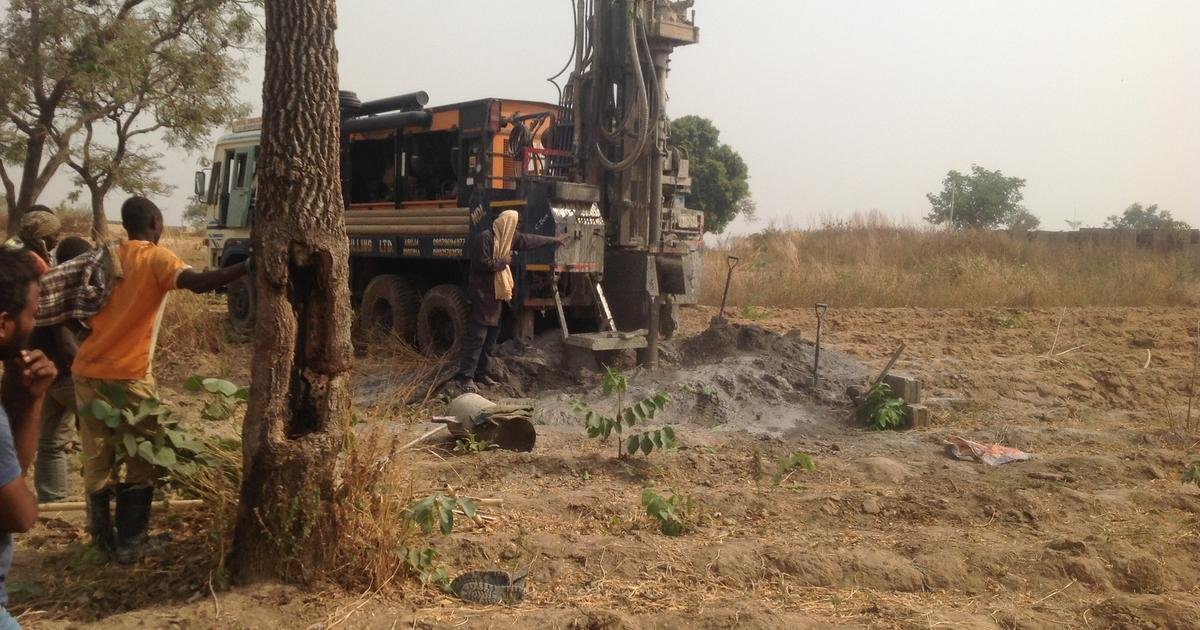
Borehole drilling Dubai projects depend on is the fieldwork stage of a geotechnical investigation that reveals what lies beneath a site before any design work begins. Engineers use the samples and readings recovered from each borehole to confirm soil strength, groundwater conditions and founding depth. This guide explains what borehole drilling involves, the rig types used across the UAE, how depth and borehole count are decided, the stepbystep drilling sequence, and what a client receives once fieldwork through geotechnical investigation services is complete. Understanding each stage helps engineers plan realistic drilling programmes.
Key Takeaways
- Borehole drilling recovers soil and rock samples that engineers use to design safe, economical foundations.
- Depth and borehole count in the UAE depend on structure type, load, site size and expected ground conditions.
- Clients receive borehole logs and laboratory test results that feed directly into the geotechnical report.
What Borehole Drilling Means in a Geotechnical Context
Borehole drilling is the process of advancing a narrow, vertical hole into the ground using a rig so engineers can log soil layers, recover samples and observe groundwater. It forms the core fieldwork of any subsurface investigation carried out before construction begins on a UAE project, regardless of building type, plot size or site location across the emirate.
A borehole is a controlled vertical excavation, typically between 100 and 150 millimetres in diameter, drilled to a depth set by the project engineer. Unlike a test pit, a borehole lets crews reach depths of 15, 20 or more metres while keeping the hole stable with casing or drilling fluid. Each metre advanced is logged in real time, recording soil colour, consistency, moisture and any layer changes. This continuous record, paired with recovered samples, gives engineers a reliable profile of the ground rather than a single surface reading, which is why soil investigation before construction always relies on borehole data rather than surface inspection alone. Because ground conditions in Dubai can vary sharply between adjacent plots, particularly across reclaimed or coastal areas, this continuous logging approach prevents design assumptions based on a single unrepresentative reading. The same discipline applies whether the site sits on natural desert sand or on filled ground near the coast.
Equipment and Rig Types Used for Borehole Drilling in the UAE
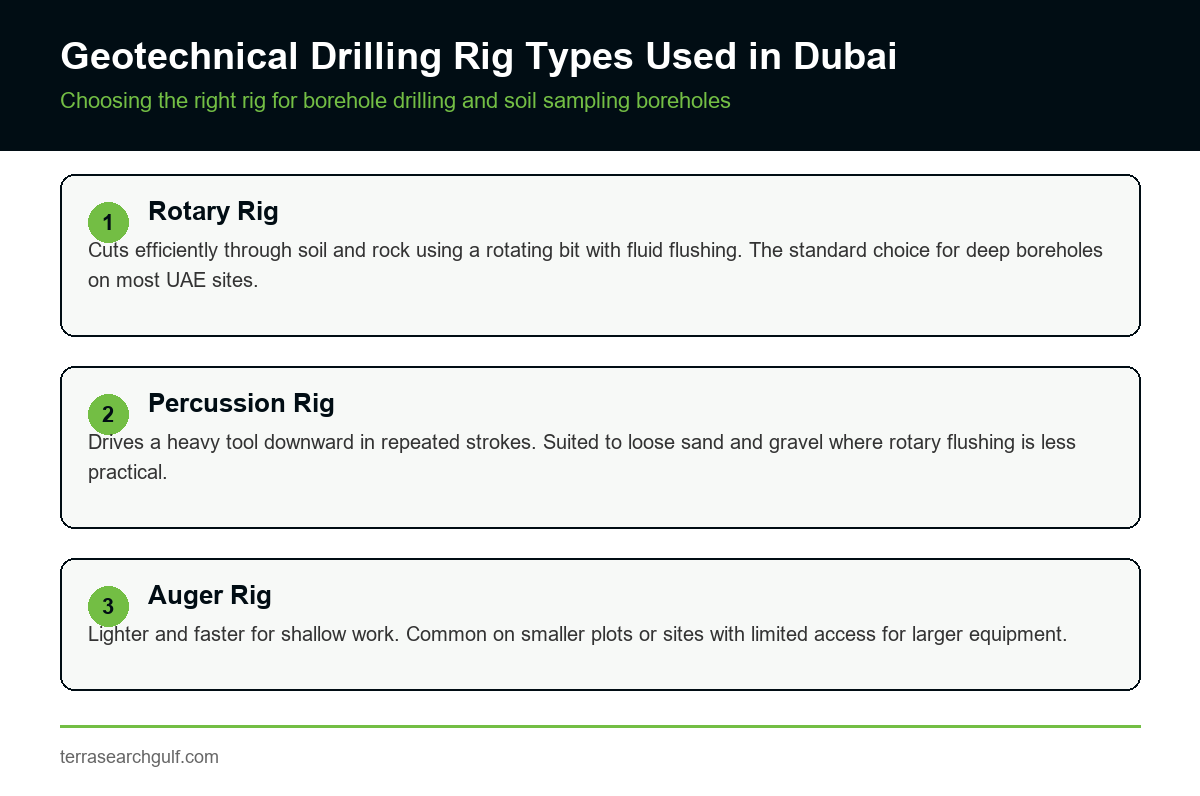
UAE sites use several types of geotechnical drilling rig depending on ground conditions and access. Rotary rigs handle rock and dense strata, while percussion and auger rigs suit shallower soil investigations in tighter urban or coastal sites across Dubai. The right choice affects both drilling speed and sample quality.
Rotary drilling rigs are the most common choice for borehole drilling uae projects because they cut efficiently through both soil and the calcareous rock found across much of the emirate. A rotating bit advances the hole while drilling fluid or air flushes cuttings to the surface, keeping the borehole open and stable. Percussion rigs, which drive a heavy tool downward in repeated strokes, work well in looser sand and gravel where rotary flushing is less practical. Crew supervisors select the rig type at the planning stage, based on findings from any earlier desk study or geophysical survey dubai so the equipment matches the ground expected at each location.
Auger rigs are lighter and faster for shallow work, commonly used on smaller plots or where access is limited, such as within existing developments. Crews also carry sampling tools, casing pipe, groundwater monitoring equipment and standard penetration test gear on the same rig, since several readings are typically taken from the same borehole during one mobilisation. Choosing the right rig for soil sampling boreholes keeps a programme on schedule while protecting sample quality. Rig access and site logistics matter too, since congested urban plots in Dubai often call for smaller, more manoeuvrable equipment than an open greenfield site would need.
How Depth and Number of Boreholes Are Decided for a UAE Project
Drilling depth requirements and borehole count are set by structure type, expected loads and site footprint. A geotechnical engineer plans the layout so every part of the site is represented before deep foundation design begins. This planning stage balances thorough coverage against programme time and cost, since every extra borehole adds both.
For a typical villa or lowrise building, boreholes may extend to around 15 to 20 metres, while a tower or heavily loaded structure can require boreholes well beyond 30 metres to confirm bearing strata suitable for piling. The number of boreholes generally scales with plot area and structural layout, with additional points added near columns carrying heavy loads or where earlier geophysical survey data shows variable ground. This planning stage is part of every thorough professional soil investigation and ensures the drilling programme reflects the actual demands of the design rather than a generic template. Coastal or reclaimed sites in Dubai often warrant deeper boreholes to fully characterise soft layers and confirm where competent bearing material begins. Engineers also consider nearby structures, planned basement levels and any known variability across the plot before finalising the drilling layout, since a programme set too shallow or too sparse can miss ground conditions that affect the final design.
The Borehole Drilling Process Step by Step
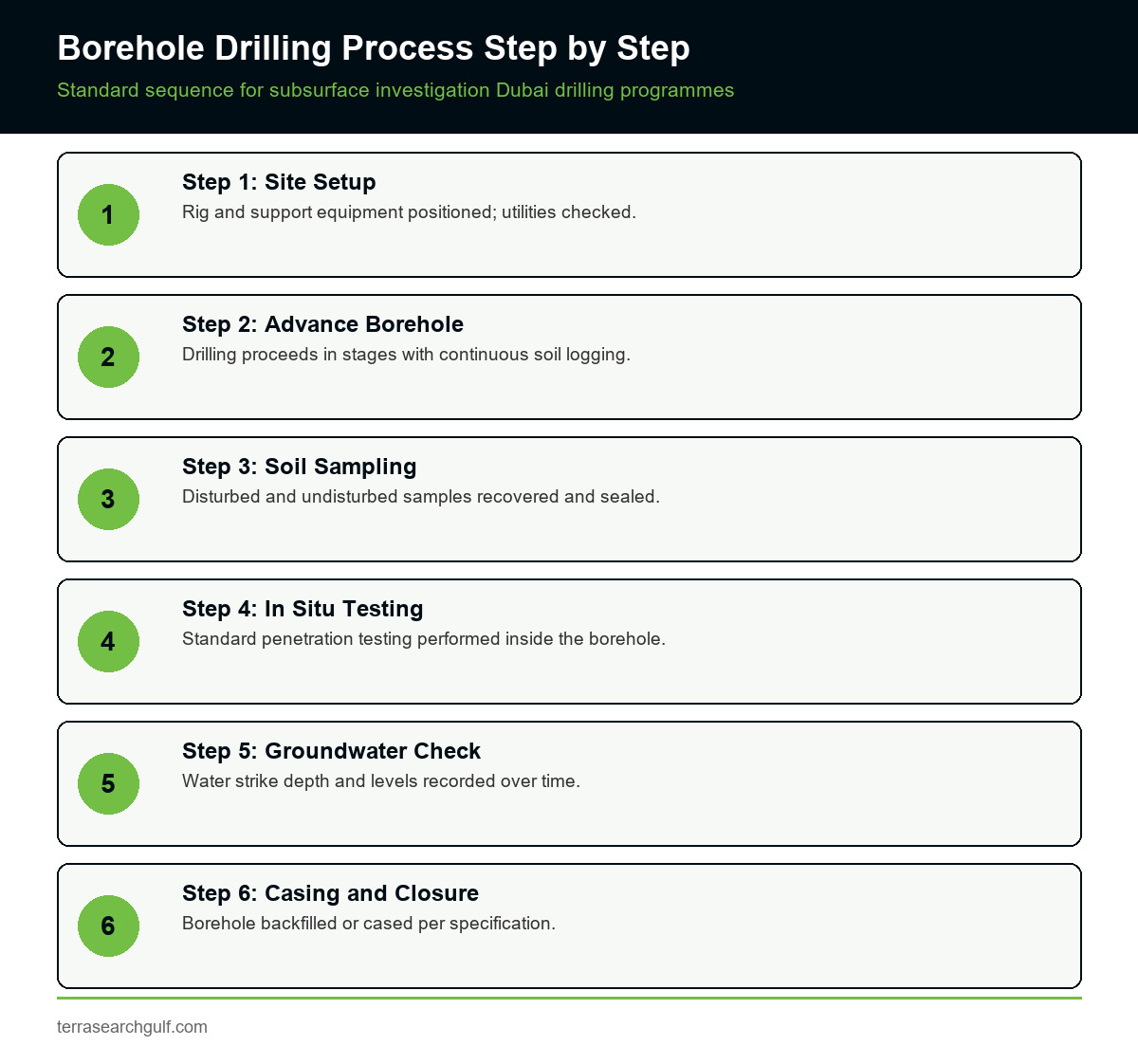
Once the drilling layout is approved, fieldwork follows a consistent sequence from mobilisation through sampling, groundwater observation and in situ testing to hole closure, so every borehole on a UAE site is drilled and logged the same disciplined way from start to finish, regardless of crew or location.
A typical borehole drilling sequence on a UAE site follows these steps, and the same order applies whether the programme covers a single borehole or a full site grid supporting a construction testing lab submission.
- Step 1: Site setup and mobilisation. The rig, water supply and support equipment are positioned at the marked borehole location, and existing utilities are checked before drilling starts.
- Step 2: Advancing the borehole. The crew drills in stages, logging soil type, colour and consistency at each interval as part of the wider soil testing programme.
- Step 3: Soil sampling. Disturbed and undisturbed samples are recovered at set intervals for later laboratory testing, sealed onsite to preserve moisture content.
- Step 4: In situ testing within the borehole. Standard penetration testing is often carried out at intervals inside the same hole to measure soil density and strength directly, a related test covered in its own dedicated guide.
- Step 5: Groundwater observation. The crew records the depth at which water is struck and monitors levels over time, since groundwater affects both foundation design and construction methods.
- Step 6: Casing and hole closure. Once the target depth is reached and readings are complete, the borehole is backfilled or cased according to the project specification and local requirements, and the crew moves on to the next planned location.
What a Client Receives After Borehole Drilling Is Complete
Fieldwork ends with a set of borehole logs and laboratory results that feed directly into the geotechnical report. These outputs give the design team the evidence needed for construction materials testing decisions and foundation sizing, and they form the documented basis for every recommendation the report contains.
Each borehole log records depth, soil description, sample locations, standard penetration results and groundwater readings in a single reference sheet. Samples recovered onsite move to the laboratory for classification, strength and chemical testing, with results compiled alongside the logs in the final soil investigation report. Consulting engineers use this combined package to select foundation type, confirm bearing capacity and finalise material testing laboratory requirements for the construction phase. A clear, accredited report also supports approval submissions to UAE authorities, which is why why soil testing matters for infrastructure so early in a project timeline. Keeping the logs and lab results together in one package also makes it easier for a design team to revisit assumptions later, for example if a project scope changes or an additional storey is added after the original soil testing laboratory work was completed.
Conclusion
Borehole drilling Dubai teams rely on remains the most direct way to understand what lies beneath a site before design decisions are made. From selecting the right rig to setting depth and sample intervals, every step exists to give engineers accurate, defensible ground data. Getting the drilling programme right at the outset also reduces the risk of costly redesigns once construction is underway. Terrasearch Gulf carries out borehole drilling and subsurface investigation across the UAE using experienced crews and accredited laboratory support. Contact Terrasearch Gulf to plan a borehole drilling programme for your next project.
Frequently Asked Questions
1. What is borehole drilling Dubai engineers rely on for foundation design?
It is the process of drilling vertical holes into the ground to recover soil samples and readings. Engineers use this data from Terrasearch Gulf’s core testing services to design safe, economical foundations for a project.
2. How deep does borehole drilling go on a typical UAE project?
Depth depends on structure type and load. Villas and lowrise buildings may need boreholes of 15 to 20 metres, while towers often require depths beyond 30 metres to reach suitable bearing strata for the foundation design.
3. How many boreholes are needed for a construction site?
The count depends on plot size, structural layout and load distribution. Larger or heavily loaded sites need more boreholes, often supported by land survey data to confirm exact positions before the drilling crew mobilises to site.
4. What samples are collected during borehole drilling?
Crews recover disturbed and undisturbed soil samples at set intervals, plus rock cores where needed. Samples are sealed onsite and sent to an accredited engineering lab for classification, strength and moisture content testing before reporting.
5. Is groundwater checked during borehole drilling?
Yes. Crews record the depth at which groundwater is first encountered and monitor levels afterward. Groundwater conditions influence foundation type, waterproofing decisions and construction sequencing on most UAE projects, especially near the coast or reclaimed land.
6. What is a geotechnical drilling rig?
It is the machine used to advance a borehole, most commonly a rotary, percussion or auger rig. Rig choice depends on expected ground conditions, required depth and access constraints found at the specific project site.
7. Is standard penetration testing done during borehole drilling?
Yes, standard penetration testing is often carried out at intervals inside the same borehole to measure soil density and strength directly. It is a related, separately documented test performed as part of the wider drilling programme.
8. What documents does a client receive after subsurface investigation Dubai fieldwork?
Clients receive borehole logs showing soil profiles and sample depths, plus laboratory test results. These combine into a single geotechnical report used for third party testing verification, design approval and formal authority submissions across the project.
9. How long does a borehole drilling programme take?
Duration depends on the number and depth of boreholes plus ground conditions. A typical small site programme takes a few days, while larger or deeper investigations may extend to one or two weeks on site.
10. Why hire an accredited company for borehole drilling in the UAE?
Accredited providers follow recognised standards for sampling, logging and laboratory testing, producing defensible results. This accuracy matters for authority approvals, which is why many project teams review Terrasearch Gulf’s background before appointing a drilling contractor.