


Plate load test vs pile load test is a common question on Dubai sites, and it usually comes up too late. Both tests apply a measured load and record settlement, but they answer different questions about different foundations, at very different depths and costs.
This guide explains what each test proves, where each one fits, and how to pick the right one before the programme forces the choice. For the procedure itself, see how a loaded steel plate is set up and read.
Key Takeaways
- A plate load test checks the ground close to the surface, under a small plate, so it suits shallow foundations, slabs and working platforms.
- A pile load test checks a finished pile, including its shaft and toe, so it is the proof test for deep foundations.
- Choosing between plate load testing and pile load testing depends on foundation type and the depth of ground the design relies on, not on cost alone.
What Each Test Actually Proves
A plate load test places a rigid steel plate on prepared ground at the founding level and loads it in steps against a reaction, usually a loaded truck or kentledge. Settlement is recorded at each step, and the result describes how the ground near the surface responds to load. The test is quick, needs little equipment, and can be repeated at several points across a plot.
A pile load test loads a constructed pile, either a sacrificial preliminary pile or a working pile, and measures how it settles under load. The result describes how the whole pile performs, including friction along the shaft and resistance at the toe. It is a far larger exercise, because the pile has to be built first and the reaction system must carry more than the test load.
So the plate load test tells you about the soil. The pile load test tells you about the pile and the soil working together. That difference drives everything else in this comparison, from the depth each test reaches to what it costs and how long it takes.
Both tests support bearing capacity decisions, but neither can stand in for the other. A good plate result says nothing about a pile at 25 metres, and a pile test says nothing about a slab bearing on fill.
Our overview of verifying design assumptions before and after construction places both tests in the wider sequence of foundation checks.
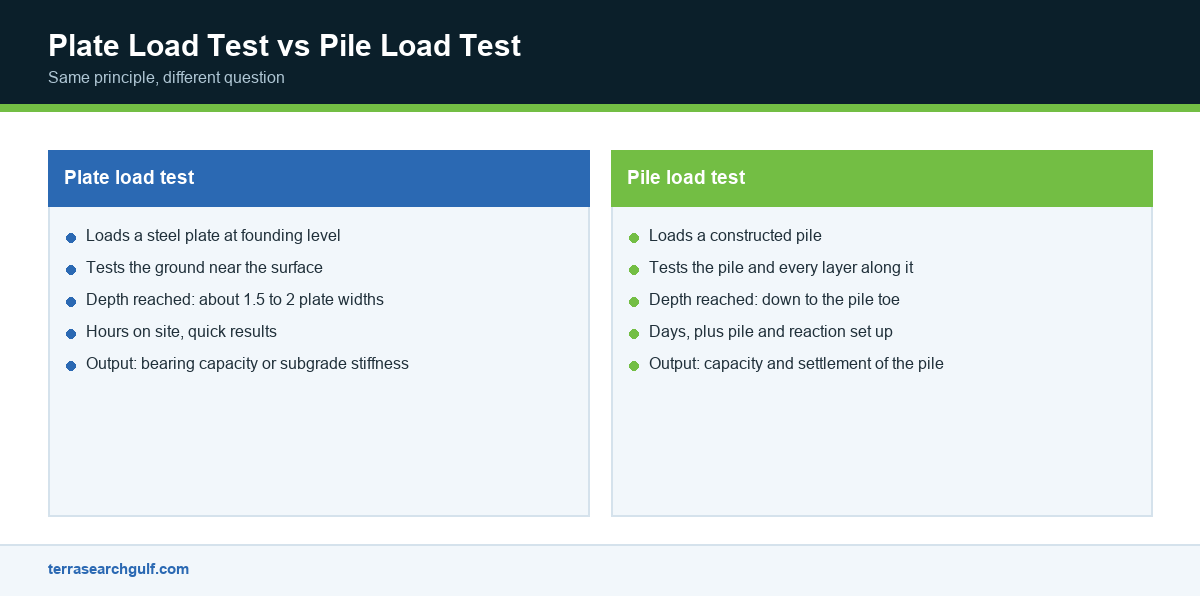
Plate Load Test vs Pile Load Test: Depth Is the Deciding Factor
The most important difference between a plate load test and a pile load test is the depth of ground each one actually tests. This is where most wrong choices begin, usually because a plate test is quicker to arrange and gets used where it cannot see the critical layer.
A loaded plate stresses the ground to a depth of roughly one and a half to two times the plate width. With plates commonly 300 to 750 millimetres across, that means the test looks at little more than a metre or so of ground below the plate.
If a softer layer sits deeper than that, the plate will not see it. A raft or wide footing will, because a large foundation stresses the ground far deeper than a small plate does. This scale effect is why engineers read plate results with care, and why the borehole log should always be checked for weaker layers below the zone the plate can reach.
A pile load test has no such limit. The pile carries load down to its toe, so the test reflects every layer along its length, including the founding stratum the design depends on. That is why authorities and consultants treat it as the proof test for piled foundations.
In practice, the plate load test vs pile load test choice follows the depth the design relies on. Shallow reliance points to the plate, and deep reliance points to the pile.
Which Foundations Need Which Test
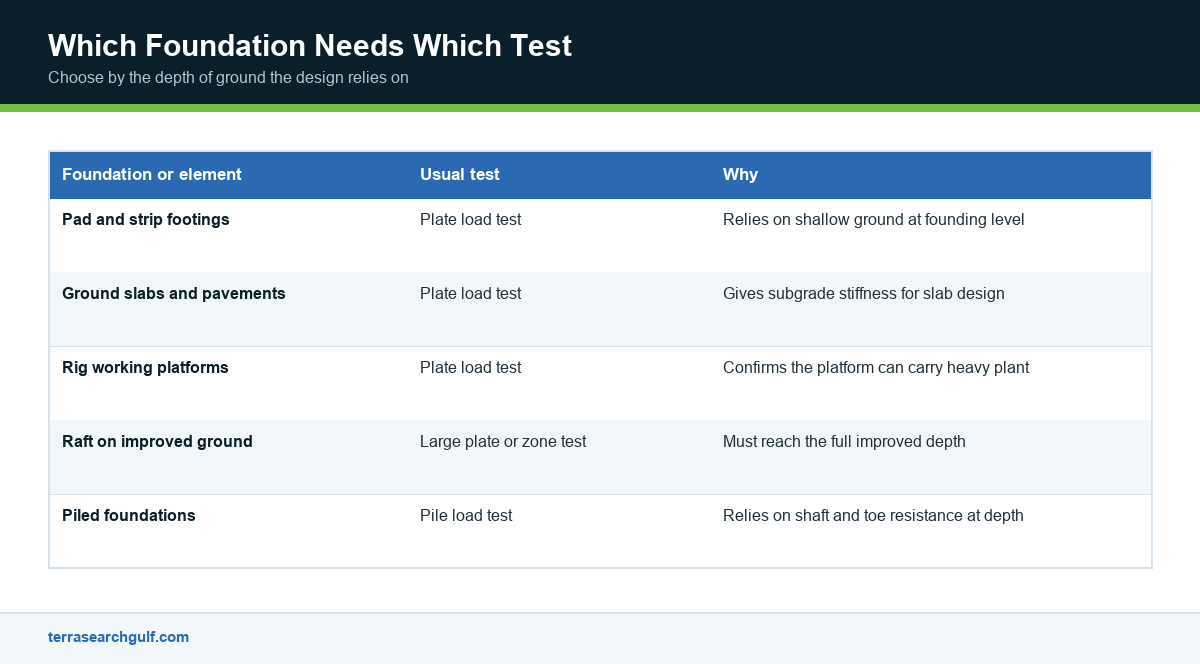
Most projects fall into a small number of foundation types, and each has a usual test. The table below sets out the common cases on Dubai sites, and the plate load test vs pile load test choice for each one.
Isolated and strip footings for villas and low rise buildings are typical plate test cases. The test confirms that the ground at founding level can carry the allowable bearing pressure the report recommended.
Ground slabs, pavements and hardstandings use plate tests too, often to derive a modulus of subgrade reaction for slab design rather than a bearing pressure. That value feeds directly into the slab thickness calculation.
Crane pads and piling rig working platforms are an important case. A plate test on the compacted platform confirms it can support the rig safely before heavy plant moves on to it. A platform that fails under a rig is a serious safety incident, not just a programme delay.
Piled foundations need pile tests. Static, dynamic and integrity methods each have a role, and our guide to static, dynamic and integrity methods explains when each is used.
Rafts on Improved Ground and Other Grey Areas
Some foundations sit between the two cases, and these are where the decision needs the structural and geotechnical engineers in the same conversation.
A raft on improved ground is the classic example. Vibro compaction or stone columns improve the upper ground, and a plate or zone load test is often used to verify the improvement. The test must be large enough to reach the improved depth, or it proves less than it appears to. A small plate on a deeply improved zone tests only the top of the treatment.
Large diameter plates and zone load tests exist for exactly this reason. They stress the ground deeper than a standard plate, at higher cost, and give results closer to the behaviour of the real foundation.
Where a foundation combines a raft with piles, both tests may be needed: plate or zone tests for the raft bearing, and pile tests for the piles. Authority requirements for the number of piles tested are covered in how many piles get tested, and when.
When in doubt, write down the assumption the design relies on, then choose the test that checks that assumption directly.
Cost, Programme and Planning Ahead
The two tests differ sharply in cost and programme. A plate test usually takes a few hours on prepared ground, with a truck or kentledge for reaction, and results are available almost immediately. The main preparation is levelling the test position and bringing the reaction load to site.
A static pile load test needs a constructed test pile, a substantial reaction system of kentledge or anchor piles, and a loading sequence that can run over several days. Standards such as ASTM D1143 set out the loading procedure.
Because pile tests take longer and cost more, preliminary piles should be programmed early, so their results can confirm or adjust the design before working piles are installed.
Plate tests are cheap enough to repeat. Testing at several locations across a plot gives a better picture of variability than a single test, and it costs little compared with the foundation it protects.
Plan both early. The worst outcome is choosing a test because it fits the remaining programme rather than because it checks what the design depends on.
Frequently Asked Questions
What is the main difference in a plate load test vs pile load test?
A plate load test checks the shallow ground under a small plate at founding level. A pile load test checks a finished pile and every layer along its length. One tests the soil near the surface, the other tests the deep foundation.
Can a plate load test replace a pile load test?
No. A plate only stresses the ground to a shallow depth, so it cannot confirm how a pile performs at its toe or along its shaft. Piled foundations need pile tests to prove capacity and settlement under load.
How deep does a plate load test measure?
As a rule of thumb, to about one and a half to two times the plate width. For common plate sizes that is around a metre of ground, which is why deeper soft layers can be missed by the test.
When is plate load testing used in Dubai?
It is used for shallow footings, ground slabs, pavements, hardstandings and piling rig working platforms across Dubai. It confirms bearing capacity or subgrade stiffness at the exact level where the foundation or slab will finally sit.
How long does a static pile load test take?
The loading sequence itself can run from one to several days depending on the procedure and load. Add the time to construct the test pile and the reaction system, which usually takes longer than the test.
Do working platforms for piling rigs need testing?
Yes, in most cases. A plate load test on the compacted platform confirms it can carry the rig safely. A platform failure under heavy plant is a serious safety risk, so the check is worth planning in.
Is a zone load test the same as a plate load test?
It follows the same principle but uses a much larger loaded area. That stresses the ground deeper, so the result is closer to how a raft or wide footing on improved ground will actually behave under load.
Which test gives a modulus of subgrade reaction?
The plate load test. Engineers use it to derive the stiffness value needed for ground slab and rigid pavement design. Results from a pile test are not used for this. Our guide to bearing ratio testing for roads covers the related pavement test.
Match the Test to What the Design Relies On
The plate load test vs pile load test decision is simpler than it looks. Shallow foundations, slabs and working platforms rely on the ground near the surface, so the plate test fits. Piled foundations rely on deep strata, so only a pile test proves them. Grey areas need larger plates or both tests.
Terrasearch Gulf carries out plate, zone and pile load testing across the UAE, with accredited reporting. Tell us about your foundation and we will recommend the test that checks what your design depends on.