

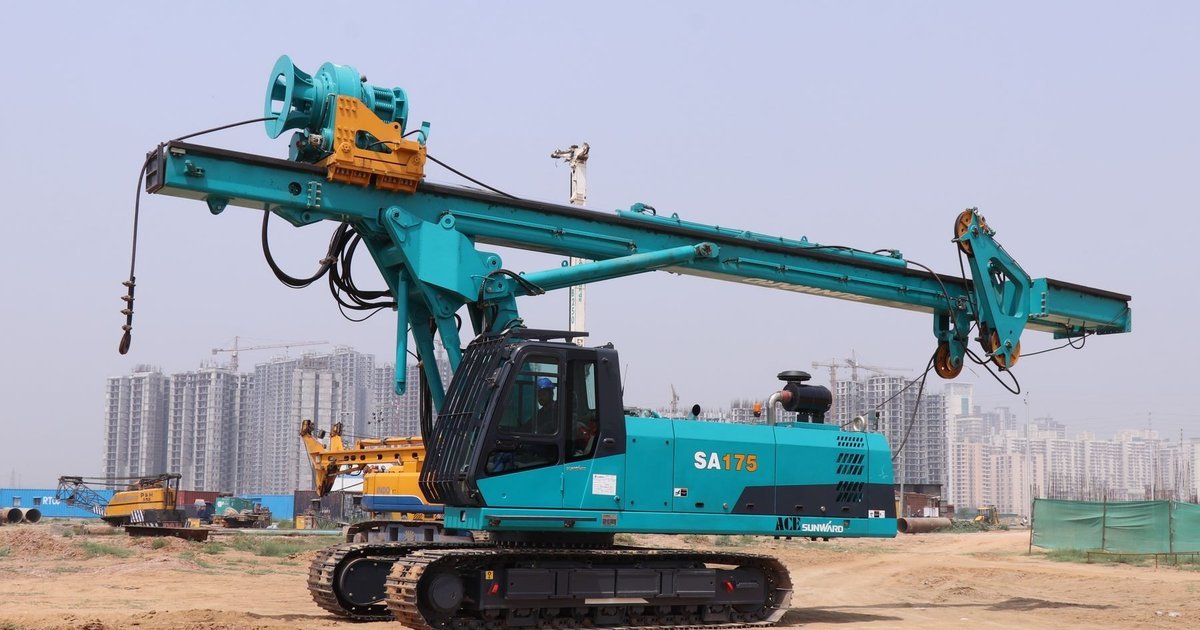
Every tower, bridge and warehouse in Dubai stands on assumptions about its piles. Pile load testing in the UAE is how those assumptions are proven before the structure goes up. If you have searched for pile load testing UAE or pile testing Dubai, this guide brings the answers together. This guide explains the three families of pile tests, how Dubai ground conditions shape the test plan, and what a sound report must contain. It builds on our wider guide to verifying foundation design assumptions and is written for contractors, consultants and developers who need clear answers before mobilising a test.
Key Takeaways
- Pile load testing in the UAE relies on three methods: static load tests for capacity, dynamic tests for speed and coverage, and integrity tests for shaft quality.
- Rock socketed piles in Dubai limestone and calcarenite behave differently from piles in sand, so the test plan must reflect the ground investigation.
- Test frequency, acceptance criteria and witnessing for pile load testing in the UAE are set by the project specification and the approving authority, so agree them before piling starts.
What Pile Load Testing in the UAE Actually Proves
A pile is designed on paper using soil parameters, empirical factors and engineering judgement. Pile load testing in the UAE replaces that judgement with measured behaviour. It confirms that a pile can carry its working load with acceptable settlement, and that it was built as designed. Without that evidence, a consultant cannot sign off the foundation with confidence.
In Dubai, pile testing is a normal condition of foundation approval. Project specifications, often aligned with BS 8004, BS EN 1997 and ASTM methods, define which piles are tested, how and when. The approving authority, usually Dubai Municipality for building projects, reviews the results before superstructure works proceed on many sites. The exact requirements vary by project, so they must be confirmed with the consultant at an early stage.
Testing also protects the contractor. A pile that settles too much or shows a defect is far cheaper to deal with at foundation stage than after the frame is built. Good test programmes in Dubai therefore start before the first pile is bored, with a test plan agreed alongside the piling method statement.
Finally, pile load testing in the UAE feeds back into design. Results from preliminary test piles can justify a more efficient design, shorter piles or higher working loads. On large projects, that saving often exceeds the full cost of the test programme.
Anyone searching for foundation testing UAE options will find that pile load testing in the UAE is only one part of the picture. Ground investigation sets the design parameters, pile tests confirm them, and quality checks on concrete and reinforcement confirm the piles were built from sound materials. When these pieces are planned together, gaps and duplicated effort disappear.
There is also a commercial reason to plan early. Test piles, reaction systems and kentledge all need space, cranage and time on the programme. When pile load testing in the UAE is treated as an afterthought, it competes with excavation and pile cap works for the same ground. A short planning meeting at mobilisation avoids weeks of disruption later.
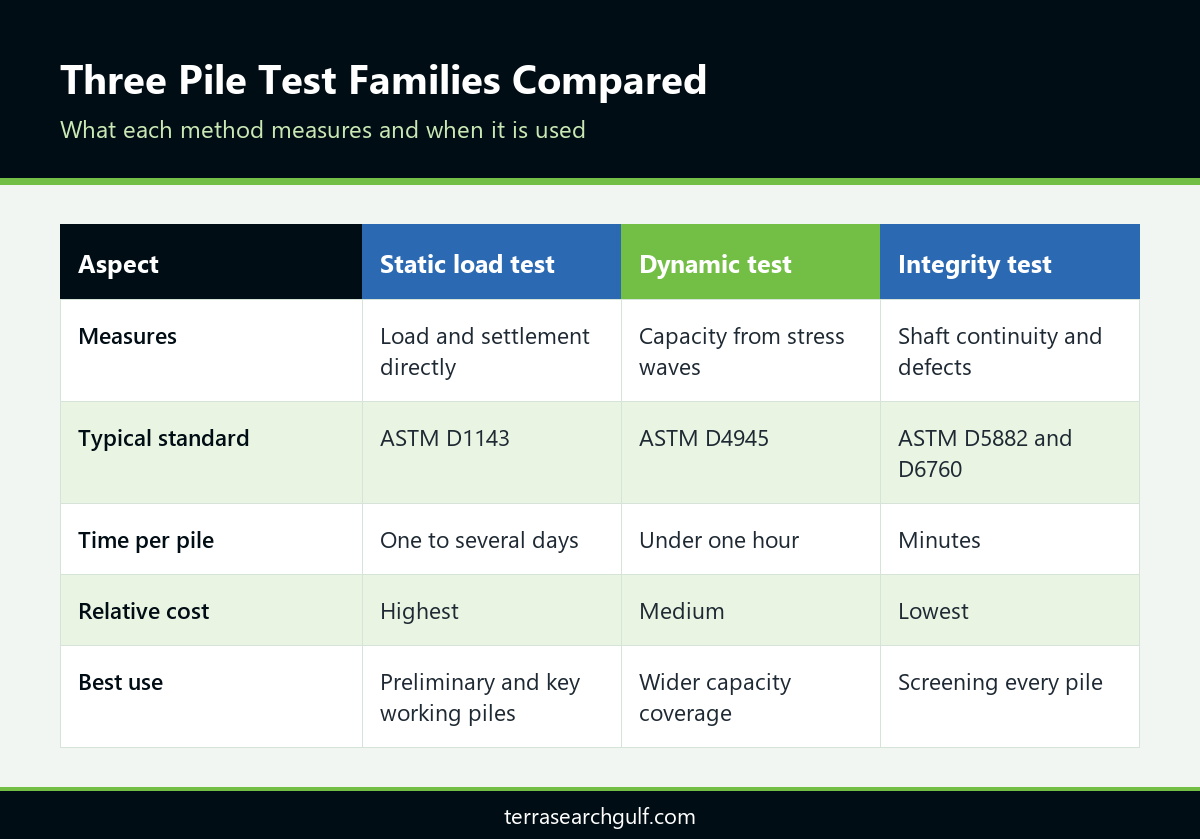
Static Load Tests: The Benchmark for Pile Load Testing in the UAE
A static load test applies a real load to the pile head and measures how the pile settles. It is the most direct test available, and it remains the benchmark against which every other method is judged. Most specifications for pile load testing in the UAE require at least some static tests, even when dynamic methods are used widely.
The method is standardised in ASTM D1143 for axial compressive load, with equivalent procedures in British practice. Load is applied by a hydraulic jack reacting against kentledge or anchor piles, and settlement is recorded with dial gauges or electronic transducers referenced to an independent beam.
Searches for pile load test Dubai and similar terms usually come from contractors facing an approval deadline. A well run test depends on careful set up. The reference beam must be supported well clear of the test pile and reaction system, and it should be shaded, since direct sun on a steel beam in a UAE summer can cause thermal movement larger than the settlement being measured. Calibrated jacks, pressure gauges and load cells are essential, and their certificates should be attached to the report.
Static tests also give the most defensible evidence if a dispute arises later. Because load and movement are measured directly, there is little room for interpretation, which is why many consultants insist on at least one static test per pile type and diameter. In most cases of pile load testing in the UAE, these static results become the reference point that every dynamic and integrity result is compared against.
Maintained load and constant rate of penetration
The maintained load test applies load in increments, holding each stage until settlement stabilises. It suits working piles and is the most common approach in pile load testing in the UAE. The constant rate of penetration test pushes the pile at a steady rate until failure, so it is reserved for preliminary piles where ultimate capacity is needed. Both methods produce a load and settlement curve that the designer compares with predicted behaviour.
Kentledge versus reaction piles
Kentledge uses concrete blocks or steel weights stacked on a platform above the test pile. It is simple but needs space and heavy lifting. Reaction systems use tension piles or ground anchors around the test pile to resist the jack. They suit high test loads and congested sites, but the reaction piles must sit far enough away to avoid influencing the result.
Instrumented test piles
On major projects, preliminary piles are often fitted with strain gauges or extensometers along the shaft. These show how load transfers between shaft friction and end bearing at each depth. For Dubai piles socketed into weak rock, that distribution is valuable, because it tells the designer how much the socket really contributes and whether pile length can be optimised.
Dynamic Testing and When It Can Replace a Static Test
Within pile load testing in the UAE, dynamic testing estimates pile capacity from the stress wave created when a heavy weight strikes the pile head. Strain transducers and accelerometers attached near the top record force and velocity, and the data is analysed with signal matching software. The method is covered by ASTM D4945 for high strain dynamic testing.
The appeal is speed. Several piles can be tested in a day at a fraction of the cost of one static test, so a larger share of the foundation can be checked. On bored piles, a drop weight of roughly one to two percent of the test load is typical, although the right weight depends on the pile and the specification.
Dynamic results are only as good as their calibration. Most consultants accept dynamic tests as a partial substitute when they are correlated against at least one static test on the same site and in similar ground. Published comparisons on piles socketed in Dubai limestone show reasonable agreement on capacity, while dynamic tests tend to overestimate settlement.
Dynamic results are not a free pass in pile load testing in the UAE. Poor pile head preparation, eccentric impacts or insufficient energy can produce misleading results. The test engineer must judge whether enough resistance was mobilised, and the report must say so plainly rather than quoting a capacity the blow could never have proven.
Used well, dynamic methods complement static tests rather than replacing them, and that is how pile load testing in the UAE usually works. It gives the designer a wider statistical picture of the pile group, highlights any unusual piles for closer investigation and shortens the programme on large sites with hundreds of piles.
Pile head preparation is the most common cause of poor dynamic data. The head must be sound, level and free of laitance, and it is often extended or capped with a steel sleeve so that the drop weight strikes squarely. Transducers are bolted to the shaft at least one to two diameters below the impact point. Time spent preparing the head pays back in cleaner signals and fewer retests.
Integrity Testing: Checking What You Cannot See
Integrity tests are the quickest part of pile load testing in the UAE, but they do not measure capacity. They check that the pile shaft is continuous and free of major defects such as necking, voids or soil inclusions. Because they are quick and cheap, they are often specified on a high percentage of working piles, sometimes on every pile.
The two main methods differ in how they look at the shaft. One works from the pile head with a small hammer. The other sends ultrasonic pulses between tubes cast into the pile. Each has strengths, and for pile load testing in the UAE the project specification usually decides which applies.
Integrity testing earns its place because bored piles are built blind. Concrete is placed by tremie under bentonite or polymer, and nobody sees the finished shaft. A collapse of the bore wall, a break in the tremie or contaminated concrete can leave a defect that no visual check will find. Screening piles early lets the contractor investigate anomalies by coring or excavation before pile caps are cast, when remedial work is still practical.
Low strain pile integrity testing
The low strain method, standardised in ASTM D5882, involves tapping the pile head with a hand held hammer and recording the reflected wave. Changes in impedance appear as reflections in the trace. The test is fast and needs no preparation beyond a clean, sound pile head. It works best on piles with a moderate length to diameter ratio, and it struggles to see defects deep in long piles or below a major change in section.
Cross hole sonic logging
Cross hole sonic logging, covered by ASTM D6760, uses steel or plastic access tubes fixed to the reinforcement cage before concreting. Probes lowered down pairs of tubes send and receive ultrasonic pulses, mapping concrete quality across the shaft at every depth. It suits large diameter bored piles for towers and bridges, but the tubes must be planned before casting because they cannot be added afterwards.
Rock Socketed Piles in Dubai Limestone and Calcarenite
Much of Dubai sits on sand and silty sand over weak sedimentary rock, commonly described as calcarenite, calcisiltite or sandstone. Bored piles for heavier structures are usually socketed into this rock. The socket provides most of the capacity, so its behaviour drives the whole plan for pile load testing in the UAE.
Weak carbonate rocks are variable. Strength can change over short distances, cemented layers can sit above weaker bands, and cavities are occasionally found. That variability is why the borehole drilling and coring stage matters so much. Rock quality, unconfined compressive strength and core recovery all feed into the predicted socket friction that testing must later confirm.
For socketed piles, pile load testing in the UAE must reach the rock. A test that mobilises only a small share of the socket tells the designer little. Test loads need to be high enough to reach meaningful movement, and instrumented preliminary piles are particularly useful. They show whether the design socket friction is conservative, which can lead to shorter sockets on the working piles.
Groundwater also matters. Near the coast, shallow groundwater and aggressive soils affect both construction and long term durability. Bored pile construction under bentonite or polymer support must be controlled carefully, since poor base cleaning reduces end bearing and shows up clearly in a static test as early settlement.
This is where pile load testing in the UAE becomes a design tool rather than a checkbox. When preliminary piles are loaded to well above working load in representative rock, the measured socket friction can be compared with the values assumed from core tests. If the design was conservative, sockets can be shortened across hundreds of working piles. If it was optimistic, the problem is found before production piling, not after.
The laboratory side of the investigation is just as important as the drilling. Unconfined compressive strength, point load index and density tests on rock cores give the designer the inputs for socket friction and end bearing. Our overview of key geotechnical laboratory tests explains how each result feeds the foundation design. When the test pile results are later compared against these values, the designer can see exactly where the original assumptions held and where they need adjusting.
How Many Piles to Test, When and Who Witnesses
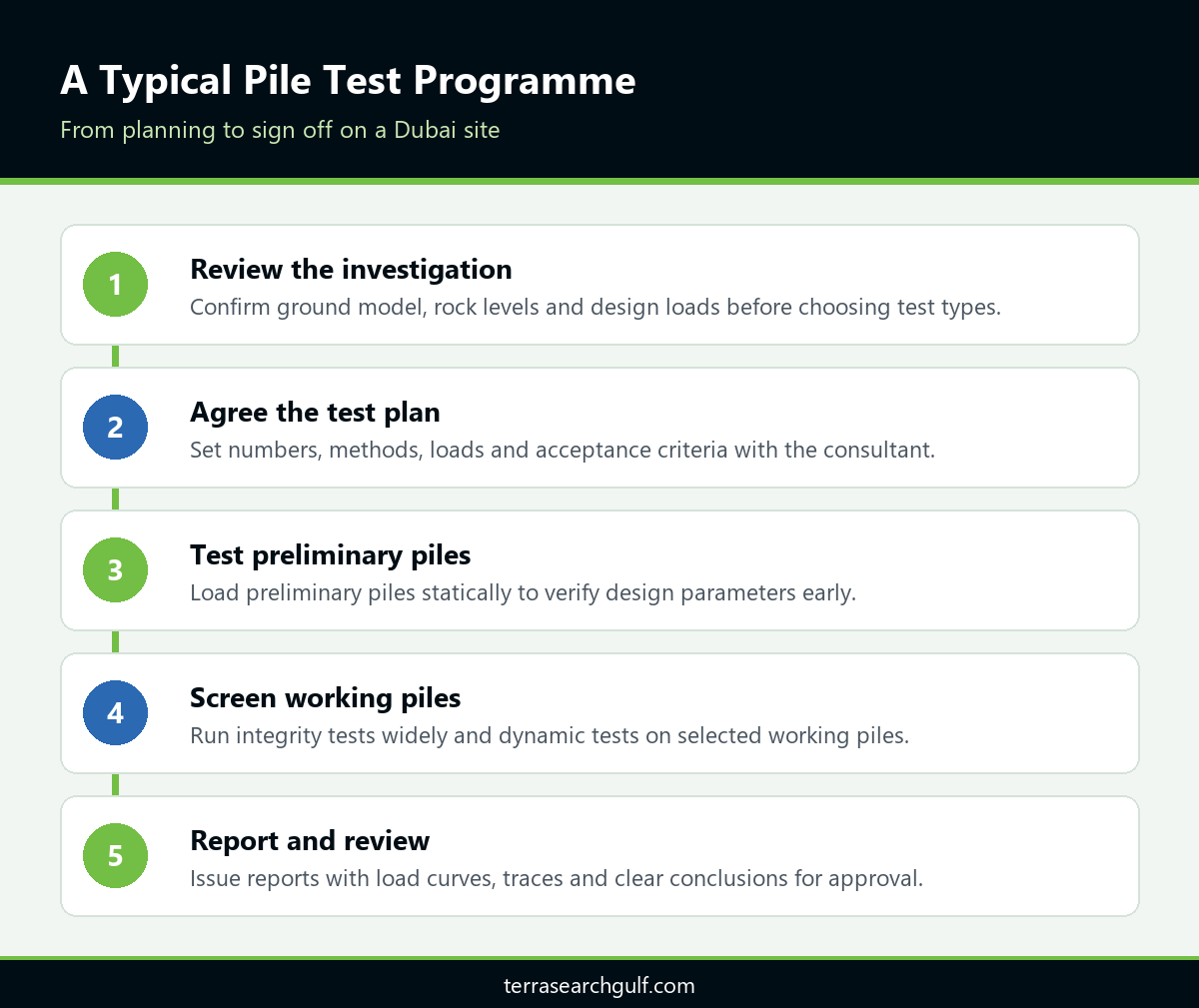
No single test count applies to every project involving pile load testing in the UAE. The project specification sets the test frequency, often as a percentage of working piles for each test type, and the approving authority may add its own conditions. A typical programme combines a small number of static tests, a larger number of dynamic tests and integrity tests on most or all piles.
Preliminary piles are tested before working piles are installed. They are constructed with the same method and equipment as the production piles, then loaded beyond working load to verify the design. Working pile tests follow during production to confirm quality and consistency across the site.
Timing matters a great deal in pile load testing in the UAE. Concrete must reach adequate strength before a pile is loaded, and the specification will state a minimum age or strength. Static tests also need time for setting up kentledge or reaction systems, so they should be scheduled early in the programme.
Witnessing is normally carried out by the consultant, and sometimes by the client or authority representative. An independent, accredited laboratory performs the test and issues the report. Accreditation by the Emirates International Accreditation Centre and the lab’s approval status give the consultant confidence in the data. Our guide to how EIAC accreditation and approvals work explains the difference between the two.
Practical selection of test piles also deserves thought. Static tests should cover the most heavily loaded piles and areas where the investigation showed weaker or more variable rock. Dynamic and integrity tests can then be spread across the site to show consistency. Where a pile shows an anomaly or was affected by a construction problem, the consultant may ask for it to be tested specifically, so keep good pile construction records for every pile.
Programme planning should also allow for retests. A dynamic test that fails to mobilise enough resistance, or an integrity trace that shows an anomaly near the head, often needs a second visit after the pile head is trimmed or repaired. Building a small allowance for these visits into the programme avoids last minute pressure on the piling subcontractor and keeps pile cap works on schedule.
Reading a Pile Test Report
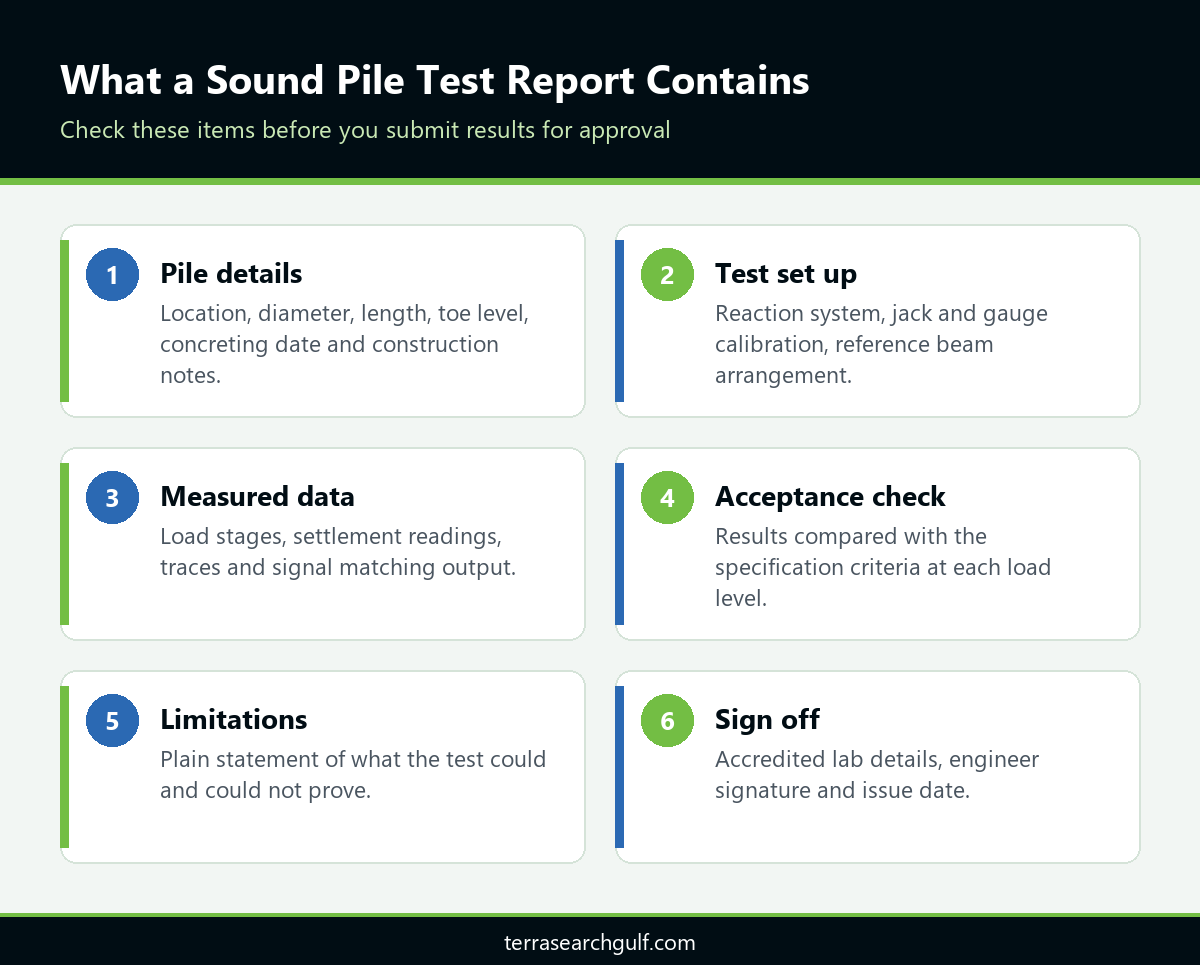
A report on pile load testing in the UAE should let any competent engineer understand what was done and what it means. It starts with pile details: location, diameter, length, toe level, concreting date and any construction notes. Without these, the results cannot be interpreted properly.
For static tests, the core output is the load and settlement curve, along with tables of each load stage, holding time and readings. Acceptance is usually judged on settlement at working load and at a multiple of working load, plus residual settlement after unloading. The criteria come from the specification, not the laboratory.
Dynamic test reports should include force and velocity traces, the signal matching output, the mobilised capacity and a statement of whether full resistance was achieved. Integrity reports should show the traces for each pile, with any anomaly described clearly and graded according to the agreed classification.
Watch for reports that quote capacity without supporting data, or that skip calibration and equipment details. A sound report is transparent. It also states limitations honestly, for example where a dynamic blow did not mobilise full capacity or where an integrity trace cannot see below a certain depth.
Reports on pile load testing in the UAE should be issued promptly. Piling programmes move fast, and a delayed report can hold up pile caps and the structure above. Agree turnaround times with the laboratory at the start of the job.
When a result falls outside the acceptance criteria, the report should present the data without spin and leave the engineering judgement to the designer. The usual next steps are to check the pile construction records, review the ground conditions at that location and decide whether further testing, additional piles or a design change is needed. A clear, honest report makes that conversation faster and far less contentious for everyone involved.
Choosing a Pile Testing Provider in Dubai
Start with scope when buying pile load testing in the UAE. Check that the laboratory is accredited for the specific test methods you need, not just for general geotechnical or materials testing. Accreditation scopes list individual methods, and a gap there can delay approval.
Next, look at equipment and crew capacity for pile load testing in the UAE on sites of your size. Static testing needs jacks, load cells and reaction systems rated for your test loads. Dynamic testing needs suitable drop weights and analysis software. Ask how many crews are available, because busy periods can stretch mobilisation times.
Experience in local ground conditions is a real advantage. A team that understands Dubai calcarenite and the subsurface conditions revealed by boreholes and geophysics can spot an unusual result early and explain it clearly.
Consider how providers of pile load testing in the UAE link with the rest of your testing. Many projects combine pile tests with plate load testing for shallow foundations, concrete testing and independent third party testing. One accountable provider reduces interfaces and keeps reports consistent.
Terrasearch Gulf supports foundation projects across the UAE through our structural testing and analysis services and geotechnical investigation team. With 342+ projects, 100+ clients and EIAC accreditation, we bring local ground knowledge to every test plan. Industry bodies such as the Deep Foundations Institute are also useful references for current practice.
Finally, ask for sample reports before you appoint. A provider confident in its work on pile load testing in the UAE will share anonymised examples that show their data presentation, analysis and conclusions. Compare these against the checklist above, and choose the laboratory whose reports your consultant will be able to approve without repeated queries.
Conclusion
Piles carry everything above them, so the evidence behind them must be solid. Static tests prove capacity, dynamic tests extend coverage and integrity tests confirm that each shaft was built properly. For Dubai projects on weak rock, the test plan should follow the ground investigation and the specification closely. A well planned programme of pile load testing in the UAE keeps approvals moving and protects the structure for its full life. To plan your next foundation test programme, speak with the Terrasearch Gulf team.
Frequently Asked Questions
Pile load testing UAE: what do contractors need for approval?
It is a set of tests that prove piles can carry their design loads safely. Most projects combine static load tests, dynamic tests and integrity tests, as defined by the project specification and reviewed by the approving authority before works continue.
How long does a static pile load test take?
A maintained load test usually takes one to several days. That includes setting up kentledge or reaction piles, loading in stages, holding each stage until settlement stabilises and unloading. Larger test loads and longer hold periods extend the programme.
Can a dynamic test replace a static load test?
Dynamic tests can replace some static tests when they are calibrated against at least one static test on the same site and in similar ground. Most consultants still require a minimum number of static tests on every project, whatever the pile count.
What does a pile integrity test detect?
Integrity tests detect major defects in the pile shaft, such as necking, voids, cracks or soil inclusions. They do not measure load capacity, so they are always used alongside static or dynamic load tests rather than instead of them.
How many piles need to be tested in Dubai?
The number depends on the project specification and the approving authority. Typically a few piles receive static tests, more receive dynamic tests, and integrity tests cover a high percentage of working piles. Confirm the exact numbers with your consultant early.
When can a pile be tested after concreting?
The pile concrete must reach the strength or age stated in the specification before any load test begins. Integrity tests can usually be carried out sooner, once the concrete has hardened and the pile head has been trimmed and properly prepared.
Who witnesses pile load tests on Dubai projects?
The consultant normally witnesses tests, sometimes joined by the client or an authority representative. An accredited laboratory performs the test and issues the report, which the consultant then reviews against the specification before giving approval to proceed.
Why are Dubai piles socketed into rock?
Much of Dubai has sand over weak carbonate rock. Socketing bored piles into that rock provides most of their capacity, which is why rock coring and laboratory strength tests are central to a full site investigation before design.
What accreditation should a pile testing lab hold?
Look for EIAC accreditation covering the specific pile test methods, plus the relevant authority approval. Our guide to what ISO 17025 accreditation guarantees explains why the method scope matters as much as the certificate.