


A pile load test failure can stop a project overnight. The programme slips, the consultant withholds approval and everyone asks the same question: what now? This guide explains what a pile load test failure means in practice, how to investigate the cause and which recovery routes are open to contractors and consultants in Dubai. It builds on our overview of verifying design assumptions through foundation checks and shows how a calm, evidence led response protects both the structure and the schedule.
Key Takeaways
- A pile load test failure means the pile did not meet the acceptance criteria in the specification. It does not always mean the pile or the design is unsafe.
- Secure the test data, the pile records and the ground information before anyone proposes a fix, because the cause decides the remedy.
- Recovery usually follows one of three routes: retest, test additional piles, or redesign. Each needs consultant approval and clear documentation.
What Counts as a Pile Load Test Failure
A pile load test failure is defined by the project specification, not by a single universal number. Most specifications set limits on settlement at working load, residual settlement after unloading and settlement at the maximum test load. Missing any one of these limits is recorded as a failure, even if the pile still carries its load.
In practice, failures fall into two broad groups. The first is a capacity failure, where the pile plunges or settlement keeps increasing under constant load. The second is a serviceability failure, where the pile holds the load but settles more than the design allows. The load settlement curve from a static load test usually shows which group you are dealing with. A capacity failure points to a ground or construction problem. A serviceability failure may simply reflect conservative limits or a stiffer than expected response elsewhere on site. Understanding the difference early stops the team from reaching for an expensive redesign when a review of the criteria would settle the matter.
It also helps to separate preliminary test piles from working piles. A preliminary pile is often loaded to a higher multiple of working load to confirm design parameters. A working pile is tested to prove it performs as built. On Dubai projects, a pile test failure on a preliminary pile usually triggers a design review, while a working pile failure raises questions about construction quality across the batch. Searches such as “pile test failure Dubai”, “pile load testing UAE” and “foundation testing UAE” usually come from teams facing exactly this decision.
The First 48 Hours: Secure the Evidence
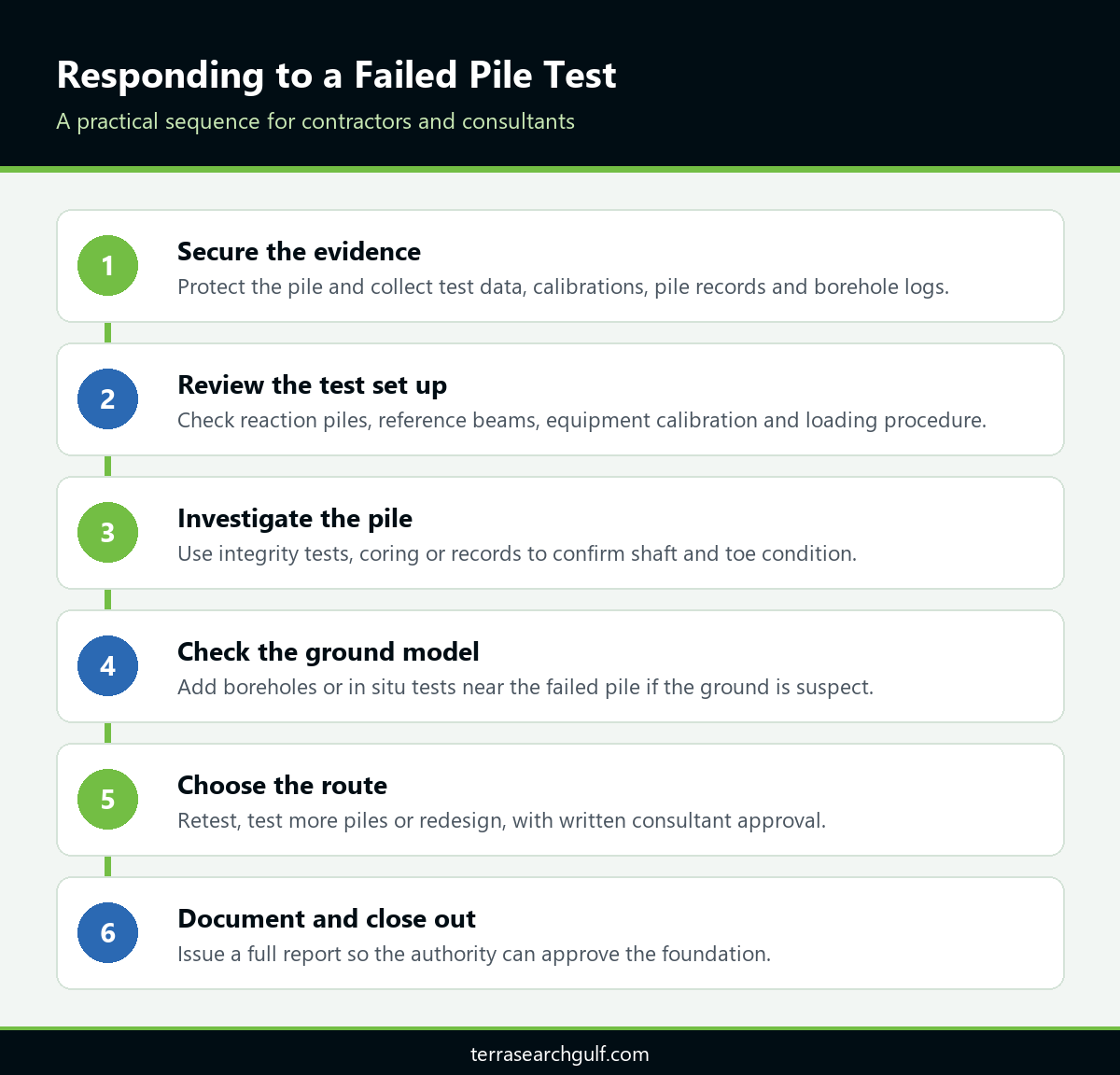
How a team responds in the first two days after a pile load test failure decides how quickly the project recovers. Freeze the records, protect the test pile and gather every piece of data before anyone proposes a fix. Decisions made on assumptions in this window often cost more than the failure itself.
Start with the test itself. Collect the raw load and displacement readings, the calibration certificates for the jack, pressure gauge and dial gauges, the reference beam set up and the site log. Check that the test followed the agreed procedure, such as the maintained load method described in ASTM D1143. Next, assemble the pile records: boring or drilling logs, concrete volumes, cage details, cube results and any notes about delays, collapses or water ingress. Finally, compare the pile location with the nearest borehole logs. A soft layer, a cavity or a lens of weak calcarenite that the investigation did not capture often explains the result. If the original borehole drilling was widely spaced, that gap becomes part of the discussion.
Keep the test pile undisturbed until the consultant agrees the next step. Cutting it down or loading it again too early can destroy evidence that later proves the pile was sound.
Finding the Cause: Ground, Pile or Test Set Up
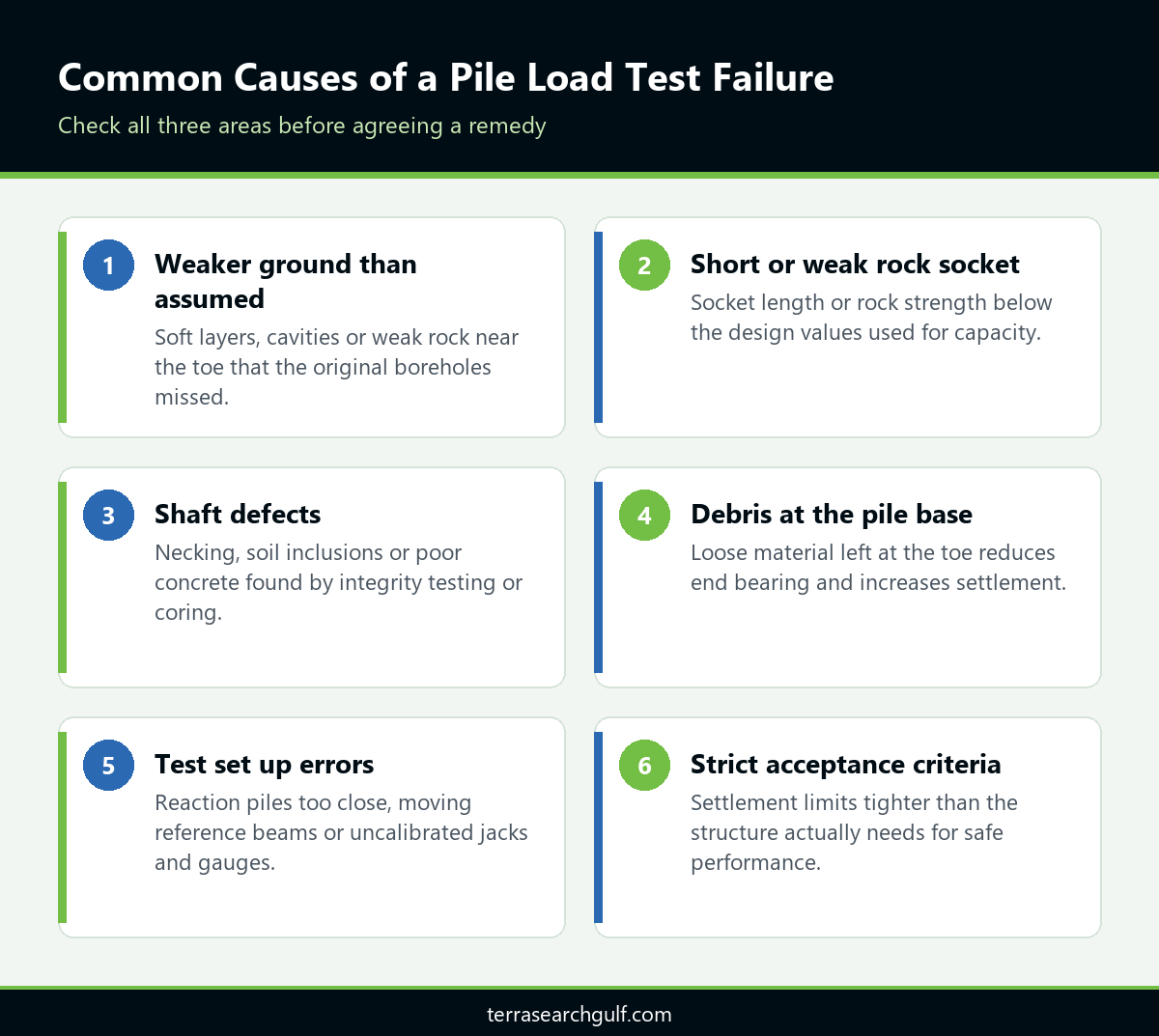
Every pile load test failure has a cause in one of three places: the ground, the pile or the test arrangement. Work through each in turn with the geotechnical engineer, the piling contractor and the testing lab. The goal is a cause supported by data, not a theory that suits one party.
Ground causes include weaker strata than assumed, unexpected groundwater, soft toe conditions or a rock socket shorter than designed. Pile causes include necking, soil inclusions, poor concrete at the toe, debris left at the base or a cage that shifted during concreting. Integrity tests, coring through the shaft and a careful review of construction records help confirm or rule these out. Test set up errors explain more than one pile load test failure on busy sites. Reaction piles placed too close to the test pile, a reference beam that moved in the afternoon heat, an uncalibrated jack or loading increments held for too short a time can all produce a false result. A structured review by an independent team, such as our structural testing and analysis engineers, keeps the investigation objective. Where the ground is the suspect, supplementary boreholes or in situ tests close to the failed pile are usually the fastest way to settle the question.
Recovery Routes: Retest, Extra Piles or Redesign
Once the cause is known, the response to a pile load test failure usually follows one of three routes. The right choice depends on whether the problem is isolated to one pile, linked to a construction method or rooted in the ground model. The consultant approves the route, and the approving authority may need to see the evidence.
A retest suits cases where the test set up is in doubt. After correcting the arrangement and recalibrating the equipment, the same pile is loaded again under an agreed procedure. Testing additional piles suits cases where one pile is suspect but the design is probably sound. Further static tests, high strain dynamic load testing or integrity tests on neighbouring piles show whether the problem is local or widespread. Redesign is the route when the ground model was wrong. Options include longer piles, deeper rock sockets, larger diameters, extra piles in the group or a reduced working load. Each option must be checked against the structural design and the programme. Throughout, keep a written record of every decision, because the final report will be reviewed by the consultant and, in many cases, by the authority that approves the foundation.
Whichever route is chosen, agree the acceptance criteria for any new test before loading starts. Changing the criteria after the result is known damages trust and delays approval.
Preventing a Repeat on Your Next Project
The best way to manage a pile load test failure is to make one less likely. Most failures trace back to gaps in the ground information, loose construction control or rushed test planning. Each can be addressed before the first pile is bored.
Start with a ground investigation that matches the foundation design. Borehole spacing, depth and the number of rock cores should reflect the pile layout and the variability of Dubai’s limestone and calcarenite. Plan preliminary pile tests early, so the design can be adjusted before hundreds of working piles are installed. During construction, record every pile in detail and investigate anomalies as they occur rather than at the end. For the test itself, agree the procedure, acceptance criteria and reaction arrangement in writing, and use calibrated equipment from an EIAC accredited testing lab. Good practice for pile load testing in the UAE also includes an independent witness and a clear reporting format. These steps do not rule out a pile load test failure, but they turn a surprise into a manageable event. They also give the consultant confidence that a single poor result is an exception rather than a pattern across the site.
Finally, treat foundation testing as a design tool rather than a final hurdle. Early test results that feed back into the design are worth far more than late results that only confirm a problem.
Conclusion
A pile load test failure is serious, but it is rarely the end of a foundation. Secure the evidence, investigate the ground, the pile and the test set up, then choose between retesting, testing more piles or redesigning with your consultant. Clear records keep approvals moving. Terrasearch Gulf supports contractors and consultants across Dubai with independent pile testing, ground investigation and reporting. If a test result has put your programme at risk, speak to our geotechnical team to plan the next step.
Frequently Asked Questions
What is considered a pile load test failure?
A pile load test failure occurs when measured settlement or pile behaviour exceeds the acceptance criteria in the project specification. Criteria usually cover settlement at working load, residual settlement after unloading and settlement at the maximum test load.
Does a failed pile test mean the pile is unsafe?
Not always. Some failures reflect strict serviceability limits or test set up errors rather than a weak pile. An engineering review of the data, the pile records and the ground conditions confirms whether remedial action is needed.
Can the same pile be tested again after a failure?
Yes, when the consultant agrees. A retest is common when the reaction system, reference beams or equipment calibration are in doubt. The procedure and acceptance criteria should be agreed in writing before loading starts again.
How long does it take to recover from a pile test failure in Dubai?
It depends on the cause. A retest may take only days, while additional testing or a redesign can take several weeks. Fast, well documented investigation and early consultant involvement usually shorten the delay to the overall programme considerably.
Who pays for extra testing after a failed pile test?
Responsibility depends on the contract and on the cause. Construction defects usually fall to the piling contractor, while unforeseen ground conditions may be treated differently. The contract terms and the investigation findings normally decide who bears the cost.
What tests help find the cause of a failed pile?
Integrity testing, coring through the shaft, dynamic testing and supplementary boreholes are the usual tools. Reviewing plate load and bearing capacity data from the same site can also help explain unexpected settlement at the test pile.
Can poor ground investigation cause a failed pile test?
Yes. Widely spaced or shallow boreholes can miss weak layers, cavities or variable rock below the pile toe. A thorough subsurface investigation reduces this risk by giving designers a realistic picture of the ground before piling begins.
Should working piles be tested after a preliminary pile fails?
Usually the design is reviewed first, because a failed preliminary pile suggests the design parameters need checking. Once the design is confirmed or revised, working pile tests then verify that construction meets the updated requirements.
How can contractors reduce the risk of pile test failure?
Match the ground investigation to the pile layout, test preliminary piles early, record every pile during construction and agree the test procedure in writing. Using calibrated equipment and an accredited lab also reduces the risk.