

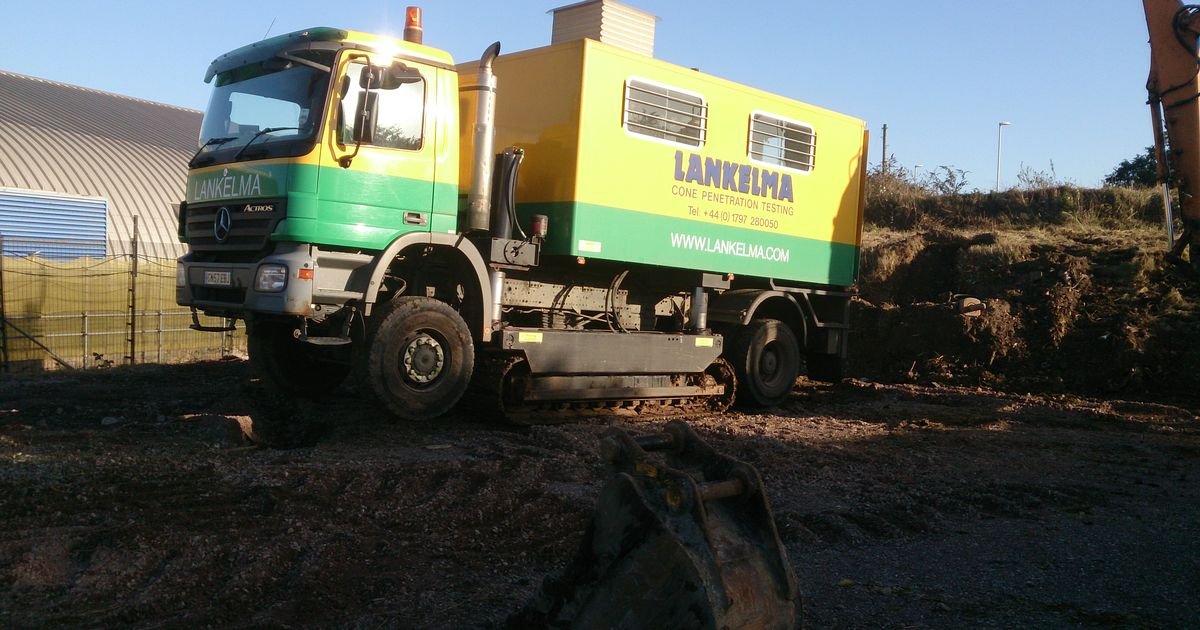
A CPT test UAE engineers trust delivers continuous subsurface data in hours rather than days. Cone penetration testing pushes an instrumented steel cone into the ground at a steady rate while sensors record resistance every few centimeters. For Dubai projects built on soft coastal deposits and reclaimed land, this speed and detail matter. Terrasearch Gulf performs CPT surveys across the UAE as part of a full geotechnical investigation program, supporting the geotechnical investigation services engineers rely on for foundation design, risk assessment, and site classification before construction begins.
Key Takeaways
- CPT delivers continuous tip resistance and sleeve friction data without sampling delays.
- Ideal for the soft coastal and reclaimed soils common across Dubai and Abu Dhabi sites.
- Results guide foundation type, bearing capacity, and liquefaction risk decisions before design starts.
What Is a Cone Penetration Test?
Cone penetration testing is a subsurface investigation method that pushes a cylindrical steel cone through soil at a constant rate. Sensors built into the cone tip record resistance and friction continuously, producing a detailed profile of soil stratigraphy without extracting physical samples.
The Cone Penetration Test method, sometimes called the CPT method, follows international standards and is widely used alongside professional soil investigation in the UAE. A hydraulic rig advances the cone at roughly two centimeters per second while onboard sensors log tip resistance and sleeve friction. This data feeds directly into soil investigation reports used for foundation design. Unlike sampling based methods, CPT produces a continuous digital record rather than isolated readings, which is why it complements the laboratory tests performed at a typical geotechnical laboratory. The result is a clear, repeatable picture of ground conditions.
Terrasearch mobilizes CPT rigs mounted on trucks or tracked carriers depending on site access, with each unit capable of applying up to twenty tonnes of push force through hydraulic rams. Cone diameter and shape follow recognized international standards so results stay comparable across projects and testing providers. Data appears on a rig mounted screen as the push advances, letting our field engineer flag unusual readings on site rather than waiting for lab results to return days later.
How the CPT Rig Measures Tip Resistance and Sleeve Friction
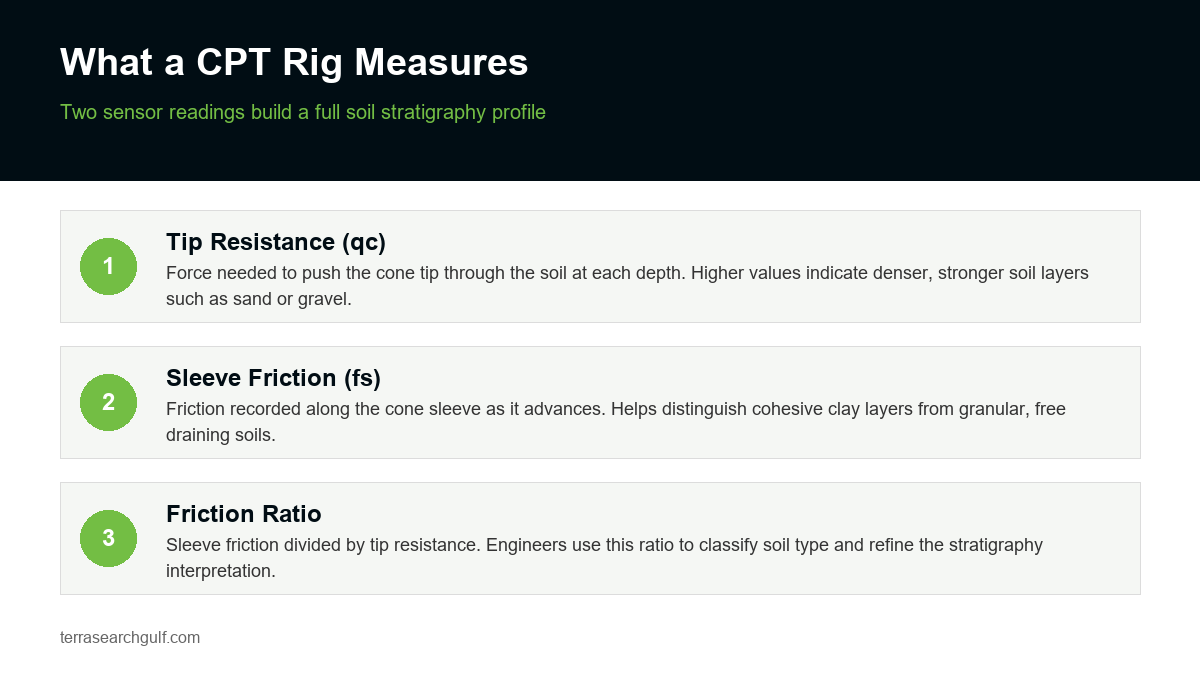
The CPT rig advances an instrumented cone fitted with two key sensors. One measures tip resistance, the force needed to push the cone tip through soil. The other measures sleeve friction along the cone shaft, revealing soil type and strength at every depth.
Tip resistance rises in dense sand and gravel and drops in soft clay, while sleeve friction helps distinguish cohesive layers from granular ones. Engineers plot both values against depth to build a soil stratigraphy profile in real time. This is the same principle applied in the engineering labs across Dubai that support structural and material testing programs. Because the CPT rig records data continuously rather than at fixed intervals, it captures thin layers and transitions that other methods can miss. Many Terrasearch clients pair CPT with the speciality testing services offered for complex sites and compare results against earlier soil testing records for consistency.
Some CPT rigs also carry a pore pressure sensor, turning the test into a piezocone sounding that adds groundwater and drainage behavior to the profile. Engineers cross reference tip resistance, sleeve friction, and pore pressure using published soil behavior charts to classify layers with confidence. This combined reading is particularly useful in Dubai, where shallow groundwater is common and drainage characteristics influence both foundation design and construction sequencing on site.
Why CPT Outperforms Traditional Borehole Sampling
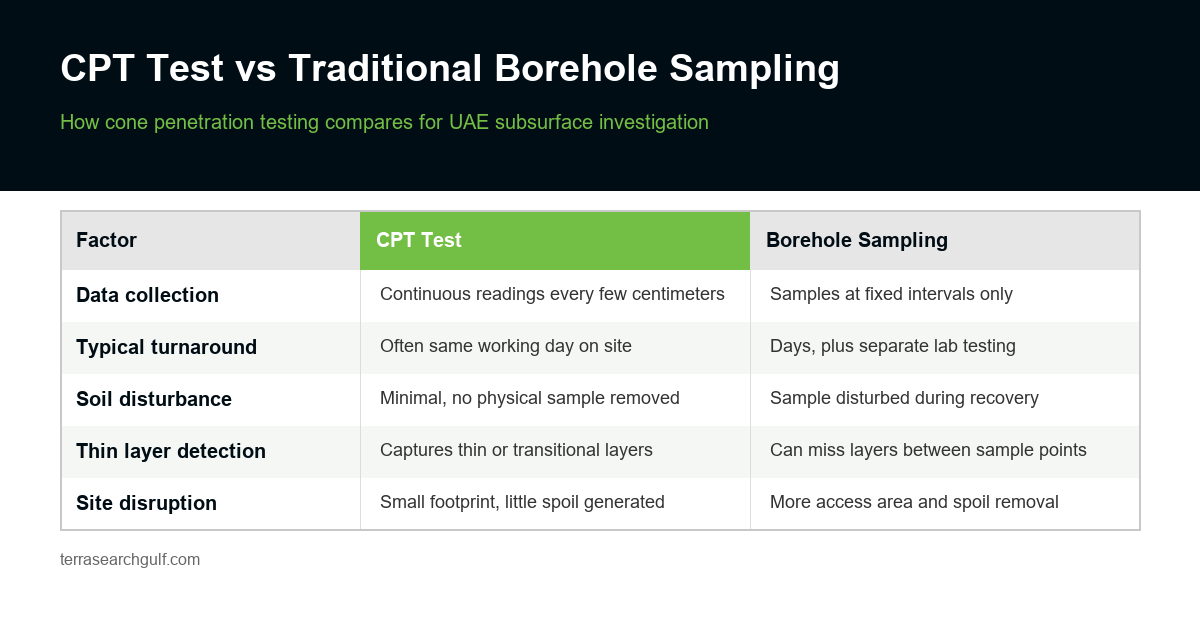
Traditional borehole sampling relies on drilling, extracting samples, and testing them separately in a laboratory, a process that can take days per location. CPT eliminates most of that lag by recording data as the cone advances, often within the same working day.
Speed is only part of the advantage. Borehole sampling captures soil at set intervals, leaving gaps that can hide weak layers or sudden changes in ground strength. CPT closes those gaps with continuous readings every few centimeters, which is especially valuable for projects that also require a soil testing laboratory review. This level of detail supports the professional soil investigation companies engineers hire for critical infrastructure. Fewer site visits and less spoil to dispose of also make CPT a practical choice for congested sites, where conditions documented during soil testing in Dubai show how tightly neighboring structures often sit to a new build.
CPT data also correlates directly with strength parameters engineers need for design, including relative density, undrained shear strength, and estimated settlement. Because results are digital from the first reading, they move into design calculations without the manual logging errors that sometimes affect handwritten borehole records. For contractors working to tight programs, this combination of speed and accuracy often reduces the overall investigation budget, even though CPT points can outnumber conventional boreholes across the same site.
When UAE Engineers Specify CPT for Site Investigation
CPT is often the preferred subsurface investigation method on Dubai and Abu Dhabi projects built over soft coastal deposits, sabkha, and reclaimed land. SPT and CBR testing may also be specified for particular design questions, but CPT usually runs first to map ground conditions quickly.
Reclaimed land along the Dubai coastline often contains loose, variable fill over soft marine clay, conditions where continuous data matters more than isolated samples. A geophysical survey can map broader site geology, while CPT adds precise, depth specific strength values engineers need for pile design and settlement calculations. On some projects, standard penetration testing or CBR testing is specified alongside CPT for particular layers or pavement design, since each test answers a different design question. Combining CPT with broader subsurface investigation practice and a matching land survey gives designers the full picture before foundations are finalized. Terrasearch also supports projects that need a sustainable construction review, and engineers may separately request plate load testing to verify bearing capacity assumptions on sensitive layers.
CPT is a common choice for coastal towers, marine facilities, and man made islands, where fill thickness and consolidation history vary across a single plot. Pipeline and utility corridor projects also benefit, since a CPT rig can move quickly between points without the access disruption a full drilling spread requires. On projects with tight programs, our team sequences CPT points first, then targets any follow up boreholes only where the CPT data flags an unusual layer.
What You Receive From a CPT Survey
A completed CPT test UAE clients receive includes raw and processed data plots, a soil stratigraphy interpretation, and an engineering summary. Reports show tip resistance, sleeve friction, and friction ratio against depth, with soil parameters ready for design use.
Typical deliverables include depth referenced graphs of tip resistance and sleeve friction, an interpreted stratigraphy log, and groundwater observations where relevant. Terrasearch issues these reports alongside supporting soil testing lab documentation so engineers have consistent pre construction data in one package. Where CPT results indicate the need for further checks, our team can schedule complementary construction materials testing or additional field work without delay. Clear reporting also links back to why soil testing is the first step in successful infrastructure development, since every later design decision depends on the accuracy of this initial data.
Reports are typically issued in digital format within a few working days of fieldwork, with raw data available sooner for design teams working to early milestones. Each report includes recommended parameters engineers can carry directly into foundation and pavement calculations, reducing the back and forth that separate lab testing sometimes requires. Where a project changes scope midstream, Terrasearch can revisit specific points rather than remobilizing an entire survey.
Conclusion
Choosing the right CPT test UAE partner comes down to equipment reliability, qualified engineers, and reporting you can act on quickly. Terrasearch Gulf runs CPT surveys as part of a complete range of services covering soil, material, and structural testing across the Emirates. Whether you need a single site profile or a phased program for a large development, our team delivers accurate, fast turnaround results. Contact us today to schedule a CPT survey or discuss which subsurface investigation approach fits your project timeline and soil conditions.
Frequently Asked Questions
1. What does a CPT test UAE contractor need before drilling starts?
Contractors need confirmed site access, utility clearance, and a scope confirming test depth, point count, and locations across the plot. Terrasearch coordinates permits and scheduling as part of standard survey services so field work begins without delay once approvals are in place.
2. How deep can a cone penetration test reach?
Most UAE cone penetration tests reach between fifteen and thirty meters, depending on soil resistance and rig capacity. Very dense layers, cemented ground, or shallow rock can limit penetration, so supplementary boring may be added to complete the profile.
3. Is CPT accredited for UAE construction projects?
Yes. Terrasearch operates as an accredited third party testing lab, and CPT results are accepted by consultants, contractors, and government authorities across the UAE for foundation design and formal site classification submissions on active projects.
4. How does CPT differ from SPT?
SPT drives a split spoon sampler in stages and counts hammer blows, producing physical samples at set intervals. CPT pushes a cone continuously and records resistance electronically, giving denser data without recovering any physical soil samples.
5. Can CPT replace CBR testing for pavement design?
No. CBR testing measures subgrade strength specifically for pavement design, while CPT profiles general soil stratigraphy across depth. Many road projects specify both tests together, since each one answers a different engineering design question.
6. How long does a typical CPT survey take?
A single CPT point usually takes under an hour to complete, and a multi point site survey often finishes within one or two working days, much faster than a comparable borehole sampling program on the same plot.
7. What standards govern CPT testing in the UAE?
UAE CPT work generally follows recognized ASTM standards and international CPT method guidance, with local municipal authorities and appointed consultants confirming exact project requirements before any rig mobilizes to a live construction site.
8. Does CPT work in all UAE soil types?
CPT performs well in sand, silt, and clay but can refuse in dense gravel, cemented layers, or shallow rock close to surface. In those cases Terrasearch pairs CPT with a construction testing lab review or targeted drilling to complete the profile.
9. How much does a CPT test UAE survey cost?
Cost depends on point count, target depth, and site access conditions. Contact Terrasearch Gulf for a project specific quote covering CPT, borehole work, or a combined geotechnical investigation and material testing program tailored to your site.