

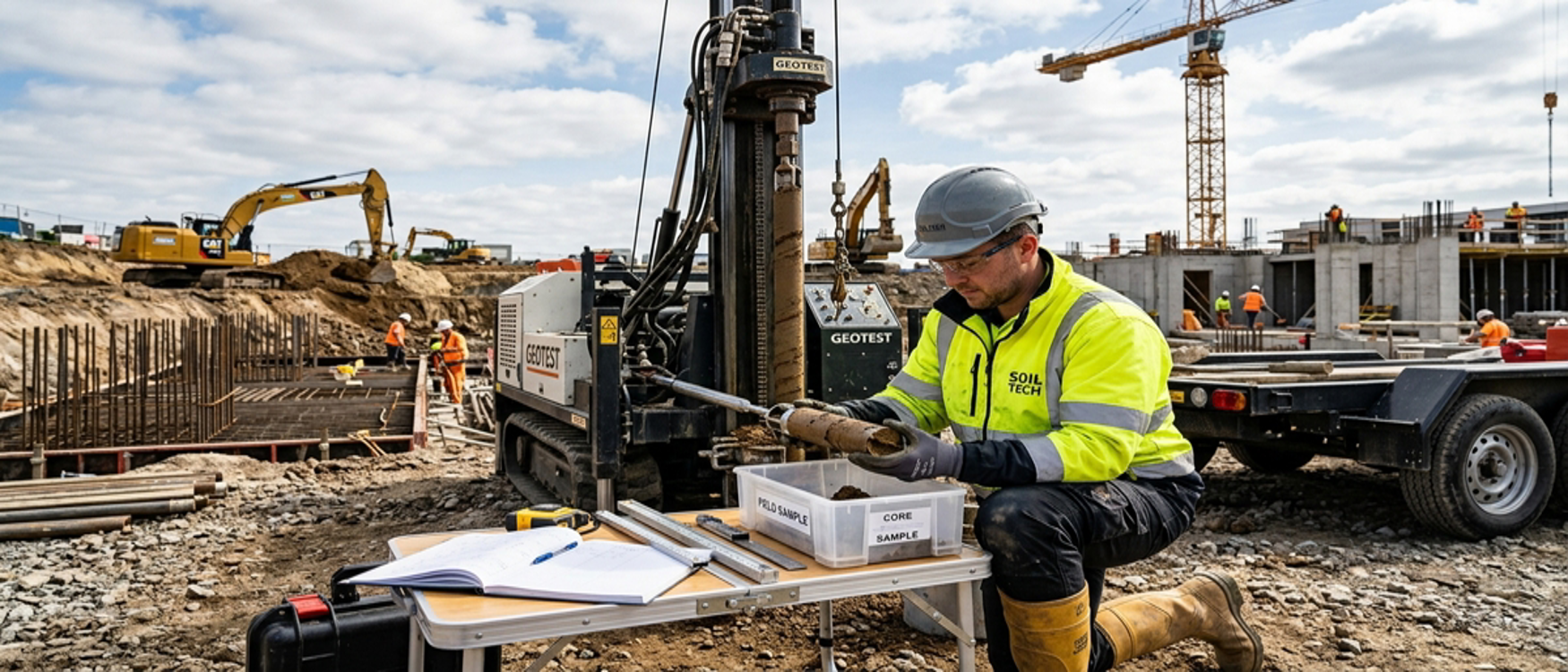
Soil testing is one of the most critical steps in any construction project, yet it is often underestimated. When soil conditions are poorly understood, foundations crack, structures shift, and entire buildings face irreversible damage. In a fast-growing construction market like Dubai, where high-rise towers and large infrastructure projects are the norm, skipping proper ground investigation is a risk no developer or engineer can afford. This blog explores how comprehensive site investigation protects foundations, ensures structural integrity, and prevents costly failures before they happen.
Key Takeaways
- Proper soil testing in Dubai helps engineers select the right foundation type for local ground conditions, including sandy and saline soils.
- Skipping geotechnical investigation exposes projects to settlement, structural cracking, and expensive remediation costs.
- EIAC-accredited laboratory results provide regulatory compliance and engineering accuracy for construction projects across the UAE.
Why Soil Testing Is the Foundation of Safe Construction
Soil testing provides engineers with precise data about the physical and chemical properties of ground beneath a construction site. Without this data, foundation design becomes guesswork. Knowing the soil bearing capacity, moisture content, compressibility, and shear strength allows structural engineers to design foundations that can handle actual load conditions. A study from the Institution of Civil Engineers confirms that a significant percentage of structural failures trace back to inadequate site investigation. In Dubai, where the soil often contains sabkha layers, loose sand, and high salt concentrations, this data is not optional. It is essential.
Every construction project begins with uncertainty about what lies beneath the surface. Geotechnical testing removes that uncertainty. It gives developers, engineers, and contractors the factual basis they need to make smart decisions from day one.
Common Soil Problems That Lead to Foundation Failures
Understanding what can go wrong underground is the first step toward preventing it. Several soil conditions are known to cause serious foundation problems.
- Sabkha soil: Common in coastal UAE areas, sabkha is soft, salt-saturated ground that collapses under load without proper treatment.
- Loose sandy soil: Lacks the cohesion to support heavy structures and is prone to liquefaction during vibration or seismic activity.
- Expansive clay: Swells when wet and shrinks when dry, creating uneven pressure on foundation slabs and walls.
- High groundwater tables: Saturated soil loses bearing strength and can cause upward hydrostatic pressure on basement structures.
- Contaminated soil: Chemical contamination can corrode concrete and steel reinforcement, compromising long-term structural integrity.
Each of these conditions requires a tailored engineering response. That response begins with accurate ground investigation and geotechnical investigation in the UAE that identifies the exact problem before construction begins.
Key Soil Tests Used in Construction Projects
A complete soil testing program includes a range of field and laboratory analyses. Each test serves a specific engineering purpose and contributes to a comprehensive understanding of site conditions.
Soil Bearing Capacity and Load Tests
The bearing capacity test determines how much load a soil can safely support per unit area. This is the most fundamental test for foundation design. If the bearing capacity is insufficient for the planned structure, engineers must design deeper foundations, wider footings, or alternative support systems such as piling. In Dubai, where tower heights and structural loads are significant, this test directly shapes the entire foundation engineering strategy. Plate load testing in Dubai is one method used to verify soil bearing capacity directly on-site before construction proceeds.
Soil Compaction and Density Testing
Compaction testing ensures that fill soil placed during site preparation meets the density specifications required by design. Poorly compacted fill creates voids that compress under load, causing differential settlement in the foundation. This is especially important in Dubai, where large areas of reclaimed and fill land require rigorous compaction verification before any structural work begins. The Proctor compaction test and in-situ density tests are standard methods used by accredited laboratories to verify that the ground meets project requirements.
Chemical and Salinity Analysis of Soil
In the UAE, chemical analysis is critical because high sulfate and chloride concentrations are common in native and coastal soils. These chemicals aggressively attack concrete foundations and corrode steel reinforcement. Without this analysis, the wrong grade of concrete or the wrong protective coatings may be specified, leading to early deterioration. An accredited soil testing lab in Dubai will conduct sulfate content tests, pH analysis, and chloride content measurements as part of a standard pre-construction investigation program.
Soil Testing in Dubai: Meeting Local Regulatory Requirements
The Dubai Municipality and Abu Dhabi authorities mandate geotechnical investigations as part of the building permit process. Soil testing in Dubai must be conducted by EIAC-accredited laboratories to be accepted by regulatory bodies. This accreditation ensures that test methods, equipment calibration, and reporting standards meet internationally recognized quality benchmarks. Developers and contractors who work with accredited laboratories avoid delays in approvals and demonstrate compliance with UAE construction standards. Terrasearch Gulf is an EIAC-accredited laboratory providing comprehensive soil testing services for projects across the UAE.
How Soil Testing Guides Foundation Design Decisions
Site investigation results are not just reports filed in a drawer. They directly influence every major decision in foundation engineering. Structural engineers use soil investigation reports to determine the type of foundation that suits site conditions. Shallow foundations such as strip footings and raft slabs are suitable for sites with high bearing capacity near the surface. Deep foundations such as bored piles or driven piles are required when surface soils are weak or when loads are heavy.
Settlement analysis performed using geotechnical data predicts how much a foundation will compress over time under the building’s weight. Controlling settlement prevents cracking in walls, floors, and structural elements. Differential settlement, where one part of the structure settles more than another, is one of the leading causes of visible structural damage and, in severe cases, structural failure.
Accurate soil testing also helps engineers design appropriate drainage systems and waterproofing strategies for below-grade structures. High groundwater conditions identified during investigation lead to design adjustments that protect basements and underground car parks from water ingress and buoyancy forces.
The Cost of Skipping Ground Investigation in Construction Projects
Avoiding geotechnical testing to reduce upfront costs is a decision that consistently leads to far greater expenses later. Foundation repair after construction is significantly more expensive than the original site investigation. Remediation methods such as underpinning, grouting, and pile insertion can cost many times more than the original investigation budget.
Beyond financial cost, foundation failures create serious safety risks. Structural movement damages utility connections, cladding systems, and internal finishes. In extreme cases, it threatens the occupants and the public. Legal liability for developers and contractors following a structural failure can be substantial.
The construction industry in the UAE recognizes this risk. According to guidance from the Dubai Municipality, proper geotechnical investigation is a mandatory step in the project approval process precisely because it protects both public safety and long-term urban infrastructure quality.
Investing in comprehensive soil testing before construction is always more economical and responsible than addressing the consequences of a foundation failure after the structure is built. For projects of any scale, from villas to commercial towers, the site investigation report is one of the most valuable technical documents in the entire project lifecycle.
Conclusion
Ground investigation is not a formality or a box to check before construction begins. It is the technical foundation on which safe, durable, and compliant structures are built. In a demanding construction environment like Dubai, where ground conditions are complex and regulatory requirements are strict, thorough soil testing in Dubai is essential for every project. By understanding subsurface conditions before breaking ground, engineers and developers can design foundations that perform reliably for decades. Terrasearch Gulf provides EIAC-accredited material testing and geotechnical investigation services to support your construction project from the first site visit to final certification. Contact our team to discuss your project’s investigation requirements.
FAQ
Q1: What is soil testing in construction and why is it important?
Soil testing in construction analyzes ground properties such as bearing capacity, compaction, and chemical content. It helps engineers design safe foundations and prevents costly failures by revealing subsurface conditions before any structural work begins on a project site.
Q2: What types of soil tests are required before construction in Dubai?
Before construction in Dubai, projects typically require bearing capacity tests, compaction tests, sulfate and chloride content analysis, and moisture content tests. These are conducted by accredited laboratories and submitted to Dubai Municipality as part of the building permit approval process.
Q3: How does poor soil quality lead to foundation failure?
Poor soil quality causes settlement, differential movement, and loss of bearing strength beneath a foundation. Conditions like loose sand, expansive clay, or sabkha soil create uneven support, leading to structural cracking, tilting, or collapse if not identified and addressed before construction begins.
Q4: What is sabkha soil and why is it a risk in the UAE?
Sabkha is a soft, salt-saturated soil found in coastal UAE regions. It is highly compressible and collapses under structural loads without proper treatment. Identifying sabkha through professional soil testing services allows engineers to specify appropriate foundation types and ground improvement measures before construction.
Q5: Does soil testing need to be conducted by an accredited laboratory in Dubai?
Yes. Soil testing in Dubai must be performed by an EIAC-accredited laboratory for results to be accepted by regulatory authorities. Accreditation confirms that the laboratory follows internationally recognized test methods, uses calibrated equipment, and produces results that meet UAE regulatory and engineering standards.
Q6: How does geotechnical testing help reduce construction project costs?
Geotechnical testing identifies ground problems early, allowing engineers to design the right foundation from the start. This avoids expensive remediation such as underpinning or grouting after construction. The cost of proper pre-construction soil investigation in Dubai is far lower than foundation repair costs.
Q7: What is differential settlement, and how is it related to site investigation?
Differential settlement occurs when different parts of a foundation settle by unequal amounts, causing cracks and structural distortion. Site investigation identifies variations in ground conditions across a site, allowing engineers to design foundations that minimize settlement differences and protect the structure’s long-term integrity.
Q8: Can soil chemical content affect concrete foundations?
Yes. High sulfate and chloride levels in UAE soils aggressively attack concrete and corrode steel reinforcement. Chemical analysis conducted as part of a geotechnical investigation ensures that the correct concrete grade and protective measures are specified to resist deterioration, which is a topic also covered in concrete testing standards in Dubai.
Q9: What is the role of plate load testing in soil investigation?
Plate load testing is a field test that applies a known load to a steel plate placed on the soil surface and measures the resulting settlement. It directly verifies the bearing capacity at a specific location on site, providing reliable data for shallow foundation design decisions.
Q10: How long does a geotechnical investigation typically take for a construction project?
The duration depends on project size and the number of boreholes required. A standard investigation for a mid-size project typically takes one to two weeks for fieldwork, followed by laboratory analysis and report preparation, which may take an additional one to two weeks to complete.