

Every tower, bridge and warehouse in the UAE depends on steel that performs exactly as specified. Contractors
searching for a “steel testing lab Dubai” usually want one thing: results that consultants will accept. An accredited
steel testing lab in Dubai is the independent check between the mill certificate and the structure. This guide
explains what a steel testing lab in Dubai actually tests, from rebar and structural sections to bolts, welds and
coatings. It also covers sampling, non destructive methods, inspection and accreditation, so you can plan testing with
confidence. For a wider view of material checks, see our guide to
common construction material tests.
Key Takeaways
-
An accredited steel testing lab in Dubai confirms that rebar, structural steel, bolts and welds meet the project
specification, independently of the supplier’s mill certificate. -
Mechanical tests, weld tests and NDT work together on every steel package. Sampling frequency and lot acceptance
rules decide how much testing is enough. -
Choose a lab that authorities recognise, with EIAC accreditation for the specific tests you need and clear,
traceable reporting.
What a Steel Testing Lab in Dubai Actually Tests
A steel testing lab in Dubai covers far more than reinforcement bars. Its scope usually spans every steel product that
carries load or protects the structure, from the bars in a raft foundation to the bolts in a roof truss and the
coating on an exposed column.
The most common samples are reinforcement bars. Rebar testing confirms yield strength, tensile strength, elongation,
bend performance and bar geometry such as mass per metre and rib profile. These properties decide how the bar behaves
in concrete, so they are checked for every delivery lot on most projects.
Structural steel sections, plates and hollow sections form the second group. Here the lab checks tensile properties,
chemical composition and, for thicker or critical members, impact toughness. Fasteners form a third group. High
strength bolts, nuts and washers are tested for proof load, hardness and tensile strength, because a weak bolt can
undermine an otherwise sound connection.
Welds and welders make up the fourth group, covering procedure qualification, welder tests and inspection of
production welds. Finally, many labs test protective systems, including galvanising thickness and paint film
thickness. Appointing a single steel testing lab in Dubai for all five groups gives consistent reporting and one point
of accountability. Our
steel testing and NDT services are
structured around these product groups.
Scope also changes with the stage of the project. During procurement, a steel testing lab in Dubai may test samples to
support material approval. During construction, the focus moves to lot testing of deliveries and checks on fabricated
members. Near handover, testing often shifts to coatings, bolt tightness and any remedial welds. Planning the scope by
stage helps the contractor budget for testing and avoids gaps where material reaches site without any independent
check. It also lets the consultant see, in one schedule, which tests apply to which elements, and which steel testing
lab in Dubai will handle each.
Mill Certificates vs Independent Testing
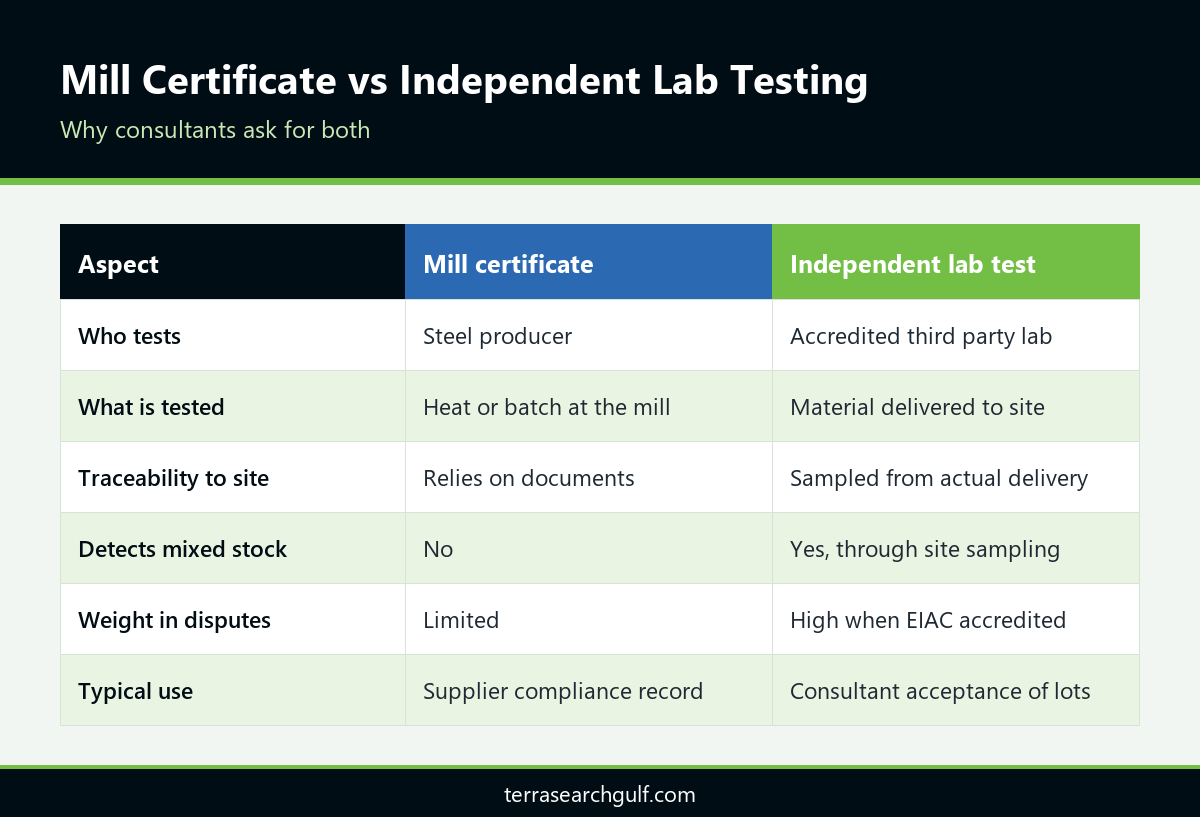
Every steel delivery arrives with a mill test report,
sometimes called a mill certificate. It records the chemical composition and mechanical properties measured by the
producer for that heat or batch. So why do consultants still ask for independent testing by an approved steel testing
lab in Dubai?
The answer is traceability and verification. A mill certificate describes the steel as it left the mill. It does not
prove that the bars or sections on your site came from that heat, that they were not mixed with other stock in a yard,
or that they were not damaged in transport. Independent testing closes that gap by sampling the material actually
delivered to the project.
Independent testing also protects the contractor. When a dispute arises over a failed member or a rejected batch,
results from an accredited lab carry weight that a supplier document cannot. Consultants on government and large
private projects in the UAE therefore commonly require a minimum level of independent testing regardless of the
certificates provided.
The two sources work best together. The lab compares its results with the mill certificate and flags any
inconsistency, such as a heat number mismatch or properties close to the minimum. That comparison is often where a
good steel testing lab in Dubai adds the most value, because it catches documentation problems before material is
fixed in place.
There is also a practical benefit for programme. When the nominated steel testing lab in Dubai receives samples as
soon as material arrives, results are usually ready before fixers need the bars. Waiting until steel is already cut
and placed turns a routine check into a potential demolition. Building testing into the delivery process, rather than
treating it as an afterthought, keeps both quality and progress on track.
Mechanical Tests: Tensile, Bend, Hardness and Impact
Mechanical tests form the core of any steel programme. They measure how the steel behaves under load and whether it
will deform safely before it fails. Most are carried out to
ASTM A370, BS EN ISO 6892 or the product standard named in the
specification, such as BS 4449 for reinforcement.
Tensile testing
The tensile test pulls a sample to failure in a universal testing machine. It records yield strength, ultimate tensile
strength and elongation at fracture. For rebar, the ratio of tensile strength to yield strength matters too, because
it indicates ductility. An accredited steel testing lab in Dubai will report each value against the specified minimum
and maximum, not just a pass or fail.
Bend and rebend testing
Bend tests wrap a bar around a mandrel of set diameter and inspect the outer surface for cracks. Rebend tests bend the
bar, age it and then straighten it partly, which simulates bending on site. Both confirm that bars can be shaped by
fixers without cracking, which is essential where tight bends and hooks are detailed.
Hardness testing
Hardness tests such as Brinell, Vickers or Rockwell measure
resistance to indentation. They are quick and useful for bolts, weld zones and heat affected areas, where excessive
hardness can signal brittleness. Hardness surveys across welds often form part of procedure qualification for
structural and pressure work.
Impact testing
The Charpy impact test strikes a notched sample with a
pendulum and measures the energy absorbed. It shows how tough the steel is and whether it may fracture in a brittle
way. Impact requirements apply mainly to thick plates, critical welds and steel used in demanding structural or
offshore conditions.
Chemical analysis
Chemical analysis measures carbon, manganese, sulphur, phosphorus and other elements. Results are used to calculate
the carbon equivalent, which predicts how easily the steel can be welded. A steel testing lab in Dubai will often run
chemical checks when the mill certificate is missing, unclear or inconsistent with mechanical results, or when welding
procedures depend on accurate composition.
Weld Testing and Welder Qualification
Welds are often the most variable part of a steel structure. The parent steel may meet every requirement, yet a poorly
made weld can still crack, distort or fail under load. That is why weld testing appears in almost every structural
steel specification in the UAE.
Weld testing starts before fabrication. A welding procedure specification describes how a joint will be made,
including process, consumables, preheat and heat input. A procedure qualification test then proves that the procedure
produces sound welds. Test plates are welded and examined by an independent steel testing lab in Dubai, using visual
inspection, NDT, tensile tests, bend tests, macro examination and hardness surveys, often to BS EN ISO 15614.
Welders are qualified separately. Each welder produces a test piece in the positions and thicknesses they will work
in, and the piece is examined and tested, typically to BS EN ISO 9606 or the AWS code named in the specification. Only
qualified welders should then work on production joints.
During production, inspectors check fit up, preheat, weld size and appearance, and select welds for NDT. The extent of
testing depends on the weld type and consequence class set by the designer. Our separate guide to
non destructive testing methods in the UAE
explains how these checks fit into wider structural quality control.
Repairs need the same discipline. When NDT finds a defect, the weld is excavated, rewelded under an approved repair
procedure and tested again. The steel testing lab in Dubai handling the work should record the original defect, the
repair and the retest so the history is complete. Frequent repairs on one joint type or by one welder are a warning
sign. They point to a procedure or training problem that is better fixed early than discovered through repeated
rejections on site.
Consumables also need control. Electrodes, wires and fluxes must match the qualified procedure and be stored
correctly, because moisture in some consumables can cause hydrogen cracking. A reliable steel testing lab in Dubai
will check consumable certificates during procedure qualification and highlight any substitution that would invalidate
the approved procedure.
NDT Methods for Steel: UT, MT, PT and RT
Non destructive testing examines welds and steel without damaging them, so every critical joint can be checked in
place. NDT on Dubai projects usually draws on four core methods, each suited to different defects and joint types. The
TWI overview of non destructive testing
gives useful background on the principles.
No single method finds every defect. Volumetric methods such as UT and RT look inside the weld, while surface methods
such as MT and PT find cracks at the toe and face. Specifications therefore often combine a surface method with a
volumetric one on critical joints. Acceptance criteria come from the governing code, so the same indication may be
acceptable on a secondary member but rejectable on a primary connection.
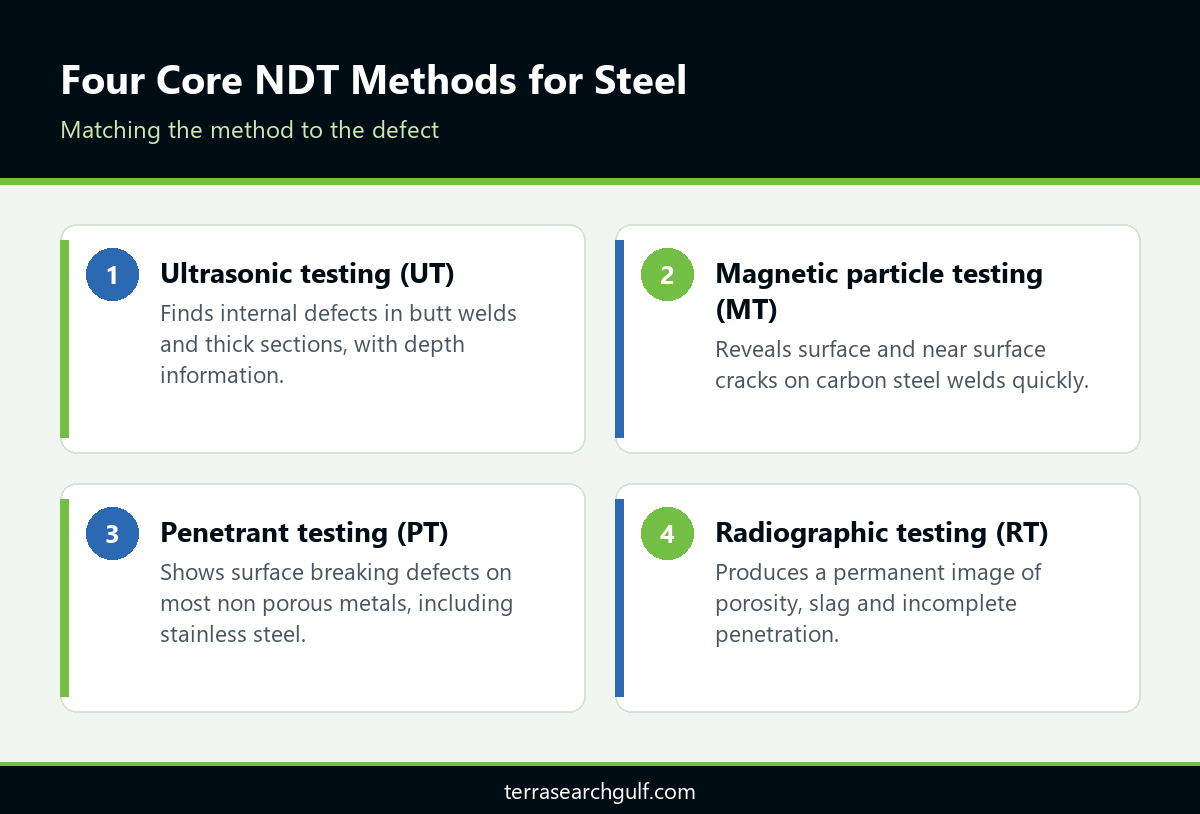
Ultrasonic testing (UT)
UT sends high frequency sound into the steel and reads the echoes. It finds internal defects such as lack of fusion,
cracks and inclusions in butt welds and thick sections. Phased array UT adds imaging and faster coverage. UT is the
main volumetric method for structural steel welds because it needs no radiation and gives depth information.
Magnetic particle testing (MT)
MT magnetises the part and applies fine iron particles. Particles gather at surface and near surface cracks, making
them visible. It is fast and sensitive on carbon steel fillet welds, toes of welds and machined surfaces. It does not
work on austenitic stainless steel or aluminium, which are not magnetic.
Penetrant testing (PT)
PT applies a coloured or fluorescent liquid that seeps into surface breaking defects, then a developer draws it out.
It works on almost any non porous material, including stainless steel. It only finds defects open to the surface, so
it complements rather than replaces volumetric methods.
Radiographic testing (RT)
RT passes X rays or gamma rays through the weld onto film or a digital detector. It gives a permanent image of
porosity, slag and incomplete penetration. Safety controls and access limits make it less common on busy building
sites, where UT is usually preferred for structural steelwork.
Planning NDT on site
NDT needs access, clean surfaces and safe working conditions. Plan the extent, timing and method of testing in the
inspection and test plan, so welds are examined before they are hidden by fireproofing or cladding. Any steel testing
lab in Dubai appointed for NDT should confirm technician certification, typically to ISO 9712 or an equivalent scheme,
for every method used.
Sampling Frequency and Lot Acceptance
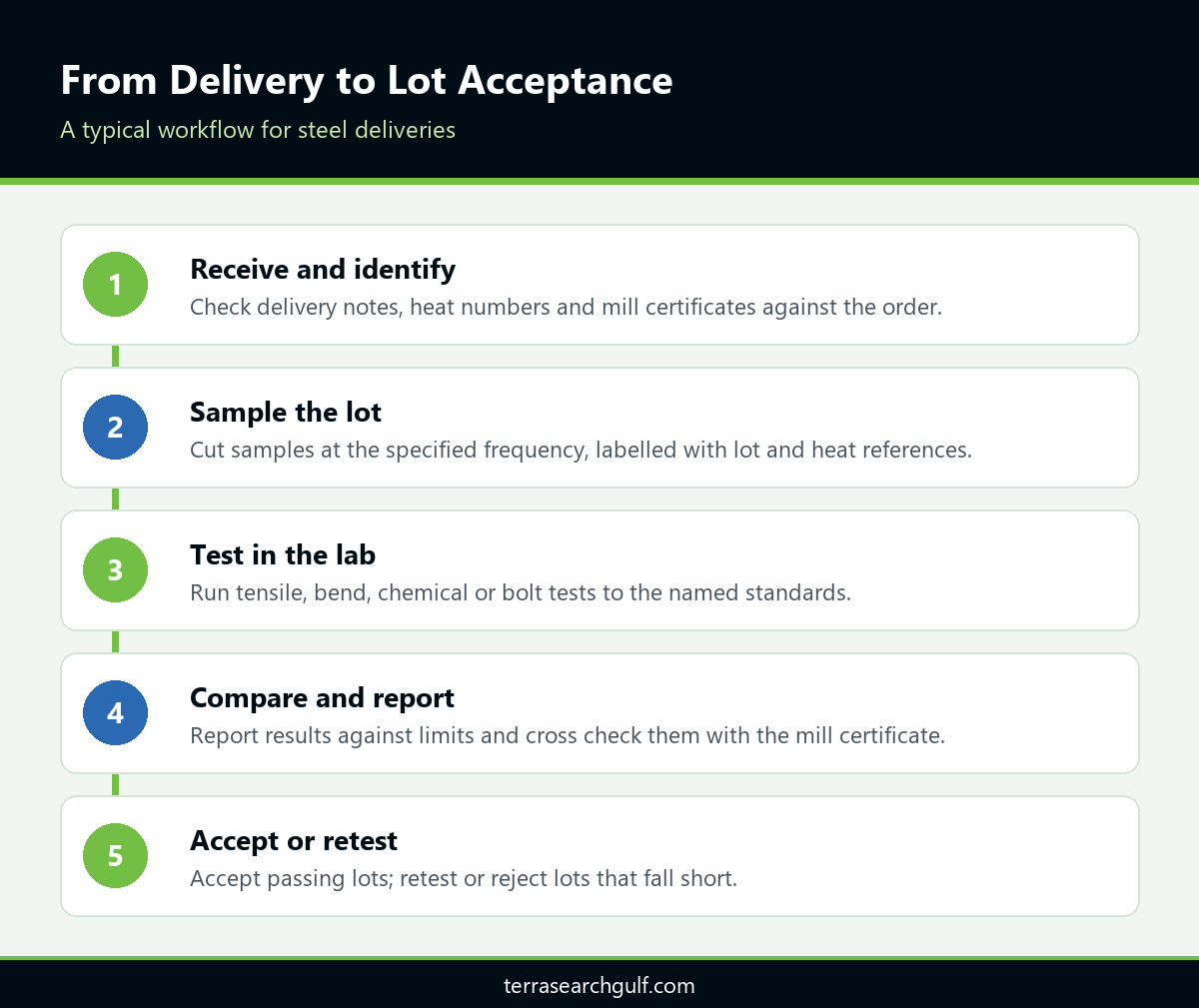
Testing only works when the samples represent the material. Sampling frequency defines how many samples are taken from
each delivery, and lot acceptance rules define what happens when a result falls short.
For reinforcement, specifications typically link sampling to bar diameter, heat number and tonnage delivered. Each lot
is identified, tagged and sampled before the bars are cut or fixed. Structural sections and plates are commonly
sampled per heat or per product type, while bolts are sampled per manufacturing lot. The exact frequency is set by the
project specification and the consultant, so always confirm it before deliveries start rather than relying on habits
from a previous job.
Lot acceptance follows clear rules. If a sample fails, most standards allow retests on additional samples from the
same lot, often twice the original number. If the retests pass, the lot may be accepted. If they fail, the lot is
usually rejected and removed from site. A trustworthy steel testing lab in Dubai will report retests separately and
keep the full history, so the decision trail is clear.
Good sample handling matters as much as frequency. Samples must be cut from the correct lot, labelled with heat
numbers and delivery references, and witnessed where the specification requires it. Mislabelled samples are one of the
most common reasons for disputed results, and they are entirely avoidable with a simple chain of custody.
Records complete the picture. A well run steel testing lab in Dubai maintains a register that links every sample to
its delivery note, heat number, location in the structure and test result. When the consultant asks where a particular
bar diameter was used, that register gives the answer in minutes. It also supports the handover file and any future
structural assessment of the building.
Third Party Inspection on Fabrication and Site
Testing samples tells you about the material. Inspection tells you about the work. Third party inspection sends an
independent inspector into the fabrication shop and onto site to check that steel is cut, welded, assembled and
erected as designed.
In the fabrication shop, the inspector reviews welding procedures and welder qualifications, checks material
traceability, witnesses tests and inspects fit up, weld size and dimensions. Hold points in the inspection and test
plan stop the work until the inspector signs off. This catches problems while they are still cheap to fix, before
members are painted, shipped and lifted into place.
On site, inspection covers bolt tightening, site welds, alignment, plumbness and the condition of protective coatings
after erection. The inspector also selects welds and connections for NDT. Inspection and testing are linked, because
the inspector often decides where the lab should test.
Independence is the point. An inspector employed by the fabricator may be competent, but the consultant needs
assurance from a party with no commercial stake in the result. Our article on
how independent testing ensures quality compliance
explains the wider role of third party labs, and our
structural testing and analysis team
supports inspection on complex steel frames.
The inspection and test plan ties everything together. It lists each activity, the applicable standard, the acceptance
criteria, who performs the check and where hold and witness points sit. When the plan is agreed early with the
consultant and the steel testing lab in Dubai, inspection runs smoothly instead of becoming a source of disputes at
every stage of fabrication and erection.
Bolted connections deserve particular attention during site inspection. Inspectors check bolt grade markings, washer
orientation and the tightening method, whether torque control, turn of nut or direct tension indicators. A sample of
bolts may be returned to the steel testing lab in Dubai for proof load or hardness checks if markings are unclear.
Coating inspection follows the same logic, with dry film thickness readings recorded on each member after erection and
damaged areas repaired before handover.
How to Choose a Steel Testing Lab in Dubai
Searches for “steel testing labs Dubai”, “NDT testing Dubai”, “third party inspection UAE” and “rebar testing UAE” all
lead to the same question: which lab will consultants accept? The labs that pass share a few essential qualities.
Checking them before you appoint a lab saves time, avoids rejected reports and protects your programme.
Start with accreditation. Confirm that the lab holds
EIAC accreditation for the specific tests you
need, not just for the lab in general. Accreditation to ISO/IEC 17025 shows that methods, equipment calibration and
staff competence have been independently assessed. Our guide to
what ISO 17025 actually guarantees explains
the difference between an accredited scope and a general claim.
Next, check approvals. Many projects also need results from a lab on the relevant authority list, so read our
explainer on
the Dubai Municipality approval route
before you shortlist. Then look at capability. A universal testing machine with enough capacity for the largest bars
and bolts, calibrated NDT equipment and qualified technicians are basic requirements. Ask about turnaround, sample
collection and whether the lab can also provide inspection, so one steel testing lab in Dubai covers both testing and
site checks.
Finally, review a sample report. It should state the standard used, the sample identity, the heat number, every
measured value with limits, and any deviations. Clear reporting is what turns test results into decisions. Terrasearch
Gulf brings 8+ years of experience, 342+ completed projects and 10+ engineers to steel and materials testing across
Dubai.
Communication matters as much as equipment. A good steel testing lab in Dubai will flag a failing result on the same
day, explain what it means and advise on retests. Silence until the formal report is issued wastes days that a project
rarely has. Ask how results are shared, who your contact will be and how urgent findings are escalated. These
practical points often separate a lab that simply tests from a steel testing lab in Dubai that teams see as a genuine
quality partner.
Conclusion
Steel only performs as designed when the material, the welds and the workmanship are all verified. An accredited steel
testing lab in Dubai brings together mechanical testing, weld qualification, NDT, sampling discipline and independent
inspection into one traceable record. Plan the testing scope early, confirm accreditation for each test and keep
sampling tied to heat numbers and lots. Terrasearch Gulf supports contractors, fabricators and consultants across the
UAE with accredited steel and materials testing. To scope testing for your next project,
contact our steel testing team.
Frequently Asked Questions
What does a steel testing lab in Dubai actually test?
It tests reinforcement bars, structural sections, plates, bolts, welds and protective coatings. Typical tests include
tensile, bend, rebend, hardness, impact, chemical analysis, weld procedure qualification, welder qualification tests
and non destructive testing of production welds on site.
Why test steel if the supplier provides a mill certificate?
A mill certificate describes steel as it left the mill. Independent testing confirms that the material actually
delivered to your site matches the order, was not mixed with other stock in transit and meets the project
specification.
How often should rebar be tested on a UAE project?
Sampling frequency is set by the project specification and the consultant, usually per bar diameter, heat number and
tonnage delivered. Confirm the agreed frequency before deliveries begin so every lot is sampled, tagged and tested
consistently.
What happens if a steel sample fails testing?
Most standards allow retests on additional samples from the same lot, often twice the original number. If the retests
pass, the lot may be accepted. If they fail, the lot is normally rejected and removed from site.
Which NDT method is best for structural steel welds?
Ultrasonic testing is the main method for internal defects in butt welds. Magnetic particle testing suits surface
cracks on carbon steel. Penetrant testing covers non magnetic metals. The specification, joint type and access decide
the final mix.
What is the difference between inspection and testing?
Testing measures material or weld properties, usually on samples in a laboratory. Inspection checks workmanship in the
shop and on site, including fit up, weld size, bolting and alignment. Most structural steel projects need both working
together.
Steel testing lab Dubai: is EIAC accreditation required?
Most consultants and authorities in Dubai expect EIAC accreditation for the specific tests reported. Accreditation to
ISO/IEC 17025 confirms that test methods, equipment calibration and staff competence have been independently assessed
and are regularly audited by the accreditation body.
Can the same lab test steel and concrete on my project?
Yes, many labs cover both. Using one lab for
concrete, aggregates and steel simplifies sampling,
scheduling and reporting, provided the lab holds current accreditation for each individual test listed on the project
testing schedule and approved by the consultant.
How long do steel test results take in Dubai?
Routine rebar and bolt tests are often reported within a few working days of sample receipt. Weld procedure
qualification takes longer because of plate preparation and multiple tests. Agree turnaround times with the lab before
work begins on site.
Why do engineering labs matter for steel quality assurance?
Independent engineering labs in Dubai give
consultants objective evidence that steel and welds meet the design. That evidence supports approvals, protects
contractors in disputes and reduces the risk of costly rework later in the project.