

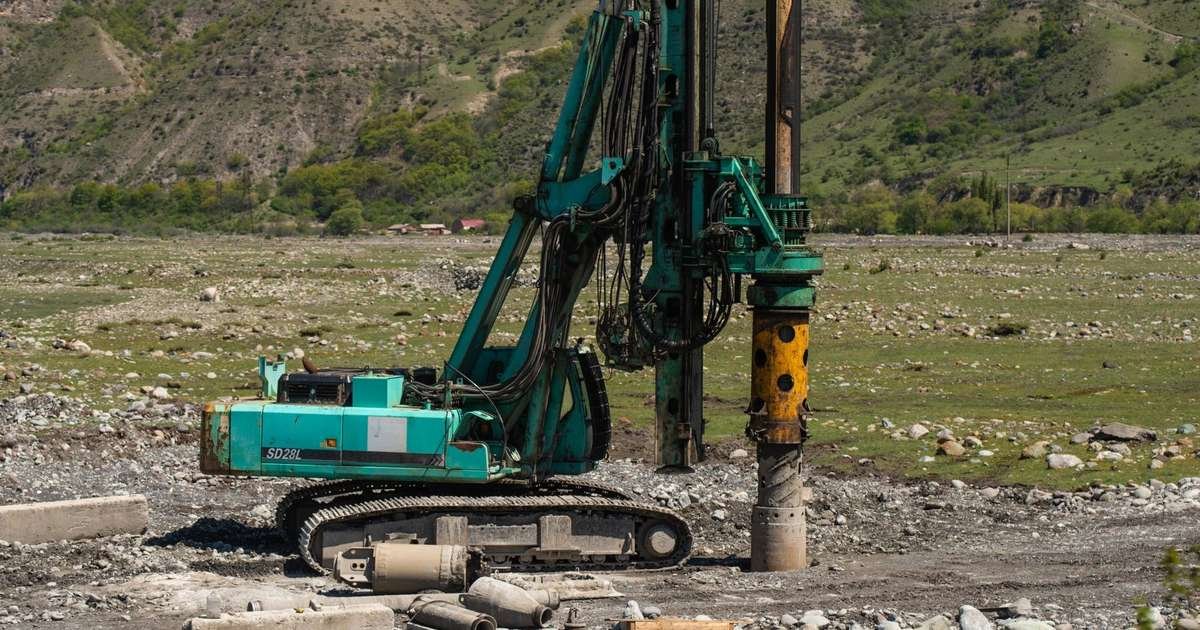
Most tall buildings and bridges in Dubai stand on bored piles that end in a socket drilled into weak rock. The way rock socketed piles in Dubai behave depends far more on that rock than on the soil above it. Yet the local limestone and calcarenite vary sharply over short distances. This guide explains why the socket carries most of the load, what makes Dubai rock hard to characterise, and why the pile test plan should be built around socket capacity. It also links to our broader guide to foundation testing in the UAE.
Key Takeaways
- In rock socketed piles in Dubai, most of the working load is carried by shaft friction in the rock socket, so socket assumptions control the design.
- Dubai limestone foundation rock is weak, variable and often fractured, so rock core testing Dubai laboratories perform is essential before design.
- Pile load testing UAE consultants specify should target the socket assumptions with instrumented or high capacity tests, not just a pass or fail check.
Why Dubai Piles Rely on Rock Sockets
The near surface soils across much of Dubai are loose to medium dense sands with shallow groundwater. They offer limited capacity for heavy structures. Below them lies weak sedimentary rock, and drilling a socket into it gives piles the friction they need to carry large loads with acceptable settlement.
In a typical rock socketed pile, the sand layers contribute some friction, but the socket provides most of the capacity. End bearing at the toe is often treated cautiously, because cleaning the base of a deep bore is difficult and soft debris can remain. This means the design of rock socketed piles for Dubai towers depends heavily on one number: the unit shaft friction that the rock can mobilise along the socket. Small changes in that value change the socket length required, and therefore cost and programme. Designers usually derive it from rock strength, using correlations that were developed for rocks elsewhere and need local judgement. The deep foundation overview describes the general principles behind this load transfer.
Because so much rests on the socket, any uncertainty about the rock carries straight through to the pile. That is why investigation quality and testing strategy matter so much for these foundations.
Settlement matters as well as capacity. Tall buildings are sensitive to differential movement between piles, and the stiffness of the socket controls how much each pile settles under load. For rock socketed piles in Dubai high rise projects, designers therefore need both strength and stiffness values for the rock. Both come from the same investigation and are confirmed by the same load tests, which is another reason to plan those tests around the socket.
What Makes Dubai Limestone Hard to Design For
Dubai limestone foundation rock is not a uniform hard layer. It includes calcarenite, calcisiltite, sandstone and cemented sand, often interbedded with weaker bands. Strength can change within a metre. Some layers soften when disturbed by drilling, which reduces the friction a socket can develop.
Several features make design difficult. The rock is weak compared with the rocks most design correlations were based on, so the correlations can be unreliable. It is variable, with cemented bands next to friable layers. It is often fractured or contains voids and solution features. It can also degrade during drilling, especially if bores are left open too long or drilled with poor fluid control. For rock socketed piles in Dubai, these factors make it risky to adopt a single design value across a whole site. The calcarenite overview explains the origin of these carbonate rocks.
For rock socketed piles in Dubai, the practical answer is better data. Designers need enough cores, enough strength tests and enough borehole coverage to see the variability, then they need load tests that confirm the socket behaves as assumed.
Groundwater adds another layer of risk. Many sites have a shallow water table and saline groundwater, so bores need casing and careful fluid management to stay stable. Where the upper rock is fractured, drilling fluid can be lost into the formation. Each of these conditions affects how rock socketed piles in Dubai perform, and each should be recorded pile by pile during construction.
Investigation That Supports Socket Design
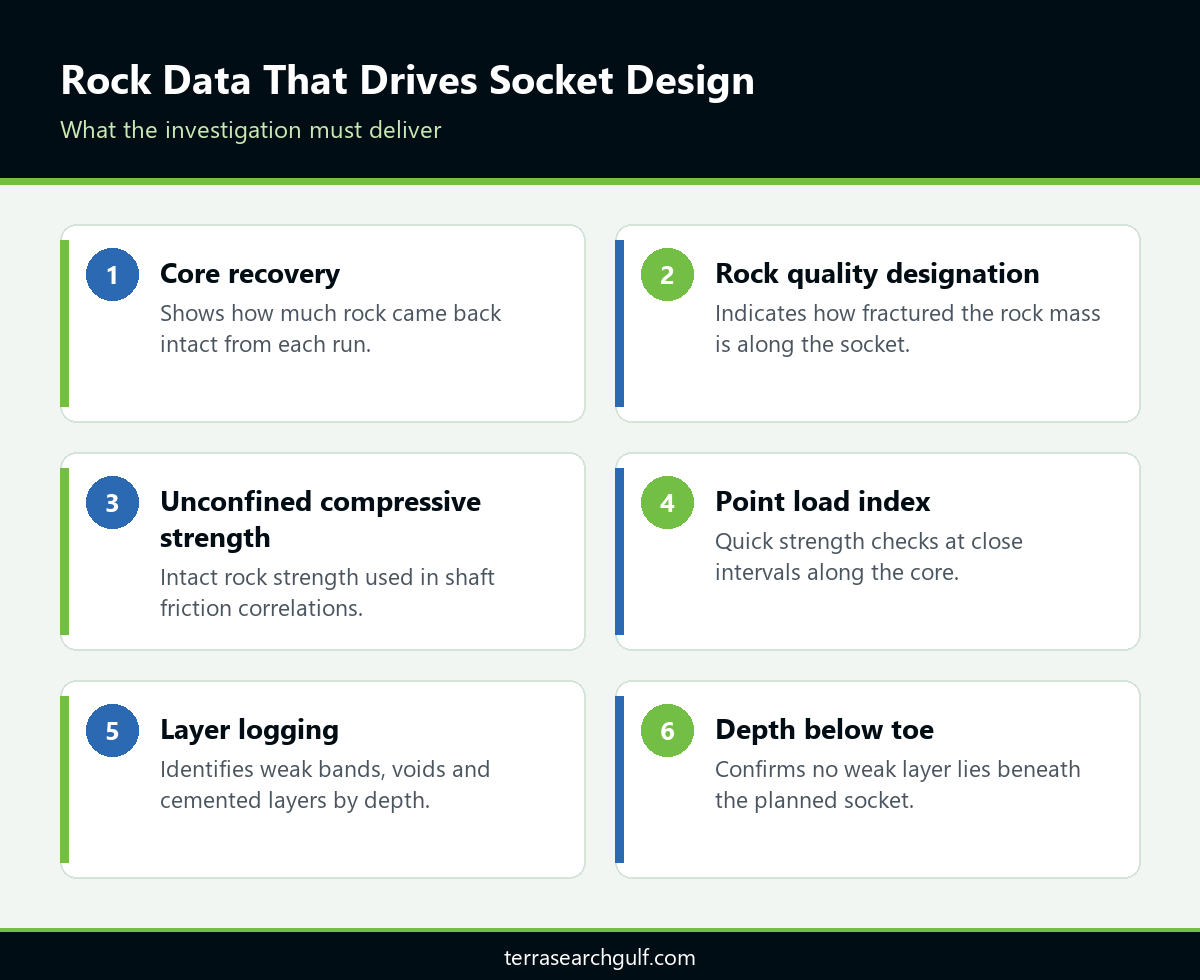
A sound design for rock socketed piles in Dubai starts with good rock data. Rotary coring recovers continuous samples so engineers can log rock type, fractures and weathering. Laboratory tests then measure strength. Together these give the parameters that feed the socket friction and settlement calculations.
Key outputs include total core recovery, rock quality designation, which indicates how fractured the rock is, and unconfined compressive strength from intact core samples. Point load tests add quick strength data along the core. Rock core testing Dubai laboratories carry out should cover each distinct layer, not just the strongest pieces, because selecting only good samples overstates capacity. Borehole spacing and depth must reflect the building footprint and the expected socket depth. Where rock socketed piles in Dubai are planned, boreholes should extend well below the planned toe to check there is no weak layer beneath. Our article on borehole drilling process and requirements covers how cores are recovered. Fracture data from the cores also feeds rock mass classification, which helps engineers judge how the socket will behave as a whole.
Laboratory quality matters as much as drilling. Cores must be protected from drying and damage, tested promptly and reported with clear sample depths. See our guide to key geotechnical laboratory tests for the full test range.
Why Socket Capacity Drives the Test Plan
Since the socket carries most of the load, the test plan should check the socket assumptions directly. A test that only proves a pile carries its working load with little movement says little about the real friction available. Designers often want more information to confirm or optimise socket lengths.
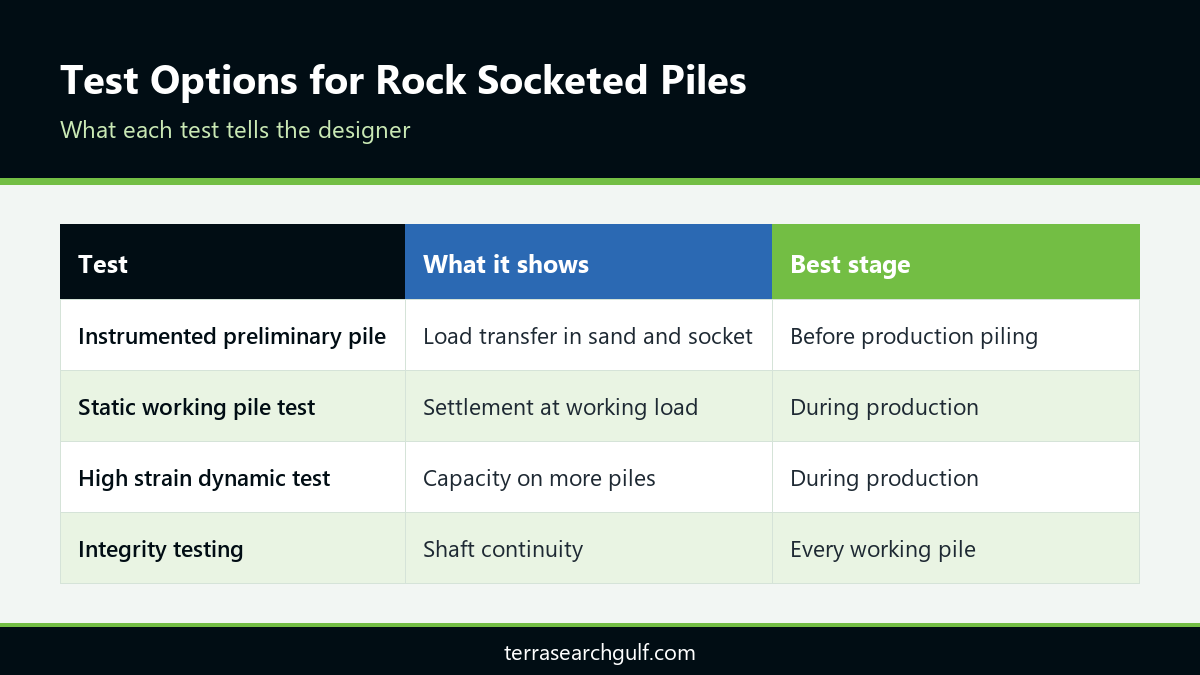
Pile load testing UAE consultants specify for rock socketed piles often includes preliminary test piles loaded well beyond working load before production piling starts. Instrumenting these piles with strain gauges along the shaft shows how load transfers between the sand and the rock socket. If the socket proves stronger than assumed, later production piles may be shortened, saving cost. If weaker, the design can be corrected before hundreds of piles are built. Static tests follow the procedures in ASTM D1143 for axial compressive load tests. High strain dynamic tests can add data on more piles, but they need careful matching to static results in weak rock.
Working pile tests then confirm that production piles behave like the design, with sampling linked to the variability seen during investigation.
Test results should be reported in a way designers can use. Load settlement curves, the load carried by the socket at each stage and the movement at the toe all help back calculate the real shaft friction. On projects with rock socketed piles in Dubai, that back analysis is often the most valuable output of the whole testing programme, because it turns assumed parameters into measured ones.
Building a Practical Test Plan
A good plan links investigation, design and testing in one sequence. Investigate the rock properly, design sockets with realistic parameters, prove them with preliminary tests and confirm production piles with working tests. Each stage should feed the next rather than run in isolation.
Agree the plan early with the consultant and the piling contractor. Define the number of preliminary and working tests, the test loads, instrumentation and acceptance criteria. Place test piles where the rock is weakest, not where access is easiest, so results represent the worst case. Record drilling times, fluid use and base cleaning for every pile, as these explain differences in performance. For foundation testing UAE consultants rely on, integrity testing of every working pile adds a final check on construction quality. Our subsurface investigation guide shows how boreholes, trial pits and geophysics fit together before this stage. Clear planning keeps rock socketed piles in Dubai on programme and backed by evidence.
Review the plan as data arrives. If early working tests show more settlement than expected, add tests in the affected zone and check the drilling records. If results are consistently stiff, the consultant may agree to reduce testing frequency within the specification. Treating the plan as a living document keeps effort focused where the rock is least certain.
Conclusion
Socket friction in weak, variable rock controls how most deep foundations in Dubai perform. Good coring, honest laboratory testing and load tests aimed at the socket assumptions turn that uncertainty into reliable design values. For any project using rock socketed piles in Dubai, the test plan should be built around the socket from day one. Terrasearch Gulf supports geotechnical and foundation testing across 342+ projects from its EIAC accredited laboratory. Talk to our geotechnical engineers about investigation and pile testing for your next project.
Frequently Asked Questions
What are rock socketed piles in Dubai?
They are bored piles drilled through the upper sands and into the underlying weak rock. The socket in the rock provides most of the shaft friction that carries heavy loads from towers, bridges and industrial structures.
Why is Dubai rock considered weak?
Much of it is carbonate rock such as calcarenite and calcisiltite, with low strength compared with granite or hard limestone. It is also variable and can soften when disturbed, so design values must be chosen carefully.
How deep should boreholes go for socketed piles?
Boreholes should extend well below the planned pile toe to confirm there is no weak layer beneath the socket. The exact depth depends on loads and design, so the geotechnical engineer should set it for each project.
What is rock quality designation?
Rock quality designation measures the percentage of core recovered in sound pieces above a set length. It indicates how fractured the rock is, which affects the friction a socket can develop and how the rock settles.
Why test a preliminary pile before production piling?
A preliminary pile loaded beyond working load shows how the socket really behaves. Results can confirm the design, allow shorter sockets or reveal weaker rock, before hundreds of production piles are built to the wrong length.
Can dynamic tests replace static tests in weak rock?
Dynamic tests add useful data on more piles, but in weak rock they should be calibrated against static results. Consultants usually require at least some static tests before relying on dynamic results for acceptance.
Does drilling method affect socket capacity?
Yes. Leaving bores open too long, poor fluid control or inadequate base cleaning can soften the rock and reduce friction. Recording drilling details for every pile helps explain differences in test results across the site.
What site investigation should come first?
Start with boreholes, rotary coring and laboratory tests across the whole footprint. Our complete site investigation guide explains each stage, from desk study and drilling to the final geotechnical report used for pile design.
Are in situ tests useful above the rock?
Yes. Tests in the overlying sands help estimate shaft friction above the socket. Our article on standard penetration testing in Dubai explains how these results are gathered on site and used in foundation design.