

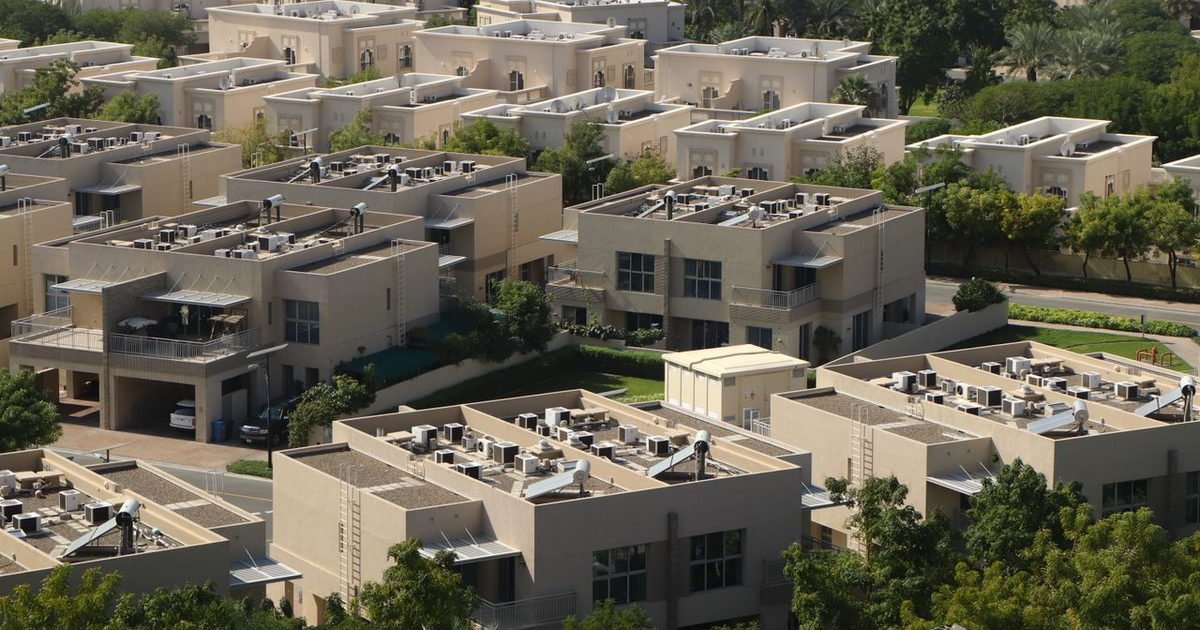
Most villa owners first hear about a soil test for villa construction in Dubai when their consultant asks for one. It feels like paperwork, but the report shapes your foundations, your concrete specification and, in the end, how much your building costs.
This guide is written for private plot owners. It explains why the authority asks for the test, what a sensible villa scope looks like, what the report tells your engineer, and how to choose a soil testing lab in Dubai with confidence.
Key Takeaways
- Your consultant needs a soil investigation report to design the foundations, and the permit submission normally depends on it.
- A villa scope is modest: a few boreholes around the footprint, field tests, laboratory classification and a chemical check of the ground.
- Choose an accredited soil testing lab in Dubai whose scope covers every test on your schedule, and ask for an interpretative report your engineer can design from.
Why the Authority Asks for a Soil Report on a Villa Plot
Foundations are designed for the ground they sit on. Without data on that ground, your structural engineer can only guess how much load it will carry and how much it will settle, and guesses are either unsafe or expensive. Engineers who lack data tend to design conservatively, which means bigger footings and more concrete than the plot may need.
That is why the building permit process for a new villa normally includes a soil investigation report. The exact requirement depends on where your plot is. In much of the emirate the permitting body is Dubai Municipality, while plots inside free zone communities or master developments may fall under the Dubai Development Authority, Trakhees or the developer’s own approvals team.
Your consultant will know which authority applies and what it expects to see. Ask them early, because the soil report is one of the first technical documents the design needs, and a late report holds up everything that follows it.
The report also protects you as the owner. Dubai’s ground can include loose sand, cemented layers, shallow groundwater and, near the coast, sabkha. Each one changes the foundation design, and some of them cannot be seen from the surface at all.
Skipping or rushing the test does not remove these risks. It only moves them from the report into the structure, where they are far more costly to fix.
What a Soil Test for Villa Construction in Dubai Includes
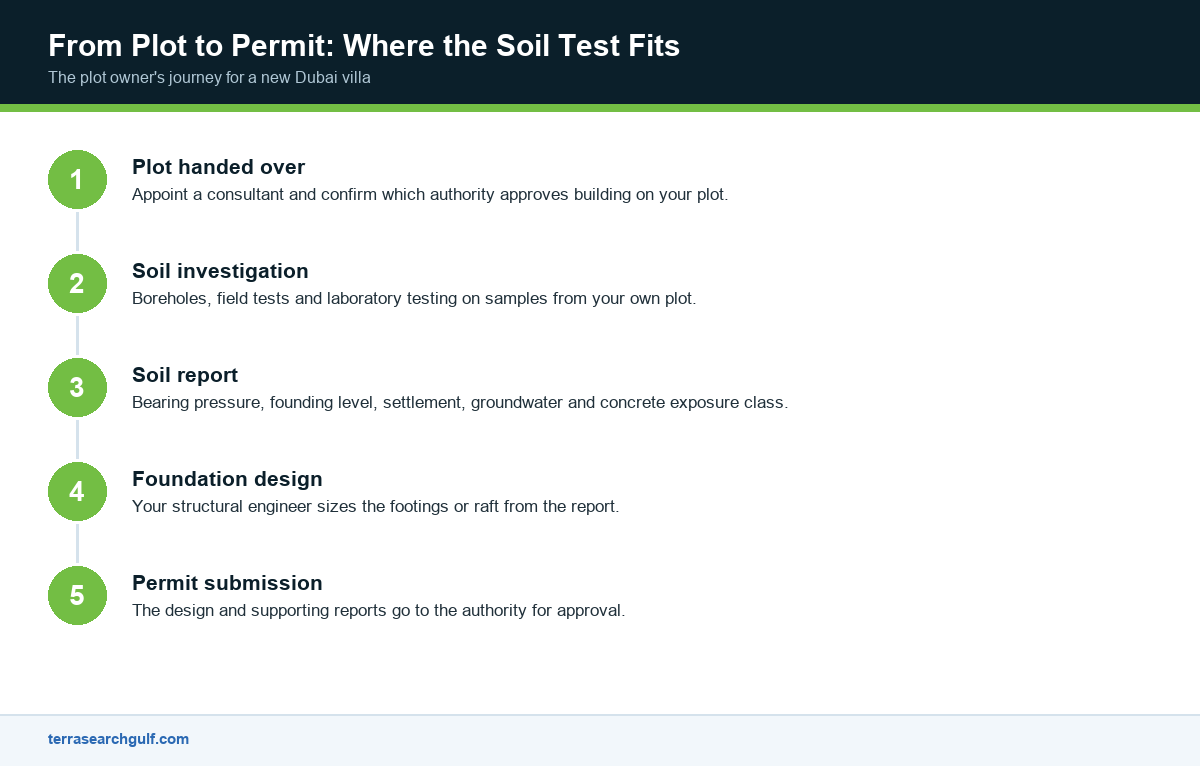
A villa does not need the scope of a tower, but it does need enough data to support a safe and economical design. A typical soil test for villa construction in Dubai has four parts.
First, boreholes. A small number are drilled around the building footprint, taken below the depth that the footings will stress. The consultant or the laboratory sets the number and depth based on plot size and the planned structure.
Second, field tests in the boreholes, usually standard penetration tests, which measure how dense or stiff each layer is. Groundwater level is recorded when it is met, because it affects both the excavation and the long term exposure of the foundations.
Third, laboratory tests on the recovered samples: grading, moisture content and classification, plus a chemical check for sulphates and chlorides. The chemical results decide how aggressive the ground is to buried concrete, and our article on the sulphate and chloride screening explains why it matters.
Fourth, the report. This brings the logs, test results and engineering recommendations together. Our guide to the core tests a ground report is built on covers each test in more detail.
Reading the Bearing Capacity Figure in Your Report
The number your engineer looks for first is the allowable bearing pressure. It states how much load per square metre the ground can carry at a stated depth, with a safety margin and an acceptable settlement already built in.
That figure drives the footing size. A higher allowable pressure means smaller footings and less concrete. A lower one means wider footings, a raft, or in some cases ground improvement or piles.
The report should also state the recommended founding level, the expected settlement, the groundwater level, and the concrete exposure class that follows from the chemical results. If any of these are missing, ask why before the design starts. A complete report saves the engineer from making assumptions on your behalf.
On some plots, the engineer may ask for a direct check at founding level once the excavation is open. Our guide to loading a steel plate at founding level explains how that confirmation works.
Do not compare bearing figures between neighbouring plots. Ground in Dubai can change over short distances, and a figure from next door is not evidence for your own plot. Even two ends of a large plot can differ.
Ground Conditions the Test Often Finds on Dubai Plots
Every plot is different, but a few conditions come up again and again in villa investigations across Dubai. Knowing them helps you read the results of the soil test for your villa with the right questions in mind.
Loose surface sand is common, especially on plots that were levelled or filled before sale. It may need compaction or removal before footings are cast, and the report should say how deep the loose layer goes.
Cemented sand and calcarenite layers can be strong but uneven. They often give good bearing, yet a thin cemented crust over looser sand below can mislead a shallow test, which is why boreholes go deeper than the footings.
Shallow groundwater is typical in low lying and coastal areas. It affects excavation, dewatering during construction, waterproofing of any basement, and the chemical exposure of the foundations.
Where sabkha or other aggressive ground is found, the report will recommend protective measures for the concrete and, in some cases, ground improvement. These are the findings that most change a villa budget, so it is better to know them before the design is fixed and the contractor has priced the work.
How Long It Takes and Choosing a Soil Testing Lab in Dubai
For a single villa plot, the field work often takes a day or two. Laboratory testing and reporting usually take longer than the drilling, so plan for the full turnaround rather than the site visit alone. Commissioning the test as soon as the plot is handed over keeps it off the critical path for the design.
Many soil testing companies in Dubai offer villa investigations, and prices vary. The difference is usually scope: the number and depth of boreholes, how many samples are tested, whether the chemical suite is included, and whether the report gives recommendations or only facts.
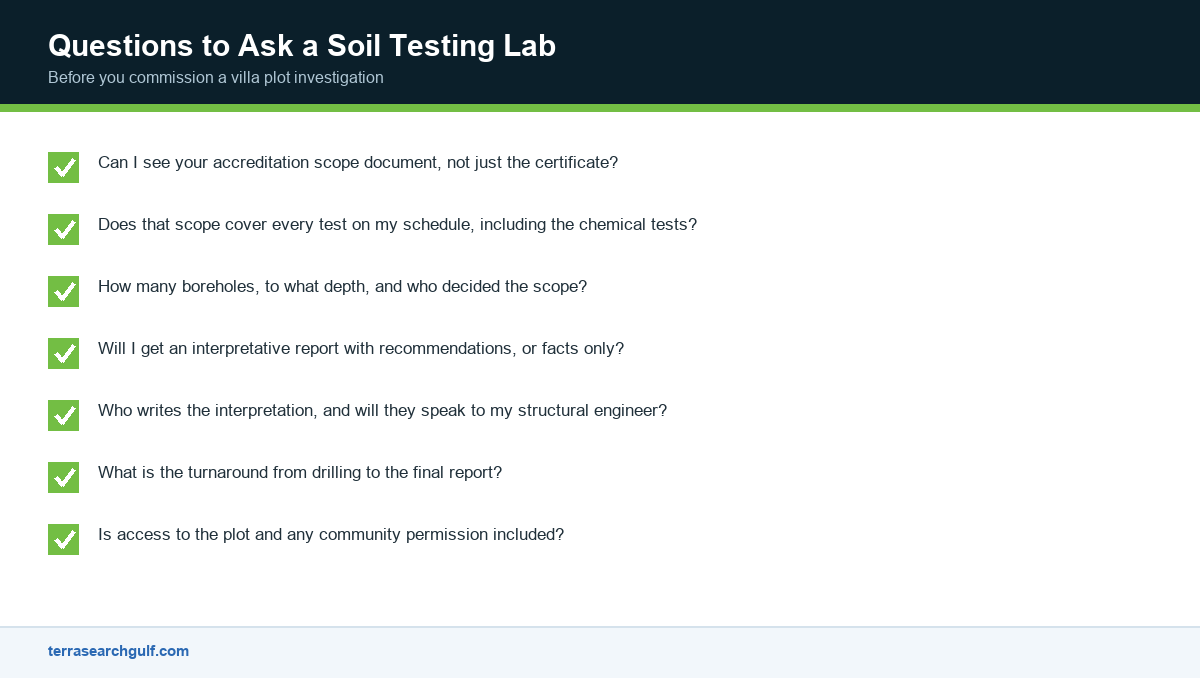
Ask each soil testing lab in Dubai for its accreditation scope document, not just a certificate. Then check that every test on your schedule appears on it. Our article on how laboratory approval works with the authority explains why both accreditation and acceptance matter.
Ask who will write the interpretation and whether they will speak to your structural engineer. A short conversation between the two often saves a round of questions later, and it helps the report answer the questions the design will actually ask.
Finally, confirm access. The rig needs a clear route on to the plot, and some communities require the developer’s permission before work starts. Sorting this early avoids a wasted mobilisation and a second charge for the same visit.
Frequently Asked Questions
Do I need a soil test for villa construction in Dubai?
In most cases, yes. Your structural engineer needs ground data to design the foundations, and the building permit submission normally relies on a soil investigation report. Your consultant can confirm what the relevant authority requires for your plot.
How many boreholes does a villa plot need?
Usually only a few, positioned around the building footprint and taken below the depth the footings will stress. The consultant or laboratory sets the final number and depth based on the plot size and the planned structure.
Can I use my neighbour’s soil report?
It is not a safe substitute. Ground conditions in Dubai can change over short distances, and the authority and your engineer will expect data from your own plot. A neighbouring report is useful background, not evidence.
What is allowable bearing pressure?
It is the load per square metre the ground can safely carry at a stated depth, with settlement limits and a safety margin included. Your engineer uses it to size the footings or decide whether a raft is needed.
Why does the report include chemical tests?
Sulphates and chlorides in the ground and groundwater can attack buried concrete and reinforcement over time. The chemical results set the concrete exposure class, which decides the cement type, cover and protection your foundations will need.
How long does a villa soil investigation take?
Field work on a single plot often takes a day or two. Laboratory testing and the written report usually take longer than the drilling, so allow for the whole turnaround when you plan the design and permit timeline.
What should I ask a soil testing lab in Dubai?
Ask for the accreditation scope document, the full test schedule, the report type, the expected turnaround, and who will write the interpretation. Then check that every test you are paying for is covered by that accreditation.
Does accreditation matter for a small villa?
Yes. The size of the project does not change how test results are judged. Our guide to what EIAC accreditation actually covers explains why consultants and authorities look for accredited results on every submission, large or small.
Start the Soil Test Early
A soil test for villa construction in Dubai is one of the first steps in your project, not a formality at the end. A sensible scope, an accredited laboratory and a clear report give your engineer what they need and keep your foundation cost under control.
Terrasearch Gulf carries out villa plot investigations across Dubai, from drilling to an interpretative report your consultant can design from. To plan yours, see how a full ground study runs or share your plot details with our team.