

Most disputes about a ground investigation are not about the drilling. They are about what the report was supposed to contain and did not. A contractor receives a bound document full of logs and test certificates, hands it to the structural engineer, and the engineer asks for the one number that is missing.
This article sets out what a UAE ground investigation should cover, how the scope is decided before anyone mobilises, and what the finished report must contain to be usable by a designer and acceptable to an approving authority. It is the detailed companion to our full walkthrough of the assessment process.
Key Takeaways
- Scope is set by the structure and its loading. Agreeing it in writing with the structural engineer before mobilisation prevents almost every re-mobilisation.
- A report is only complete when it states allowable bearing pressure with a founding level, settlement, design groundwater level and a chemical classification.
- Field logs must be readable alongside the summary. Averaged values that hide real variation across a plot are the most common reporting weakness.
- Accreditation scope is checked test by test. A laboratory accredited for classification is not automatically accredited for the chemical suite.
Who Decides the Scope, and When
Scope should be agreed between three parties before a rig moves: the client who pays for it, the geotechnical contractor who executes it, and the structural engineer who will use the output. In practice the third party is often left out, and that is where under-scoping begins.
The structural engineer is the only one who knows the loading, the proposed foundation concept and the settlement tolerance of the structure. Without that, the investigation contractor is guessing at depths and test selection. A fifteen-minute conversation at scoping stage is the cheapest risk reduction available on the whole project.
Timing matters as much as content. Instructed early, the results shape the foundation concept. Instructed late, they arrive after the concept is fixed and become a compliance exercise that occasionally forces an expensive redesign.
Stage One: What the Desk Study Should Cover
The desk study is the cheapest stage and the one most often skipped. It should assemble published geology for the area, any previous investigation reports for the plot or its neighbours, historical aerial imagery, and records of buried services and previous structures.
On reclaimed or previously developed land this stage is not optional. Historical imagery regularly reveals fill, old foundations or former watercourses that change where holes should be positioned. Finding that out from a photograph costs nothing. Finding it out from a rig costs a day.
The output is a preliminary ground model: a written statement of what the team expects to find, which the field work then confirms or corrects.
Stage Two: Scoping the Field Work
Two decisions dominate cost and both follow from the structure.
Depth
Exploration must extend through the zone of ground that will carry meaningful stress from the structure. For shallow foundations that is a function of foundation width. For piled structures, holes must continue well below the anticipated toe level, because the founding stratum is the entire object of the exercise. Stopping at a convenient round number is how a pile design ends up unverified.
Position and spacing
Positions should be spread to detect variation rather than to average it out. A large plot investigated from its centre produces a report about the centre. Spacing is tightened where the desk study suggests variability, where the structure is sensitive to differential settlement, or where fill is suspected.
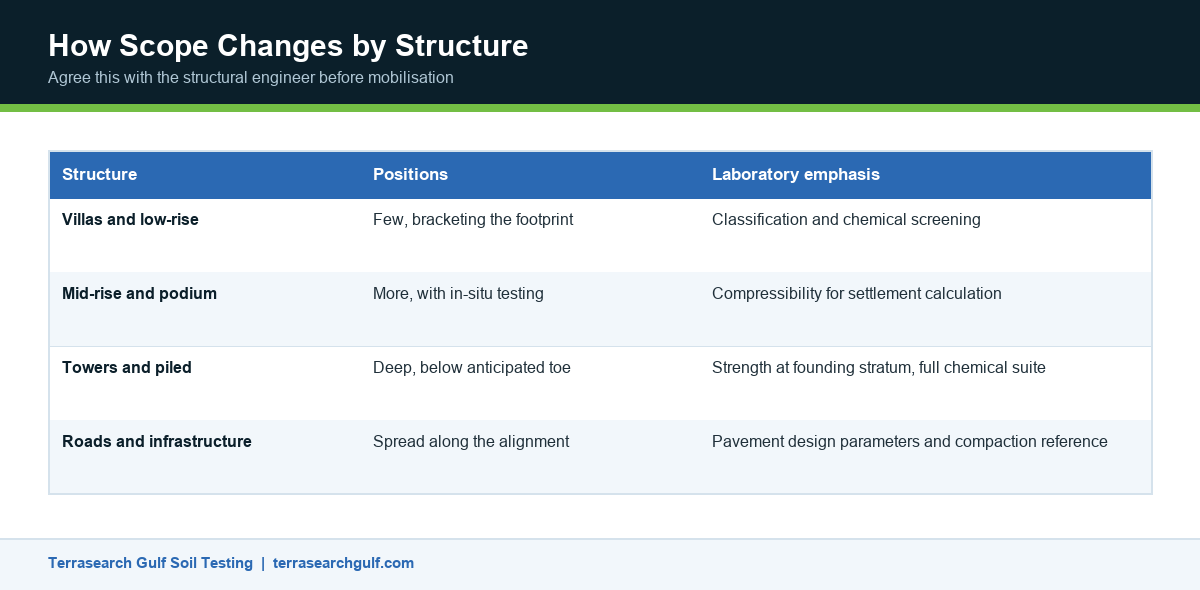
- Villas and low-rise: enough positions to bracket the footprint, depths covering the shallow stressed zone.
- Mid-rise and podium: more positions, deeper holes, in-situ testing added so settlement can be calculated.
- Towers and piled structures: depths well past the anticipated toe, with at least one deep control hole.
- Roads and linear works: positions spread along the alignment, shallower but far more numerous.
Stage Three: Field Execution and Sampling Quality
Execution quality decides whether the laboratory results mean anything. How a rig advances a hole and what it recovers governs sample condition, and a disturbed sample produces a misleading strength result regardless of how carefully it is tested afterwards.
In-situ testing runs alongside the drilling. The hammer-and-sampler method behind N values provides resistance readings at intervals plus a disturbed sample each time, while the cone method that logs resistance continuously produces an unbroken profile where the ground is soft enough to penetrate. Groundwater should be recorded on strike and again after standing, because the two readings are rarely the same and the standing level is the one that matters for design.
A comparison of the intrusive and non-intrusive options is set out in how boreholes, trial pits and geophysics compare.
Stage Four: Building the Laboratory Schedule
The schedule should be written against the questions the designer needs answered, not copied from a previous job.
- Classification: particle size distribution, moisture content, and plasticity where fines are present. This is the foundation of every later interpretation.
- Strength and compressibility: selected against the foundation concept. Consolidation testing is slow, so if settlement matters it must be scheduled early.
- Compaction reference: where fill will be placed, how maximum dry density is established sets the benchmark that site compaction is judged against.
- Chemical suite: the aggression checks for buried concrete drive the substructure concrete specification and are effectively mandatory in the Gulf.
Check the accreditation scope test by test at this point. Accreditation is granted against a declared list, and a laboratory accredited for classification testing is not automatically accredited for the chemical suite. What the bench programme covers sets out the usual range.
What the Report Must Contain
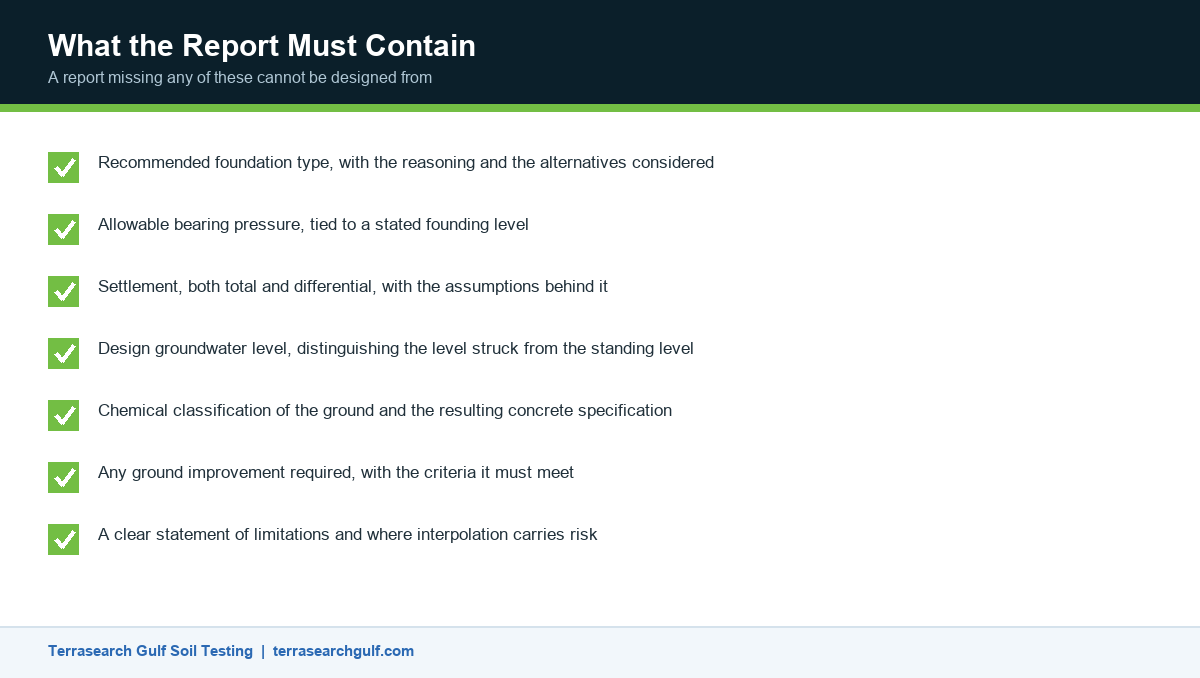
A complete report has a factual half and an interpretative half. The factual half is the logs, test certificates and photographs. The interpretative half is what the designer actually reads, and it must state the following without ambiguity.
- Recommended foundation type, with the reasoning and the alternatives considered.
- Allowable bearing pressure, tied to a stated founding level. A pressure without a level is not usable.
- Settlement, both total and differential, with the assumptions behind the calculation.
- Design groundwater level, distinguishing the level struck from the standing level.
- Chemical classification of the ground and the resulting concrete specification.
- Any ground improvement required, with the performance criteria it must meet.
- A clear statement of the limitations: what was not investigated, and where interpolation between positions carries risk.
That last item is the mark of a serious report. Ground varies between exploration positions and an honest report says so rather than presenting a smooth model the data does not support.
Where Reports Fall Short
The recurring weaknesses are consistent across the market. Averaged values presented without the spread behind them. Bearing pressure quoted without a founding level. Groundwater recorded on strike only. Chemical results reported as raw numbers with no classification or specification consequence drawn from them. And recommendations written so generically that they would suit any plot in the Emirates.
A related failure is scope drift: tests appearing on the certificate that were never in the agreed schedule, and tests in the schedule that quietly never happened. Reconcile the certificate list against the agreed scope before accepting the report.
If you are still selecting a provider, how to weigh one provider against another covers what to ask before an order is placed, and verifying design assumptions on site covers what happens once excavation exposes the ground.
Frequently Asked Questions
What is the difference between ground investigation and site investigation?
In UAE practice the two terms are used interchangeably for the same activity. Some specifications reserve site investigation for the wider exercise including surveys and services searches, and ground investigation for the intrusive work specifically. Check which definition your specification uses.
How many boreholes does a ground investigation need?
It depends on plot size, structure type and how variable the ground is expected to be. The governing principle is that positions should be spread enough to detect variation across the plot rather than average it away.
What should I check before accepting the report?
That allowable bearing pressure is tied to a founding level, that settlement is stated, that groundwater is reported both on strike and standing, that the chemical results carry a classification, and that the certificate list matches the scope you agreed.
Is a desk study really necessary?
On greenfield desert plots it is brief. On reclaimed, previously developed or coastal land it frequently changes the drilling plan and pays for itself several times over.
Can the laboratory schedule be decided after drilling?
Partly. Classification testing can be assigned once samples are logged, but slow tests such as consolidation need to be anticipated in the programme or they will delay the report.
What does accreditation scope mean in practice?
Accreditation is granted against a declared list of specific tests and methods, not to a company in general. A laboratory can be accredited for some tests on your schedule and not others, so the scope document has to be read test by test. Our note on why the mark on a certificate matters explains the consequence.
Who owns the report, the client or the contractor?
Whoever commissioned it, subject to the appointment terms. What matters practically is that the structural engineer has direct access to the geotechnical engineer who wrote it.
How long is a report valid for?
The ground does not change quickly, but the site can. Regrading, excavation, dewatering or the placement of fill after the investigation can invalidate parts of it. Significant changes to the plot or to the structure warrant a review.
Do roads and infrastructure need a different scope?
Yes. Linear works need wide coverage along the alignment rather than deep clustered holes, and the testing shifts towards pavement design parameters such as the bearing ratio used for road layers.
What happens if the report recommends ground improvement?
It should state the performance criteria the improved ground must meet and how compliance will be verified. Improvement without a verification regime is an unproven assumption.
A Report You Can Actually Design From
A ground investigation earns its cost in the interpretation, not the drilling. Agree the scope with the structural engineer before mobilisation, check the accreditation scope test by test, and reconcile the finished report against what you asked for.
Terrasearch Gulf scopes, executes and reports ground investigations from our Dubai facility, with drilling, in-situ testing and laboratory work under one accredited roof. Send us your plot details and we will tell you what the structure requires.